
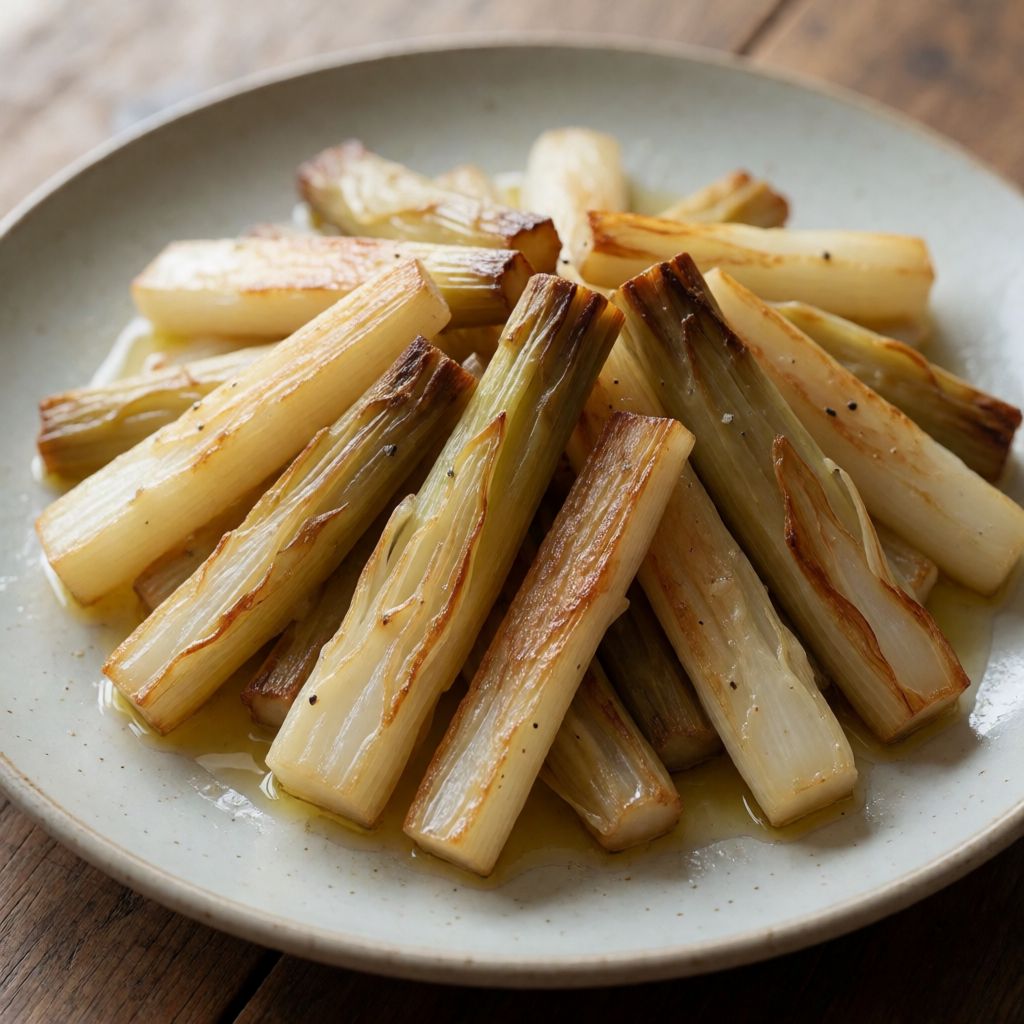
 AI photo
Pan-Fried Cardoons
Cardoons simmered until tender, then quickly pan-fried in olive oil for a simple side dish.
Labels are worked out automatically from the ingredients and can be wrong. Check the packaging if it matters to you.
Ingredients
- 1 kg Cardoons
- 0.5 pcs Lemon juice juice of half a lemon
- Olive oil to taste
- Sea salt to taste



Steps
Make sure the cardoons are well cleaned; remove any tough strings or skin.
5 minFill a pot with water, add salt, the juice of half a lemon and a tablespoon of olive oil.
2 minBring the water to the boil.
5 minAdd the cardoons and cook until tender.
20 minCheck tenderness with a fork.
1 minDrain and set the cardoons aside.
2 minHeat a few tablespoons of olive oil in a large frying pan.
2 minAdd the cardoons to the pan and cook for a few minutes.
5 min
Cardoons look like a fatter, paler bunch of celery that fell into bad company — and that's almost right. Botanically they're a thistle, first cousin to the globe artichoke, grown for the stalk instead of the flower bud. That kinship is the whole story of this dish: like an artichoke, raw cardoon turns black within minutes of being cut, and like an artichoke it carries a bitterness that doesn't cook away in five minutes — it needs a proper simmer to tire itself out.
So don't believe the first thing people say about cardoons: "it's just ugly celery, treat it the same." No — because celery doesn't blacken on the chopping board and celery doesn't need twenty minutes of simmering before it's edible. Cardoon does both. Everything in this recipe answers one of those two problems.
The lemon and the oil in the boiling water aren't seasoning at that stage — they're damage control. Cut cardoon has an enzyme that reacts with air the instant the flesh is exposed, the same browning you see on a cut apple, just faster and uglier because of the thistle's own chemistry. Acid slows that enzyme down; a film of oil on the water's surface keeps air off what's submerged. Skip this and you boil grey, sad-looking stalks that taste fine but look like something went wrong.
Buying cardoons: look for firm, pale stalks, not grey or hollow-sounding when tapped, and expect to throw away close to half of what you bring home. The outer ribs are stringy and often bitter enough to need the toughest trimming; the inner, paler ones are tenderer and need less peeling. That trimming in step one — strings and skin off, like you'd do to tough celery but more thoroughly — matters because those strings are vascular fibre that no amount of boiling softens. Leave them in and you get a fork-tender vegetable that's still a mouthful of thread. In Britain you'll mostly find cardoons through Italian delis or a farmers' market in late autumn to winter, which is their proper season — they're a southern European vegetable that never built a supply chain here, not because the UK can't grow them but because nobody built the demand.
Lemon juice does the antioxidant job described above; if you're out of lemons, any acid with no strong flavour of its own will do the same chemical work — a splash of white wine vinegar, say. Don't skip it and don't oversubstitute with something assertive like balsamic, which will fight the dish rather than protect it.
Olive oil appears twice, for two different reasons. In the boiling water it's mostly a physical barrier against air, so even a cheap, mild olive oil earns its place there. In the frying pan at the end it's doing flavour work, so use something with actual character if you have it — this is the one place a "neutral oil" substitution would genuinely flatten the dish. The reason cardoons default to olive oil at all isn't tradition for tradition's sake — it's that cardoons come from places where olive oil was the cheap, everyday fat, the way we'd reach for butter or a flavourless vegetable oil here. Use what's cheap and good where you are; the mechanism doesn't care about geography, only about carrying flavour and heat.
Salt goes into the boiling water early, same logic as salting pasta water — it seasons the vegetable from the inside as it softens, rather than sitting on the surface afterwards tasting like an afterthought.
On a domestic hob, the honest limit is your pot size and your burner's actual output, not the one in a restaurant kitchen. Use a wide pot so the cardoons aren't stacked three deep cooling the water down in the middle — crowding is the real cause of unevenly cooked cardoons, soft at the edges and raw in the centre, more often than timing is. For the fry, a wide frying pan for the same reason: spread the pieces so the water you worked so hard to boil into them can actually escape as steam instead of just stewing them a second time in oil. If your pan isn't big enough, do it in two batches rather than one crowded one — patience here isn't a virtue for its own sake, it's the only way the browning actually happens.