
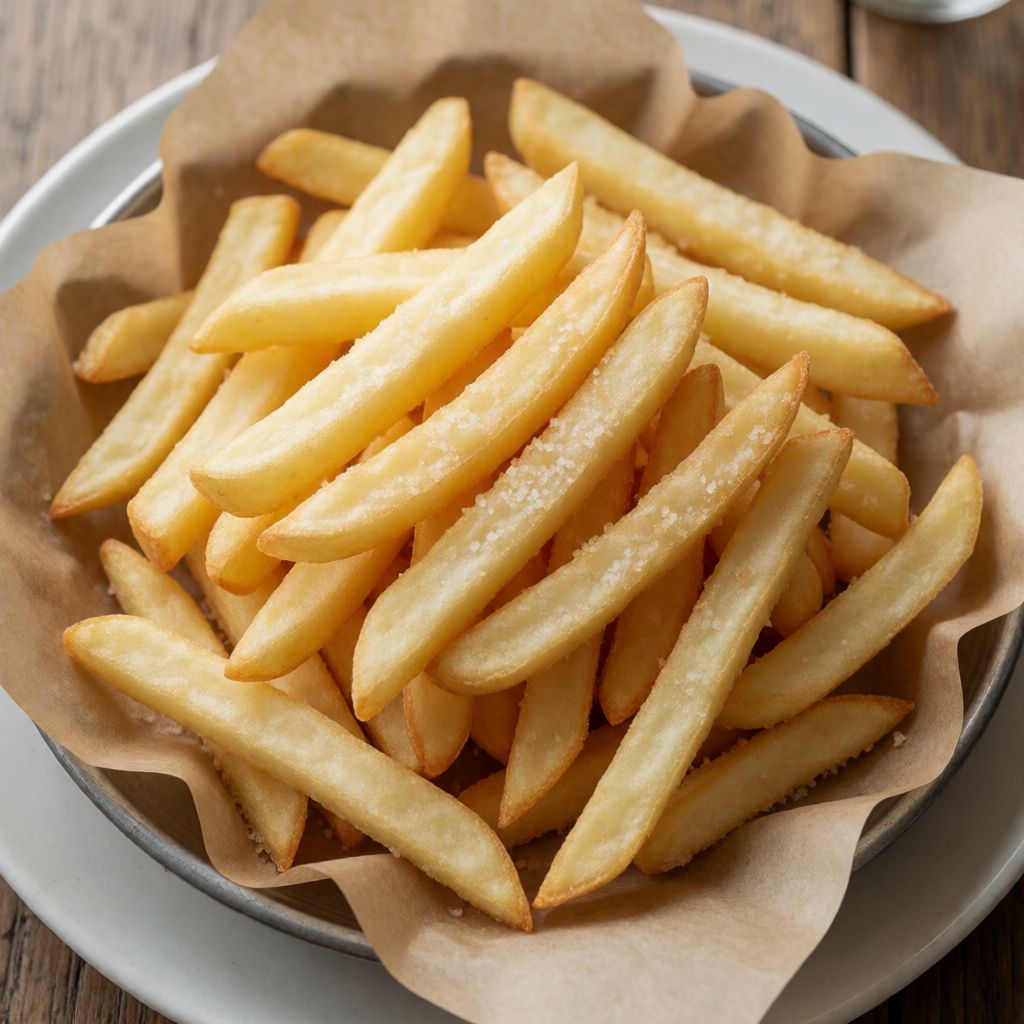
 AI photo
French Fries
Crispy double-fried potato chips, soaked beforehand to rinse away starch for extra crunch.
Labels are worked out automatically from the ingredients and can be wrong. Check the packaging if it matters to you.
Ingredients
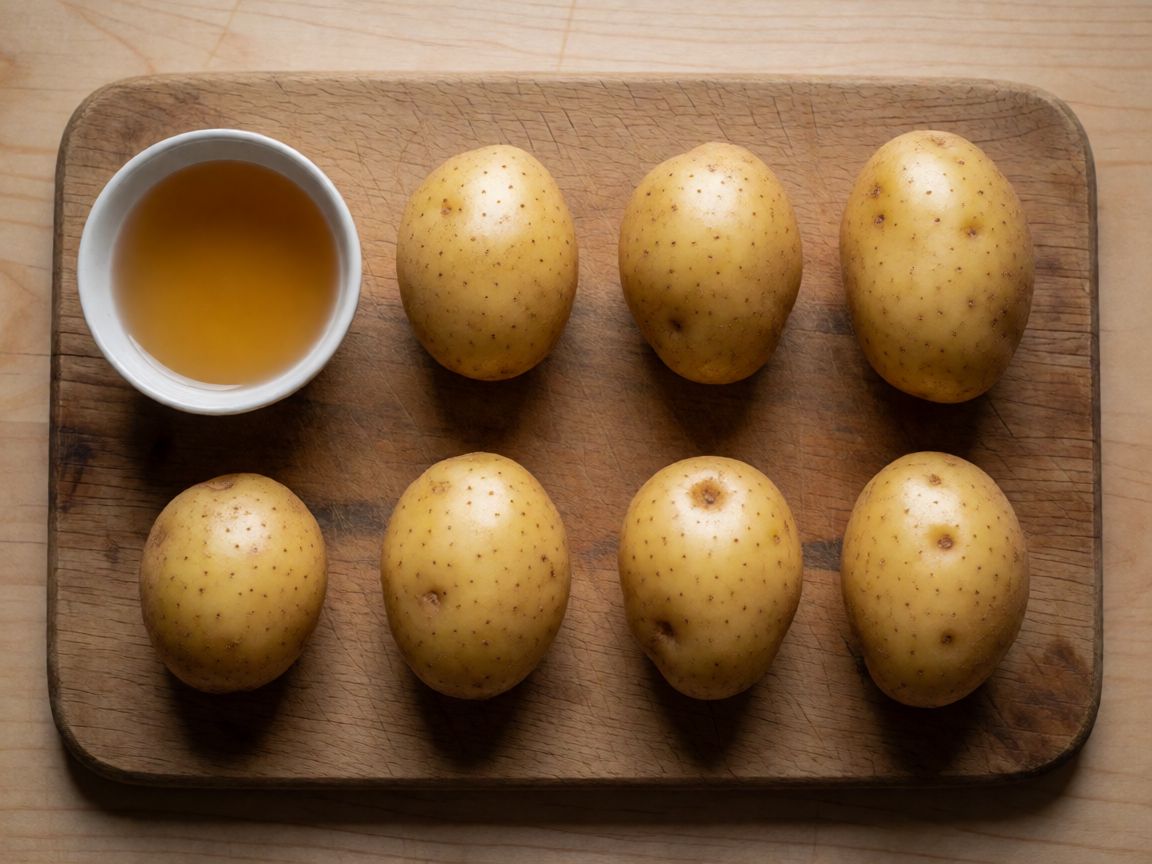
- 8 pcs Potatoes
- 2 tsp Salt for boiling the potatoes
- 3 tbsp Apple cider vinegar
- 2 l Vegetable oil
- 1 tbsp Salt for sprinkling


Steps
Peel or wash the potatoes. If the skin is thin and delicate, simply washing them is enough.
Cut the potatoes into even batons and place them in a large bowl of cold water.
Change the water 5-6 times over 1 hour to rinse the starch from the potatoes.
60 minAdd the potatoes to a pot of boiling salted water with the apple cider vinegar and cook for about 10 minutes.
10 minDrain and let the potatoes cool on a tea towel.
Heat the frying oil to about 150°C.
Fry the potatoes in small batches for about 5 minutes, until they just barely start to take on colour.
5 minLay the pieces out on baking paper as they are ready.
The pre-fried chips can be kept until serving, frozen, or cooked straight through.
Heat the frying oil to 180°C.
Fry the chips in small batches until crisp and a good golden colour.
5 minDrain off excess oil on a paper towel and serve the hot chips straight away.
A chip is not one fry, it is two different jobs done at two different fires. The first fire is a plumber's job: push the water out of the potato and set a dry shell around it, no colour needed, no colour wanted. The second fire is a carpenter's job: crisp that shell and give it the deep gold that Maillard chemistry pays out when sugars and proteins finally meet enough heat. Try to do both in one fry and you get a chip that's either pale and limp, or dark outside and raw in the middle — because 180°C cooks the surface faster than it can cook the core.
The cold-water soak before any heat touches the potato is not housekeeping, it's the whole game. Potatoes are full of free starch sitting loose on the cut surface. Leave it there and in the fryer it scorches before the inside is even warm, and it glues the batons to each other. Change the water five or six times and you're washing that starch away, not the dirt — the dirt left with the peeler. Some say soaking is just old-fashioned fussing. No — skip it and your fries brown in patches, dark freckles on a pale stick, because the starch burns unevenly wherever it's thickest.
On the potato itself — you want a floury one, not a waxy one. In a UK shop that's Maris Piper or King Edward, the ones sold for roasting and mash, not the little salad potatoes sold for boiling whole. A floury potato has loose, starchy cells that puff and separate under heat, giving you the fluffy inside a chip needs. A waxy potato's cells are packed tight with pectin and barely any starch — fry it and you get something closer to a crisp potato stick than a chip, dense all the way through, no contrast between crust and middle. If you only have waxy potatoes, fry them — they won't ruin your dinner — but don't expect the cloud-like centre.
The cut matters less for taste than for timing: a thinner baton cooks through faster at the first fry, a thick one needs longer at 150°C before it's safe to crisp at 180°C. Keep them roughly the same size in one batch, or the thin ones will be done and darkening while the thick ones are still raw in the middle — that's the real reason a chip shop's fries look so uniform, not pride, just physics.
The oil needs no character of its own, because its job is heat, not flavour — any refined oil with a high smoke point and no smell works: sunflower, rapeseed, groundnut. Olive oil has too much personality and too low a ceiling for 180°C; it'll smoke and taste bitter before the chip is even close to done. Two litres is a lot for a domestic pan — fry in small batches not because the recipe is precious about it, but because dumping in too much cold potato at once drops the oil's temperature hard, and a fryer's thermometer in your flat is probably your eyes and a wooden spoon, not a dial. Watch the surface: oil that shimmers and moves gently is near temperature; oil that's dead still is too cold; oil that's smoking is already past the point where the chip will taste of the pan, not the potato.
Salt does two separate jobs and that's why it's split. The salt in the boiling water seasons the potato from the inside, through the water it absorbs as it cooks — you can't fix that later by salting the outside of a finished chip, it just sits on the surface and falls off in the bowl. The salt you sprinkle at the end is for the tongue, the first hit, and it needs to go on while the fat on the surface is still warm enough to hold it.
The vinegar is cider vinegar for its mildness — any light vinegar with no strong flavour of its own will do the same chemical job, lemon juice included, in roughly the same small amount. What you're after is acidity, not taste; three tablespoons in a pot of water barely registers on the tongue but does plenty to the pectin.
And patience is not a nice-to-have here — it's the ingredient that makes the other two fires possible. Rushing the soak leaves starch on the potato. Rushing the cooling between fries means a soggier second crust. Four people, eight potatoes, and the better part of an hour before any oil gets properly hot: that's not a long recipe, it's a recipe with its time spent in the right places.