
 AI photo
Pecan Pie
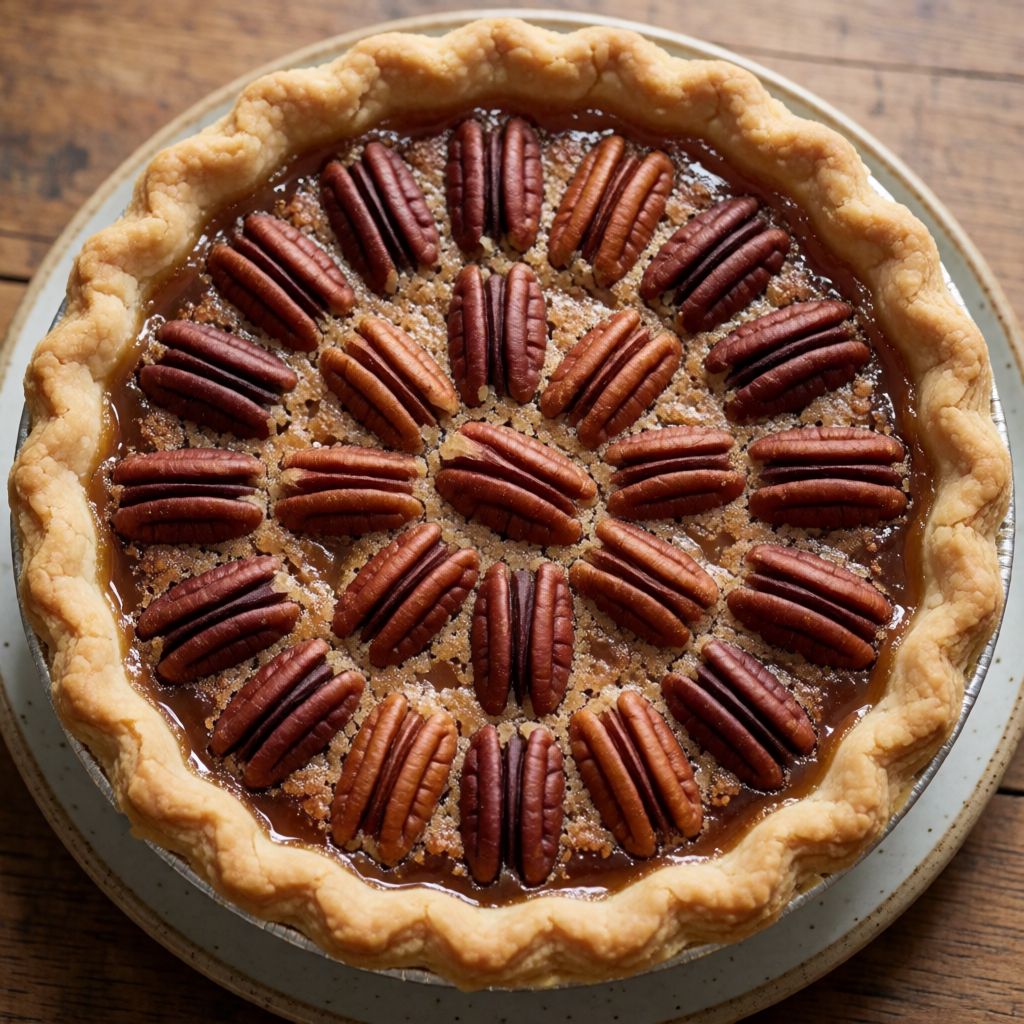
A classic pecan pie with a crisp shortcrust base and a rich, buttery filling, finished with whole pecans on top.
Labels are worked out automatically from the ingredients and can be wrong. Check the packaging if it matters to you.
Ingredients
- 120 g Pecans whole
- 1 l Vanilla ice cream
For the shortcrust pastry
- 240 g Plain flour
- 50 g Icing sugar
- 1 pinch Salt
- 120 g Butter cold
- 1 pcs Egg beaten
- Water cold, if needed






For the filling
- 100 g Caster sugar
- 100 g Muscovado sugar
- 50 g Butter melted
- 3 pcs Eggs
- 1 pinch Salt
- 100 g Pecans roughly chopped


Steps
Quickly mix the flour, icing sugar, salt and butter in a food processor until combined.
Bring the dough together in a bowl with the beaten egg and, if needed, a little cold water.
Roll out the dough between two sheets of baking paper and chill in the fridge for 30 minutes.
30 minGrease a 24 cm tart tin with butter and line it with the pastry.
Press the pastry into the edges and trim off the excess so the sides are neat.
Prick the base with a fork and cover the pastry with baking paper.
Fill with dried beans or baking beads and blind-bake in a preheated oven at 175°C (fan) for about 15 minutes.
15 minBeat the caster sugar, muscovado sugar, melted butter, eggs and salt until smooth.
Fold the chopped pecans into the mixture and pour it into the prepared base.
Arrange the whole pecans on top in a neat pattern and press them lightly into the filling.
Bake the pie in a preheated oven at 170°C (fan) for 30–35 minutes.
32 minThe pie is ready when the filling is set but still slightly soft, not runny, in the centre.
If the pie starts browning too much, cover it with foil.
Let the pie cool completely before serving with vanilla ice cream.
Pecan pie is really two separate jobs pretending to be one dish: a shortcrust shell that has to survive baking twice, and a filling that's basically a loose custard carrying chopped and whole pecans. Everything that goes wrong with this pie comes from treating it as one job instead of two.
The shell is the harder part, and it fails for a reason you can see coming: butter that gets warm. Cold butter stays as tiny solid flecks in the dough; when it melts in the oven, each fleck leaves a tiny gap, and those gaps are what give you "short" — crumbly, not tough. Work the butter in a food processor in short pulses so the friction of your hands never warms it, and you're protecting that structure, not following a ritual. Chilling the rolled dough for the full 30 minutes before it goes anywhere near heat is the same insurance: warm dough shrinks violently and unevenly in the oven, so you get a lopsided rim.
The filling decides the whole dish's personality: set at the edges, barely trembling in the centre, never a liquid pool under a dry crust. That line between "soft" and "runny" is the entire difficulty of a pecan pie, and it's a matter of watching, not counting — a gentle shake of the tin tells you more than a timer does. Muscovado alongside plain caster sugar isn't decoration; muscovado carries molasses, which caster sugar doesn't, and that's where the deep, slightly bitter-caramel edge comes from that stops this pie tasting like plain sugar syrup with nuts in it.
Blind-baking with beans or baking beads earns its place for a reason, not tradition for tradition's sake: an empty pastry shell with nothing weighing it down will puff and slump as the trapped steam pushes up the base, and you end up with a crust that's thick in the middle and thin at the edges. The weight keeps the base flat while the sides firm up enough to hold their own shape — only then do you remove the paper and beans and let the base finish drying out, for the final few minutes, with nothing in the way. Skip this step and the crust under a wet, eggy filling has no chance; it goes soggy from underneath before it's cooked through, which is the real cause of the "soggy bottom" everyone blames on the oven.
Flour is just flour here — plain, nothing fancy, because this pastry wants structure, not extra protein pulling it tough. Icing sugar rather than caster sugar is deliberate: it dissolves into the fat instantly with no grit, so the dough stays smooth and short rather than slightly sandy. Butter has to be cold, and I mean fridge-cold, cut into cubes if it helps it stay that way under your hands — any fat that's at all soft starts coating the flour instead of staying in separate pieces, and that's the difference between a short crust and a biscuit-hard one. If you want a reliable swap, you can use a flavourless block margarine in a pinch, but butter has a natural edge here because it also carries flavour, not just fat.
The melted butter in the filling plays a different role to the cold butter in the pastry — it's there to carry fat smoothly through a liquid mixture, so use it melted and slightly cooled, not hot, or it'll start cooking the eggs before they ever see the oven. Eggs are your setting agent, as said — three of them, beaten in, not whisked to a foam; you want them combined, not full of air bubbles that'll rise and burst and leave holes in the baked filling. A pinch of salt in both the pastry and the filling isn't there to make anything taste "salty" — it's there to sharpen the sweetness, the way a squeeze of lemon would in a fruit filling; leave it out and the pie tastes flatter, oddly, even though nothing salty is missing.
Pecans do double duty by design: the roughly chopped ones go into the filling itself for texture through every bite, while the whole ones go on top, pressed in lightly, for the look and for a contrast of a slightly crisp, toasted top against the soft set underneath. If pecans aren't to hand or the price has put you off — they're not cheap in a UK shop — walnuts are the honest substitute; same oil content, same kind of bitterness under the sugar, though the flavour leans a touch more savoury than pecan's natural sweetness.
On a domestic hob and oven, the one thing to be honest about is your oven's hot spots — fan ovens in ordinary flats rarely heat perfectly evenly, which is exactly why foil over the top, if the pecans start going dark before the centre has set, isn't a failure, it's a correction. Don't chase a faster bake by pushing the temperature up; a filling that's basically egg custard will curdle and weep fat before it sets properly if it's rushed, and you'll get a greasy, separated layer instead of a clean set custard.
And then there's the part nobody wants to hear: let it cool completely before you cut it. A custard filling carries on setting as it cools — cut it warm and you'll get a filling that looks underdone and runs everywhere, even if it was perfectly timed in the oven. That cooling time is as much a part of the recipe as anything that happens over heat; patience here is simply another ingredient, and it's the one people skip because the kitchen smells so good they can't wait. This pie serves a generous Sunday-roast-sized table — eight slices without anyone feeling short-changed — with vanilla ice cream, whose job is mostly to be cold against something rich, nothing more complicated than that.