
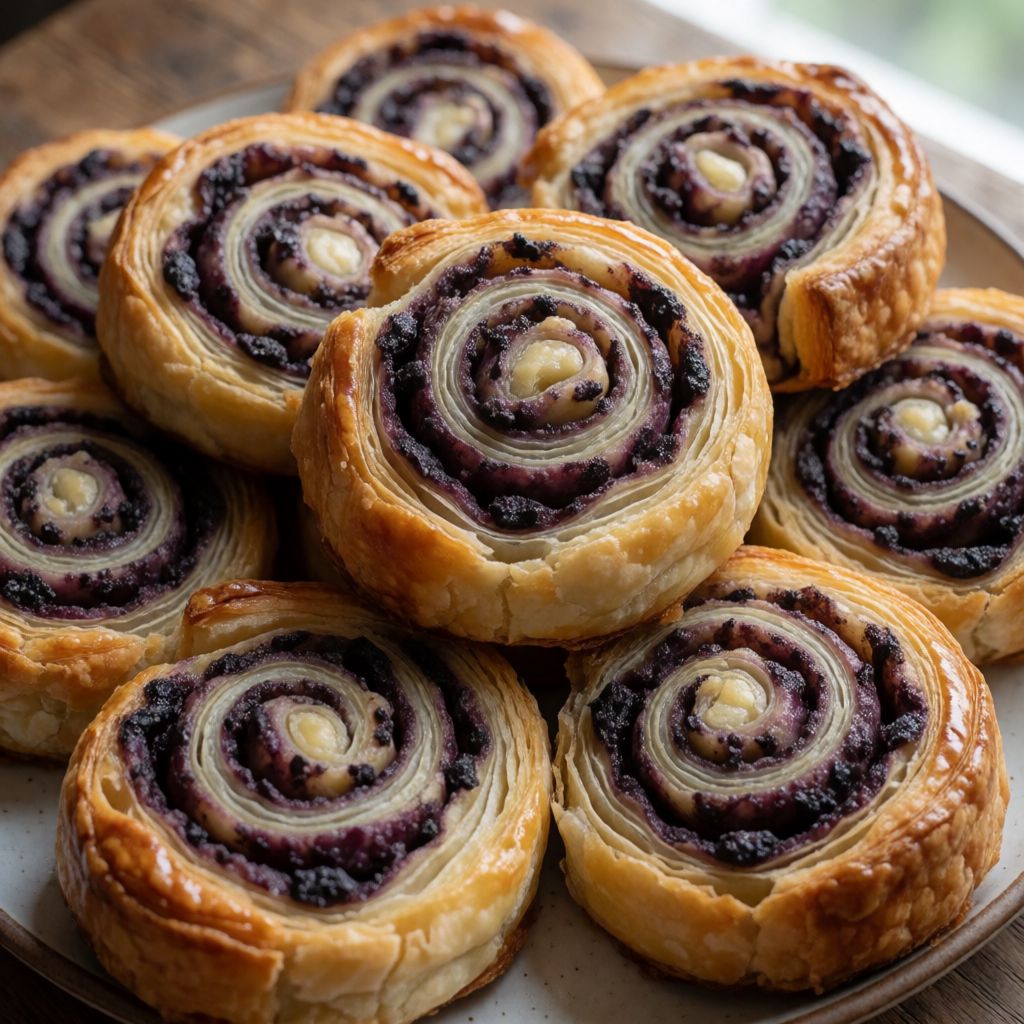
 AI photo
Puff Pastry Pinwheels with Olive Tapenade
Flaky puff pastry swirls filled with olive tapenade and grated Gruyère, baked until golden.
Labels are worked out automatically from the ingredients and can be wrong. Check the packaging if it matters to you.
Ingredients
- 250 g Puff pastry
- 75 g Olive tapenade
- 75 g Gruyère freshly grated
- 1 pcs Egg beaten, for brushing


Steps
Lay the puff pastry on the work surface and cut it in half lengthways. Spread both pieces with olive tapenade and sprinkle with freshly grated Gruyère.
5 minRoll each piece into a log and slice into rounds about 8 mm thick. Instead of a knife, you can use a piece of thread: wrap it around the dough at the cutting point, cross the ends and pull tight — this slices the dough cleanly without squashing it.
Place the pastry pinwheels on a baking tray lined with parchment paper, brush with beaten egg and bake in a preheated fan (convection) oven at 220°C for about 10 minutes. Let cool on a wire rack for 5–10 minutes before serving.
10 min
These are savoury puff pastry snails — spread with olive paste, dusted with cheese, rolled into a log, then sliced into coins so each one shows a little spiral when it lands on the plate. What you're actually looking at, under the fancy name, is a demonstration of lamination: dozens of paper-thin sheets of dough with cold butter trapped between them. In the oven that butter turns to steam, the steam has nowhere to go but up and sideways, and the sheets separate and lift. That's the whole trick behind puff pastry, and it's why everything in this recipe is really in service of keeping those layers intact until they hit the heat.
Which is why step two matters more than it looks. Some say a sharp knife is all you need to slice a filled pastry log — no, because a blade, however sharp, still pushes down as it cuts, and that downward pressure squashes the layers together right at the cut edge. Where the layers get squashed, they fuse, and a fused edge can't separate in the oven — you get a flat, dense disc sitting next to pinwheels that puffed properly. The thread trick works because it has no edge to press: it closes around the dough and pulls through sideways, parting the layers instead of crushing them. If you've ever wondered why some bakery pinwheels have a neat spiral all the way to the rim and others go gluey and flat in the middle, that's usually the answer.
Puff pastry itself — nobody expects you to laminate your own butter and dough for thirty canapés, and there's no shame owed here. Making puff pastry by hand is a bakery skill, built around having a cold marble slab, a big fridge, and time to spare; a block of good ready-rolled puff from the chiller cabinet does the same job at home, because the manufacturer has already done the folding and resting for you. What you're buying, essentially, is other people's patience. The 250 g in this recipe is roughly one standard UK block — if yours comes a touch heavier, trim it rather than trying to stretch the filling to match; too much pastry per gram of filling just gives you plain bready pinwheels with a smear of flavour lost somewhere inside.
Olive tapenade is the filling doing the actual seasoning — it's concentrated, salty, and a little bitter from the olives, which is exactly what plain pastry and mild cheese need. Choose one that's thick, more paste than sauce; anything runny with a lot of oil will migrate into the dough while it waits to be sliced and baked, softening the very layers you're relying on to crisp up. If you don't have tapenade, the criterion to match is a concentrated savoury spread with body — sun-dried tomato paste or a firm basil pesto will do the job, just don't reach for anything watery.
Gruyère is there for its dryness as much as its flavour — it's an aged, low-moisture cheese, so it melts into pockets and browns rather than pooling out as oil and leaving greasy patches on the pastry. The substitution rule is the same: any firm, well-aged cheese that doesn't weep fat when heated. A mature Cheddar — hardly a stretch to find in a British kitchen — does the job just as well, and arguably suits the olive tapenade better than people expect, since sharp Cheddar and salty olives aren't that far apart in character.
The egg wash isn't decoration. Beaten egg on the surface browns through the same reaction that browns a roast or a crust of bread — proteins and sugars colouring under heat — and that's what gives these their gold rather than a pale, boiled-looking top. If you're out of eggs, a brush of milk will still give you some colour and a bit of shine, just softer and less deeply coloured; it's a fair substitute, not an equal one.
On an ordinary domestic oven: trust your eyes over the dial. Home ovens often run several degrees off whatever the display claims, and a fan oven especially can have a hotter patch near the back — if your first batch browns unevenly, that's the oven talking, not a fault in the recipe. Rotate the tray halfway if you notice it, and judge each pinwheel on its own spiral and colour rather than assuming the whole tray cooked at the same rate.