
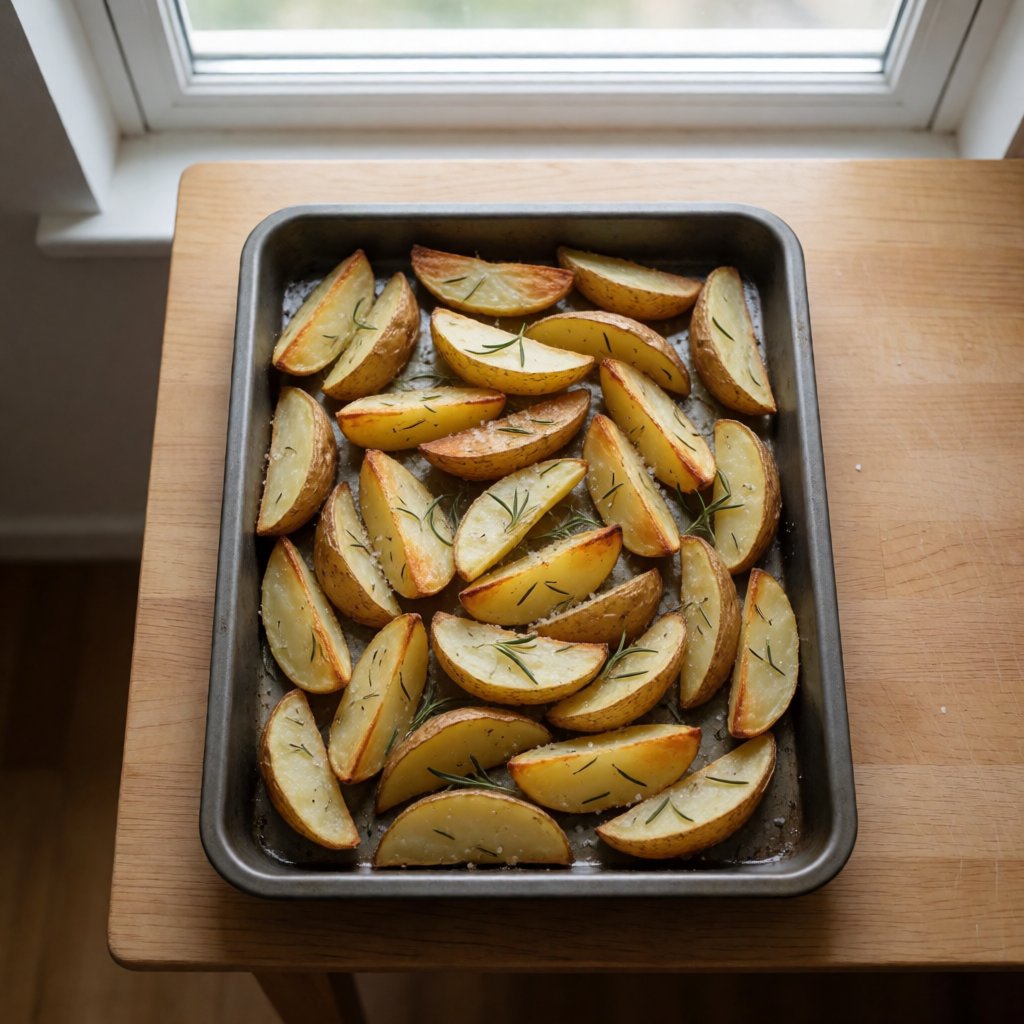
 AI photo
Roasted Potato Wedges with Rosemary
Crispy potato wedges seasoned with rosemary and roasted until golden.
Labels are worked out automatically from the ingredients and can be wrong. Check the packaging if it matters to you.
Ingredients
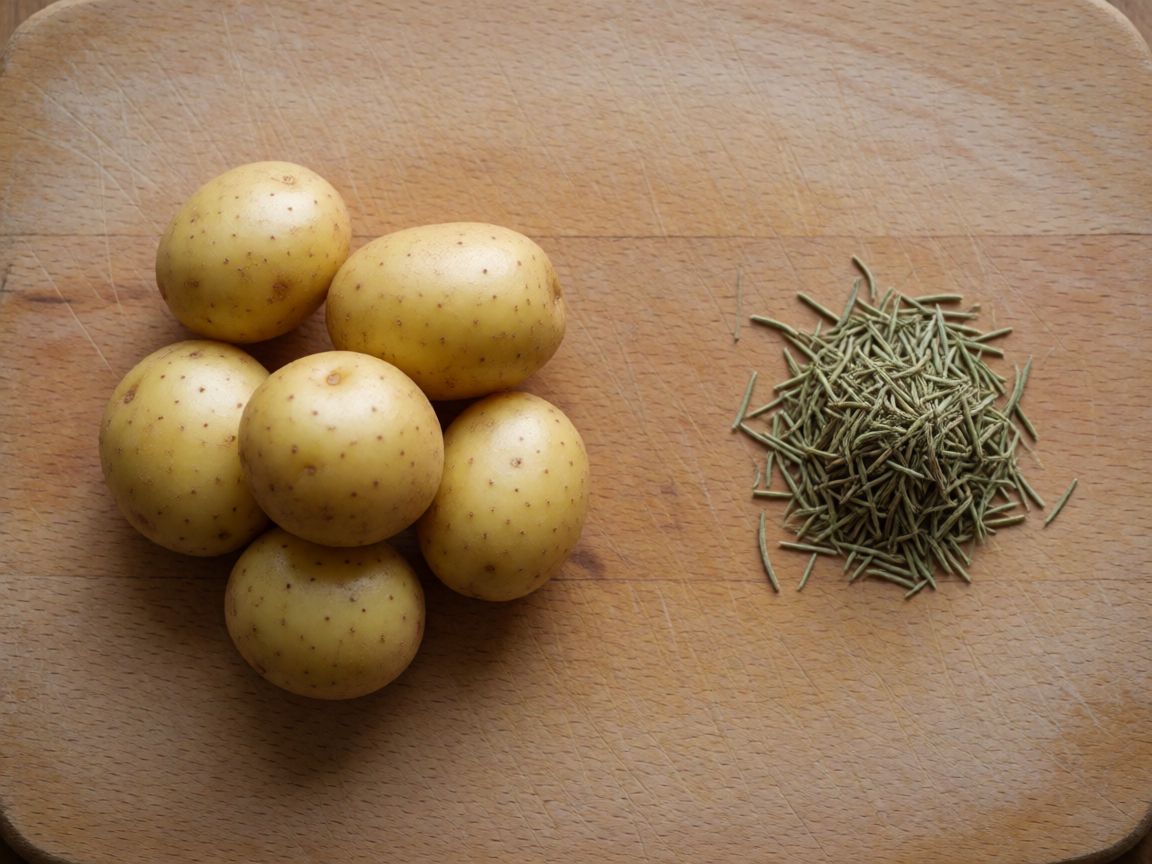
- 600 g potatoes
- 2 tbsp sunflower oil
- 1 tsp dried rosemary
- 1 pinch salt to taste



Steps
Cut the potatoes into even wedges and pat them dry.
Toss with the oil, salt and rosemary, then spread in a single layer on a baking tray.
Put the tray into an oven preheated to 200°C for 20 minutes.
20 minHalfway through, take out the tray, turn the wedges and return to the oven for another 20 minutes.
20 minTake the tray out of the oven.
This is the lazy cousin of Sunday roast potatoes — no parboiling, no goose fat, no fussing with a fork to rough up the edges. You cut raw potato into wedges, toss in oil, and let the oven do everything a saucepan would normally do first. That's the whole trick of this dish: it skips a step that every British grandmother insists is non-negotiable, and it still works, because a wedge is thinner than a roast potato and doesn't need the head start.
What decides whether this comes out right is moisture, not time. Potato surfaces are wet with starch water the moment you cut them, and a wet surface can't brown — it steams. Water has to boil off before the Maillard reaction (that's the browning, the crust, the whole reason you're using an oven and not a pot) can even begin. Patting the wedges dry isn't fussiness, it's buying back the first five minutes of oven time that would otherwise go to evaporation instead of crisping.
The second thing that decides it is space on the tray. Potatoes exhale steam as they cook. Crowd them and that steam has nowhere to go — it sits in the gaps between wedges and keeps the surface damp, so you get soft, pale potato instead of a shell. A single layer with gaps between pieces is what lets the steam escape upward into the oven instead of lingering around the food.
The potato itself does most of the deciding before the oven ever gets involved. You want a floury type — Maris Piper or King Edward are the ones you'll see labelled 'for roasting' in a UK shop, and that label means something: high starch, low moisture, a structure that fluffs up inside while the surface dries and crisps. A waxy potato — Charlotte, a new potato — holds its shape and stays a bit rubbery; fine for a salad, disappointing here, because it has less starch to gelatinise and turn into that floury interior you're after.
The oil's job is simple: carry heat into direct contact with the potato surface and help the browning along, not to add its own flavour. That's why 'sunflower oil' is really shorthand for 'any oil with no smell of its own' — rapeseed, groundnut, light olive oil all do the same job. Extra virgin olive oil works too, but its flavour compounds break down a little at this heat and you lose some of what you paid for; save the good stuff for drizzling on afterwards if you want it.
Rosemary dried is actually doing you a favour here rather than a compromise. Fresh rosemary is mostly water held inside a tough little needle, and 200°C dry heat will scorch the tips before the oil's even warmed through — you get bitter char, not perfume. Dried rosemary has already lost that water, so it just slowly gives up its oil into the fat around it. If you've only got fresh, chop it fine and add it in the last ten minutes, not before the first roast.
Salt goes on with the oil, before the oven, not after — not for flavour penetration (potato doesn't take salt in from the outside, it mostly sits on the surface) but because salt on a wet surface draws moisture out, which is one more small help toward drying the skin before it hits the heat.
About that turn at the halfway mark: a tray only gets hot from one direction — underneath, from the element or the rack below — plus the general heat of the oven around everything. The side touching the metal browns faster than the side facing up. Turning the wedges is just giving the other side its turn at the hot surface. Skip it and you get potatoes that are a good crust on one face and pale on the other, which some people shrug off and call 'rustic'. It's not rustic, it's just unturned.
An ordinary UK oven doesn't hold 200°C as evenly as the dial suggests — there's usually a hotter back corner, sometimes a cooler door side. If your wedges are browning unevenly across the tray rather than top-to-bottom, that's the oven's fault, not yours, and the fix is the same turning step, just done with a half-rotation of the tray as well as the potatoes. Don't open the door more than you need to check — every open door bleeds heat you then have to wait to build back up, and patience here isn't poetry, it's literally how the crust forms. You'll know they're done by colour and feel, not the clock: deep gold at the edges, a fork that goes in without resistance, a wedge that doesn't collapse when you pick it up. Twenty plus twenty minutes is where it usually lands, but it's the lower bound, not the finish line.
·