
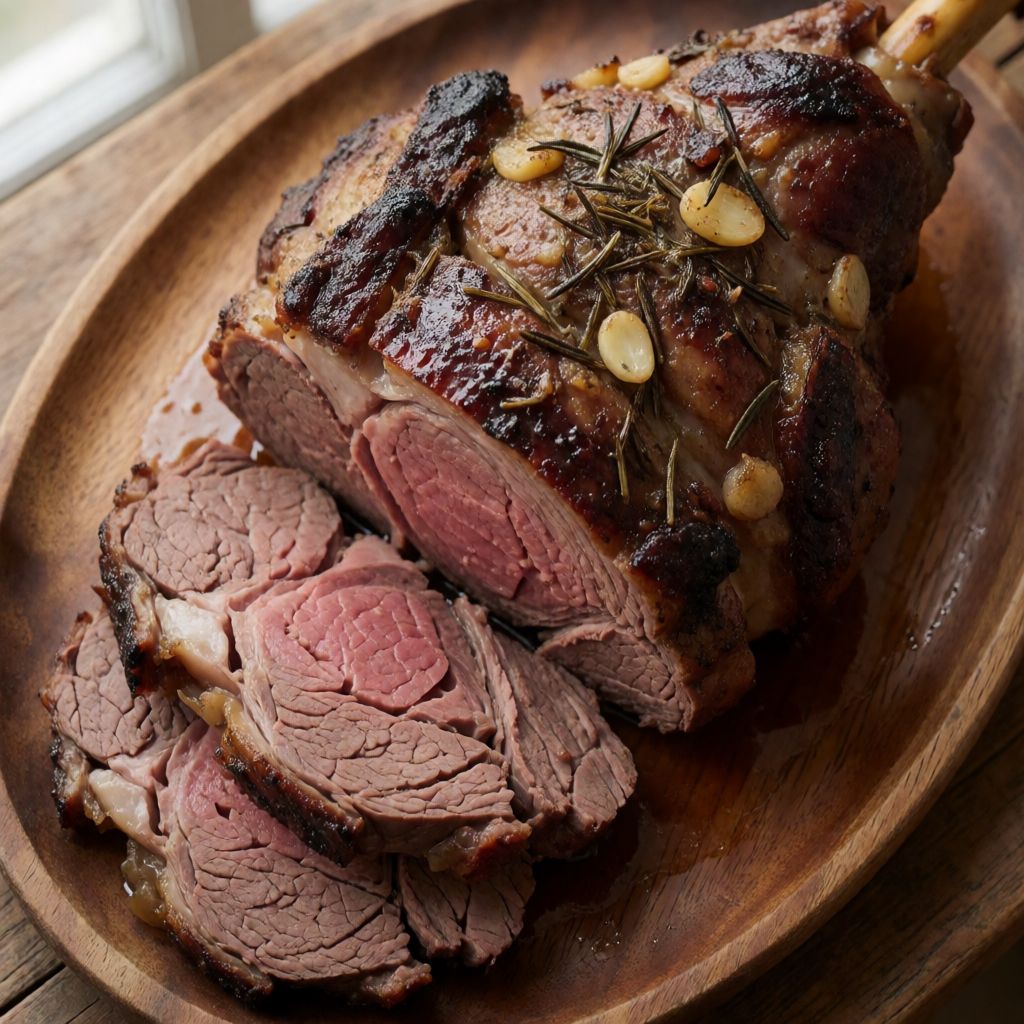
 AI photo
Slow-Roasted Leg of Lamb
A classic slow-roasted leg of lamb, cooked low and gentle until tender, with a rich gravy from the roasting juices.
Ingredients








Steps
Trim the leg of lamb and score a diamond pattern into the fat layer with a sharp knife, without cutting into the meat.
In a mortar, pound the garlic, rosemary, salt and pepper into a smooth paste and rub it well over the leg.
Place the leg in a greased roasting dish, cover with cling film and refrigerate until the next day.
Arrange the carrot, onion, garlic and rosemary in the dish with the lamb and put the cold meat into a cold oven. Pour in the wine and half the stock, then set the oven to 130°C fan.
Baste the leg generously with the dish juices 1-2 times an hour at 130°C, topping up with extra stock as needed.
150 minRoast the leg at 130°C fan for 2½ hours, then raise the temperature to 150°C fan and roast for a further 30 minutes, or until the internal temperature of the leg reaches 65°C.
30 minOnce the leg has reached 65°C, strain the dish juices into a bowl and skim off the fat. Pour into a saucepan and thicken with a little cornflour if needed. Season well.
Let the leg rest for 20 minutes on a board, then carve.
20 min
A leg of lamb done slow is really two separate jobs pretending to be one dish: curing the outside overnight, then cooking the inside gently enough that it never fights back. The scoring, the paste, the fridge night — that's the first job, and it's the one people skip because it looks like fuss. Skip it and you get a leg that tastes of itself on the surface and of nothing much underneath, because salt and garlic don't jump three centimetres into cold muscle in twenty minutes. They need hours, and cold, and patience, which is the actual ingredient here, not a figure of speech.
The second job is temperature discipline, and this is where the Sunday roast tradition and the thermometer disagree with each other, politely. The oven starts cold with the meat in it — not because that's mystical, but because a leg that size is dense enough that if you blast it from a hot oven, the outside is grey and dry by the time the centre gets anywhere near done. Starting cold lets the heat arrive at the same pace right through the joint, so 130°C fan isn't "medium", it's the temperature at which connective tissue softens into gelatine without the muscle fibres seizing and squeezing their water out first. That's the mechanism. Go hotter and you don't save time, you trade juiciness for speed, which is a bad trade on a 2kg joint.
Start with the leg itself. Ask your butcher to leave the fat cap on and to give you something with a bit of bone showing at the shank — bone conducts heat differently from muscle and gives you a handle for carving later. Trimming excess fat matters less for calories than for the scoring that follows: score only the fat, never into the muscle, because a cut into the meat is a door for juices to leave through while it cooks slowly for two and a half hours. The diamond pattern isn't decoration — it opens the fat up so the rub actually gets under it instead of sliding off a slick surface, and it lets rendered fat baste the meat from above as it melts.
Garlic and rosemary pounded to a paste, not chopped, because a paste clings to scored fat and sits in the cuts; chopped bits roll off in the oven's first ten minutes of heat and end up charred and bitter in the tray rather than flavouring the meat. If you don't own a mortar, the flat of a knife blade and a cutting board does the same crushing job, just slower and with more swearing. Rosemary's job here is resinous and sharp against lamb's fat — if you can't get fresh, use it sparingly dried, a third of the amount, because dried herbs are concentrated and go bitter fast in a paste that sits raw on meat overnight.
The overnight fridge rest is the unglamorous half of this recipe and the half that actually earns its flavour. Salt pulls moisture out of the surface first, then that moisture — now carrying dissolved salt and the paste's oils — gets reabsorbed back into the meat over hours, carrying seasoning with it below the surface. Twenty minutes of rubbing can't do that; it can only coat. This is also why the dish should be uncovered loosely or under cling film rather than sealed airtight — you want some air circulation so the surface dries slightly, which helps the fat render and crisp rather than steam later in the oven.
The vegetables under the leg — carrot, onion, garlic, a rosemary sprig — aren't really there to be eaten as a side. They're a trivet and a stock-maker in one: they lift the meat fractionally off the dish so it doesn't fry in its own fat on direct metal, and as the wine and stock reduce around them over two hours, they give up their own sugars and aromatics into what becomes your gravy base. Carrot bends rather than snaps when it's given up most of its structure to the liquid — that's roughly your cue that the braising liquid has had enough time working, though by then the leg itself has long been the main concern, not the veg.
Wine and stock together do a job neither does alone. Wine's acidity helps break down a little of the surface protein and cuts the richness of the lamb fat in the final sauce; stock gives body and saves you from an all-acid, thin gravy. If you've no wine open, a decent stock alone with a splash of vinegar at the end gets you most of the way — the alcohol mostly cooks off anyway over two hours, so you're really after the acidity and flavour compounds, not a buzz.
Cornflour at the end is there for one reason only: to thicken a sauce that's otherwise thin because it's mostly rendered fat, wine and stock reduction with nothing starchy in it. Skim the fat first or the cornflour will thicken a greasy liquid into a greasy gel, which helps nobody. Mix it to a thin paste with a little cold water before adding to hot liquid — straight into the pan it clumps, because starch granules need to be separated by liquid before they hit heat, or they just seize together on contact. Any neutral starch does the same job if you're out of cornflour — potato starch, even a flour-and-butter paste whisked in, though that brings its own taste that cornflour doesn't.