
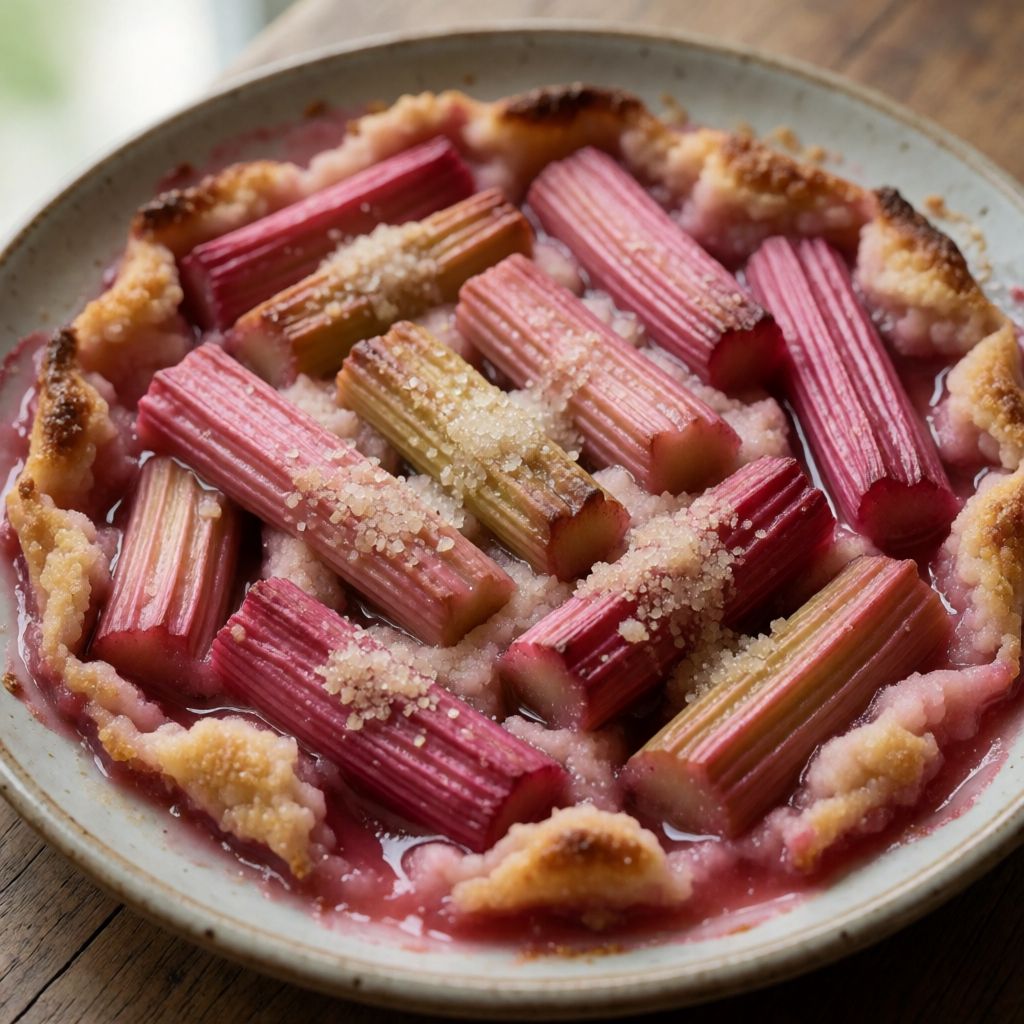
 AI photo
Baked Rhubarb
A simple oven-baked rhubarb dessert, lightly spiced with vanilla and sweetened with sugar.
Labels are worked out automatically from the ingredients and can be wrong. Check the packaging if it matters to you.
Ingredients
- 300 g Rhubarb diced
- ½ tsp vanilla powder
- 2 tbsp Sugar



Steps
Put the rhubarb, vanilla powder and sugar into a bowl and mix well.
Spread the mixture onto a baking tray lined with parchment paper and bake in a preheated fan oven at 140°C for 30 minutes.
30 min
This is rhubarb with nothing to hide behind — no pastry, no custard, just the stalk, a little sugar, a breath of vanilla and an oven set low enough to think. What you get isn't a bake in the usual sense of browning and crisping. It's rhubarb persuaded to give up its water slowly, and sugar persuaded to catch that water and turn it into syrup around the pieces, instead of boiling it off or scorching it.
What decides whether it works is heat and patience working together, not against each other. 140°C in a fan oven is not hot enough to brown anything — it's hot enough to soften cell walls and start osmosis, sugar pulling moisture out of the rhubarb cell by cell. Push the heat up because you're impatient and you'll get pieces that collapse on the outside while the core stays stringy and sour. Thirty minutes is the floor, not the target — you're watching for rhubarb that gives under the back of a spoon without a fight, sitting in its own glossy, thickened juice, still holding its shape as a piece rather than dissolving into mush.
Some say rhubarb needs a hot oven to caramelise properly, the way you'd roast a parsnip. No — because rhubarb is mostly water in a fibrous jacket, not a dense vegetable with sugars near the surface. High heat on something that wet just cooks the edges fast and leaves the middle raw and tart. Low and slow is the only way the whole piece turns tender at the same rate, which is the entire point of a dish with three ingredients and nowhere to hide a mistake.
Rhubarb itself splits into two kinds you'll meet in a British shop, and it matters which one you've got. Forced rhubarb — grown in the dark, usually from the Yorkshire sheds in early spring — is pale pink, thin-stalked, and already tender and mild; it needs less time and less sugar than the recipe assumes, so check it earlier. Garden rhubarb, picked in summer, is thicker, greener, more fibrous and properly sour — it's the one this cook time and sugar amount is really built for. Dice it to roughly the same size throughout; uneven pieces are the real cause of a dish that's mush in one bite and raw-sour in the next, because the small pieces finish while the big ones are still fighting their cell walls.
Sugar is doing more than sweetening. It's the thing driving the osmosis — drawing water out of the rhubarb and then holding onto it as syrup instead of letting it just evaporate into the oven. Two tablespoons on 300g is a light hand, which tells you this isn't meant to taste like jam; it's meant to taste like rhubarb, slightly rounded off. Any sugar that dissolves cleanly and doesn't bring its own flavour will do the job — caster sugar dissolves fastest because the grains are fine, granulated works but slower, and if you're using honey or a syrup instead, remember it's already wet, so the rhubarb will sit in more liquid, not less.
Vanilla powder here is doing a quiet job — it's rounding the sourness, not announcing itself. The substitution to look for is anything that gives vanilla aroma without adding its own competing flavour or extra liquid: a vanilla pod's scraped seeds work exactly the same way, vanilla extract works too but it's alcohol and water, so it'll thin the syrup slightly — not a disaster, just worth knowing why your tray looks a touch wetter.
The parchment paper on the tray isn't fussiness. Once the sugar starts drawing out rhubarb's juice and that juice starts to concentrate under heat, it will glue itself to bare metal and burn in patches long before the rhubarb itself is done — parchment is what stops you scraping caramelised sugar off a tray with a knife afterwards. A domestic fan oven circulates air around the tray evenly, which is exactly what this dish is built on: even gentle heat everywhere, no hot spot doing the work of the rest. If your oven has no fan, know that still air cooks more slowly and unevenly, so lean on the doneness cue — the give of a spoon, the look of the syrup — rather than trusting the clock alone.
As for serving: the recipe gives you rhubarb and nothing else, and that's deliberate — it's a component, not a finished pudding. Cold double cream, or custard if you're that way inclined, is the obvious next move, and it's not in the steps because it doesn't need to be; one portion of 300g rhubarb is generous for one person eaten plain, but stretches further once you're spooning it over something. That's not cheating the recipe — that's just what rhubarb has always been in a British kitchen, a cheap, hardy, slightly sour thing from the garden that needed very little sugar to turn into pudding, because sugar, historically, was the expensive part.