
 AI photo
Baked Mont d'Or
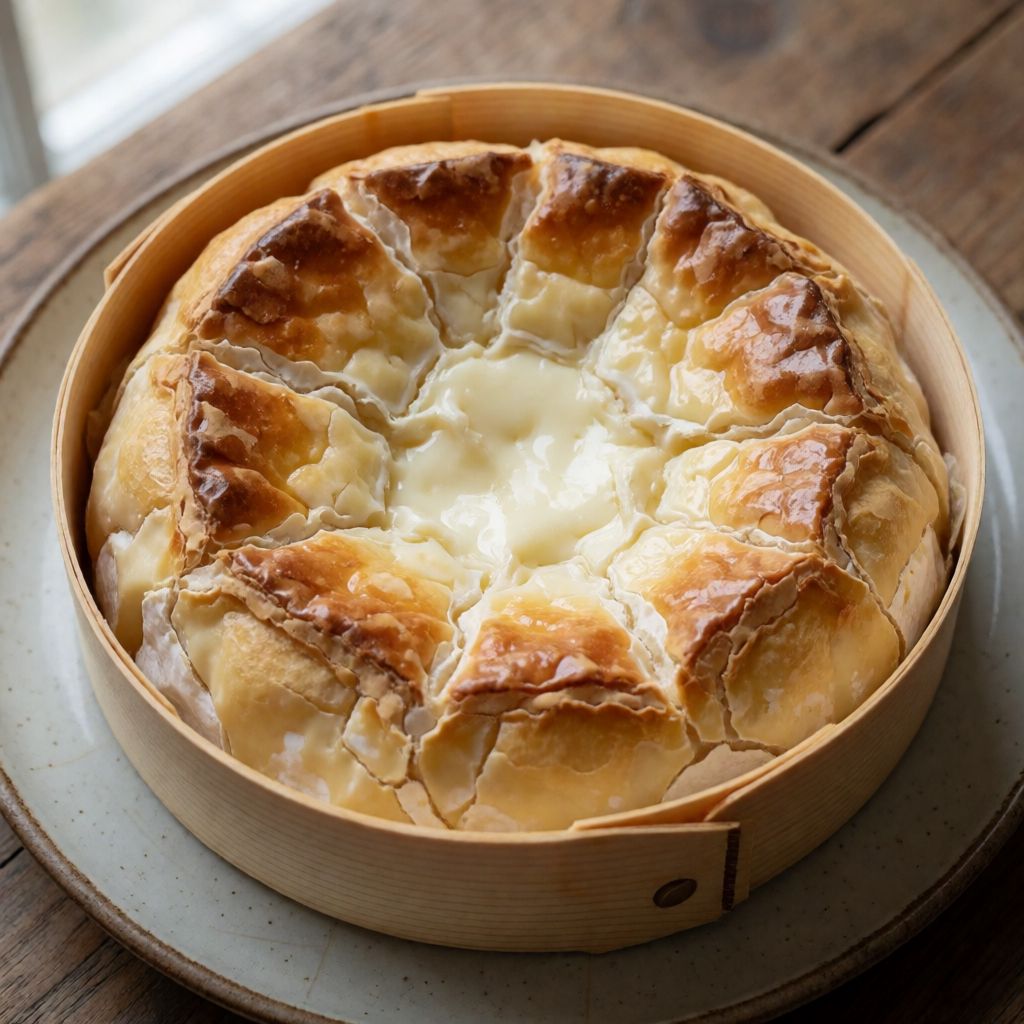
A whole wheel of Mont d'Or, baked in its wooden box with white wine and rosemary until soft and creamy.
Labels are worked out automatically from the ingredients and can be wrong. Check the packaging if it matters to you.
Ingredients
- 1 pcs Mont d'Or
- 100 ml White Wine
- 3 pcs Rosemary fresh sprigs



Steps
Remove all the plastic packaging from the Mont d'Or cheese. Leave the cheese in its wooden box, lid off, both while it bakes and afterwards.
Cut a cross in the centre of the cheese and tuck the small rosemary sprigs around it.
Slowly pour over the white wine and bake the cheese in a preheated oven at 175°C (fan) for about 30 minutes.
30 minTake the cheese out of the oven and let it rest for 10 minutes.
10 minRemove the rosemary sprigs and stir the cheese with a spoon until soft, runny and creamy.
Mont d'Or isn't a cheese you cook so much as a cheese you wake up. By the time it reaches that stage of ripeness its paste is already halfway to liquid — held together only by a thin washed rind and the wooden box it's sold in. The oven doesn't "melt" it in the way it melts cheddar on toast; it just finishes the job the cheesemaker started, pushing a soft paste the rest of the way into a pourable one.
The box is not packaging you tolerate — it's the only thing stopping the cheese from running flat across your oven tray once the heat gets into it. That's why the method keeps the lid off but keeps the cheese in the box, in the oven and after. Some people think you can do this trick with any soft cheese, a baked Camembert say — no, because Camembert's paste is drier and its rind firmer; it holds its own shape without a box crutch. Mont d'Or at the right ripeness won't.
The cross you cut in the top isn't decoration either. Score it and the rind can't seal itself into a tight skin as it heats — steam escapes evenly, and the wine you pour over actually gets in rather than sitting on the surface going nowhere. Skip that cut and you risk a cheese that's scalding liquid trapped under an intact rind, with cold, under-warmed cheese still sulking at the edges.
Cheese first, because it's the only ingredient that can't really be substituted on taste alone, only on structure. Vacherin Mont d'Or is a seasonal cheese by law — the AOC only allows it to be made and sold roughly from late summer to early spring, a rule rooted in old mountain economics: in the Jura, winter milk was scarcer and richer, and rather than press it into a hard wheel that takes months to age, farmers made a soft one that could be eaten within weeks. The wooden box — a strip of spruce called a sangle — was never about presentation; it's what let a floppy cheese travel to market without collapsing, and it still gives the paste a faint resin note you'd miss without it. If you can't find Mont d'Or, look for the same shape of thing: a cow's-milk cheese sold boxed, washed-rind, loose paste at room temperature. Vacherin Fribourgeois in its box is the nearest cousin. Without a boxed cheese, you'd need another vessel — a small ovenproof dish, foil folded tight — because the method depends on something holding the shape while the cheese goes molten inside it.
The wine is there to cut through the fat, not to flavour it with sweetness, so keep it dry — a crisp white, nothing oaked or heavy, nothing you wouldn't happily drink alongside. The alcohol cooks off in the oven; what stays is the acid, and that acid is what keeps the finished cheese tasting rich rather than just heavy. A Jura wine is traditional simply because that's what was on the farmer's own shelf — not because any other dry white would fail you.
Rosemary needs to be fresh, and that's not fussiness. Fresh sprigs release their oil slowly over the half hour in the oven; dried rosemary, with no moisture left in it, would just scorch on the hot surface and leave you with the taste of dust rather than perfume. Thyme works by the same logic if that's what's in the garden — a woody herb with real oil in its leaves, not a dried jar.
On the oven: 175°C fan matters because a fan oven moves hot air around the cheese constantly, so the heat reaches the rind evenly rather than baking one side and leaving the other sulking — which is exactly the defect that happens with box cheeses in a still oven, where the far side from the element stays cooler and never really goes creamy. Thirty minutes is the lower bound, not a deadline: you're watching for the surface to have gone from flat to faintly domed and glossy, with wine visibly bubbling at the cut, not for the clock.
As for serving — this isn't a Sunday roast, and it isn't trying to be one. Treat it as the centre of its own small meal: good bread for dipping, boiled new potatoes if you want something more substantial, maybe cold meats on the side. One box, the usual 450g size, does four people comfortably as a shared starter, fewer if it's the whole point of the evening and everyone's hungry.