
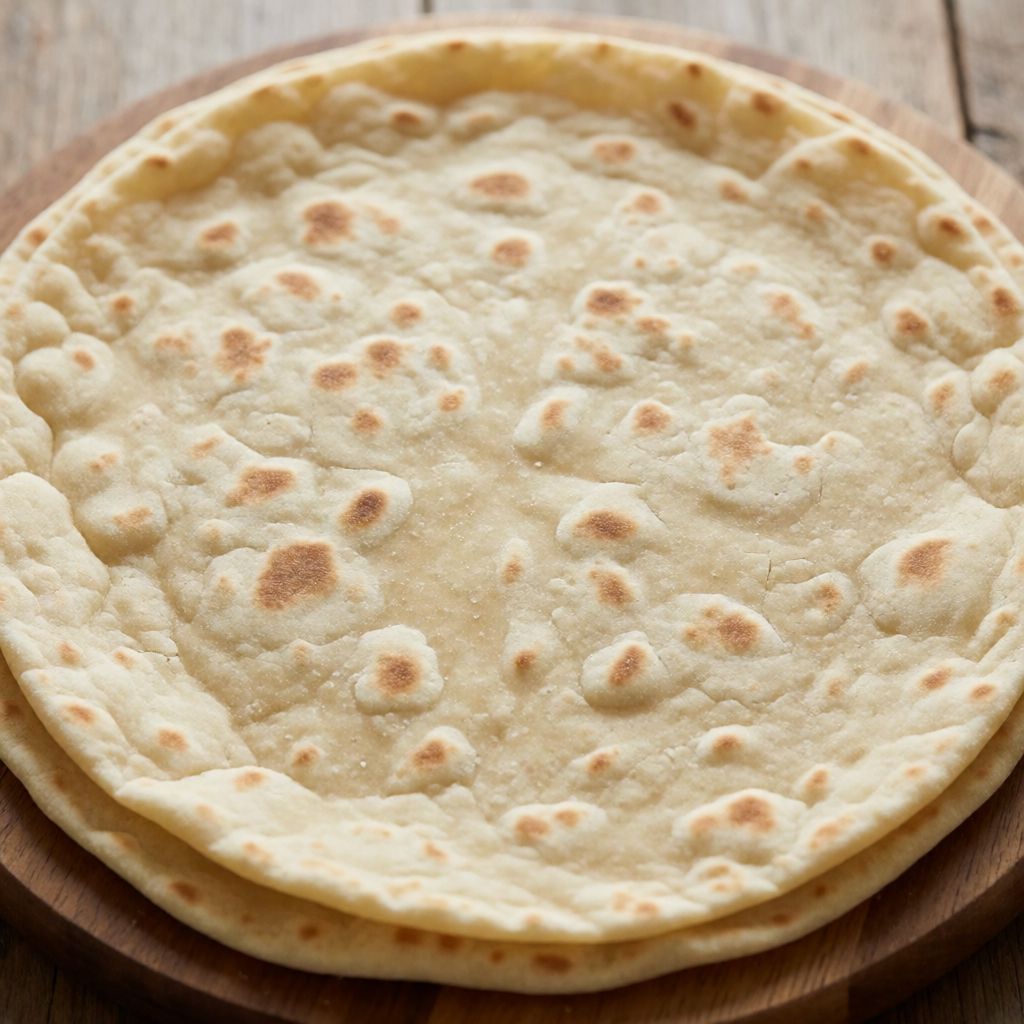
 AI photo
Gluten-Free Piadina
A thin, gluten-free Italian-style flatbread that you fill with whatever you like.
Labels are worked out automatically from the ingredients and can be wrong. Check the packaging if it matters to you.
Ingredients
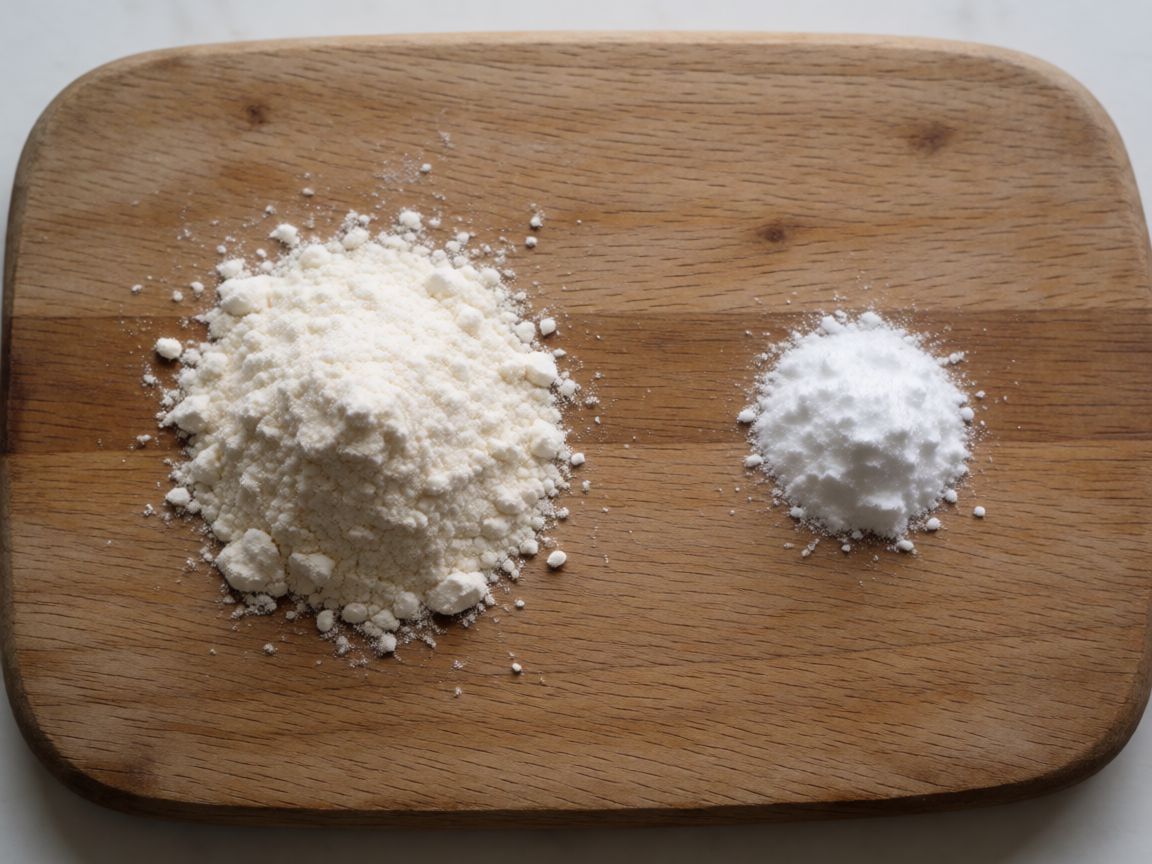
- 400 g Gluten-free flour mix
- 300 ml Water
- 10 g Salt
- 1 tbsp Olive oil
- 5 g Baking powder for savoury baking




Steps
In a large bowl, sift the gluten-free flour together with the baking powder, add the olive oil and salt, and mix well.
Gradually pour in the water in small amounts, stirring constantly, until the mixture becomes smooth and even.
Tip the dough onto a lightly floured surface and knead by hand until you get a smooth, compact ball.
Divide the dough into 6 equal pieces.
Roll out each piece with a flour-dusted rolling pin on a floured surface into a very thin sheet, about 1-2 mm thick.
To get a neat round shape, you can use a pan lid of the right size or a baking ring as a guide.
Trim away any excess dough and use it to shape the next piadina.
Heat a frying pan and cook each piadina for 1-2 minutes on each side.
2 minCover the pan with a lid so the piadinas don't dry out.
Fill the piadina with your favourite filling and serve.
Piadina is Romagna's answer to bread when there was no oven in the house and no money to heat one even if you had it. Flour, water, salt, a scrape of fat, cooked flat on a hot disc over the fire — that's the whole poverty of it, and the whole genius. What you have here is the gluten-free version of that same poverty logic: you've lost the thing that made wheat dough elastic and chewy, so baking powder stands in for lift, and oil stands in for suppleness. Two different jobs, two different ingredients, neither pretending to be the other.
What decides whether this works is not minutes, it's thickness and heat. Roll it thin enough that light would get through if you held it up — a millimetre, two at most — because a gluten-free flatbread rolled thick doesn't toast, it bakes, and you get something closer to a biscuit than a wrap. Then it goes into a dry pan, hot enough that the dough starts blistering and freckling with brown almost as soon as it touches down. If it just sits there going pale, the pan wasn't ready and you'll end up steaming the dough instead of toasting it — chewy and sad instead of freckled and pliable.
Some say a piadina isn't a real piadina unless it's cooked on a *testo*, the terracotta disc Romagnoli women used to heat over embers. No — because what the terracotta actually does is hold a huge amount of heat steady through each piadina without dropping, which matters on an open fire with no thermostat. A heavy flat pan on a domestic hob does the same job by a different route: it's not the clay that's sacred, it's the mass holding the heat.
The gluten-free flour mix is doing a job wheat flour does almost by accident: it's not one ingredient, it's a blend already engineered to behave like flour without gluten, usually rice or corn starch cut with something binding like xanthan gum. That's the criterion when you're buying one — look for a blend meant for bread or flatbread, not a plain single-grain flour, because a single starch alone won't hold a dough together when you fold it round a filling, it'll shatter at the seam. If you're mixing your own, you want a starchy base plus a small pinch of a gum binder standing in for the structure gluten would normally give you.
Baking powder here isn't raising the dough the way it raises a cake — there's no long bake, no oven spring. What it's doing in those two minutes a side is pushing just enough gas through the dough to keep it from turning into a dense, leathery disc, giving you something with a bit of lightness instead of a flour-and-water paste cooked flat. This is also why kneading gluten-free dough for ages is wasted effort: some say you have to knead it like bread dough until it fights back — no, because there's no gluten network in there to develop. You knead just until it holds together as one piece. Past that point you're not building strength, you're just making your arms tired.
Salt is doing what salt always does, seasoning and tightening the dough slightly, but it's also why you mix it in with the dry ingredients rather than dissolving it straight into the water — evenly distributed salt means no bitter patch in one piadina and a flat one in the next.
The olive oil is the thing standing in for the fat that made the original dough workable — lard, traditionally, because this was a dish built around what a poor household in Romagna actually had, and a pig gave you fat far more reliably than olives did in that climate. Oil here coats the starch as you mix, which is why the dough comes together smooth instead of sticky, and it's also what keeps the finished piadina bendable rather than brittle once it cools. The criterion for substituting it is simple: any oil with no smell of its own, so it doesn't fight the filling later — sunflower or a neutral vegetable oil both do the job; you'd only reach for something like coconut oil if you wanted its flavour riding along, which here you don't.
Water is just water, but how it goes in matters more than how much: in small amounts, worked in as you go, rather than tipped in all at once. Gluten-free starches absorb liquid more unevenly than wheat flour does, so pouring it all in together risks a dough that's wet on one side of the bowl and dry on the other, and no amount of kneading afterwards fully evens that out.
One more thing worth saying honestly, since this is a flat with a hob and not a Romagna kitchen with a wood fire: your pan will take a minute or two to get properly hot before the first piadina even goes in, and it's worth waiting for that rather than starting the moment it feels warm to your hand near it — a pan that's only half-ready gives you the first piadina pale and the last one burnt, because by piadina four the pan has finally caught up to where it should have been at piadina one.