
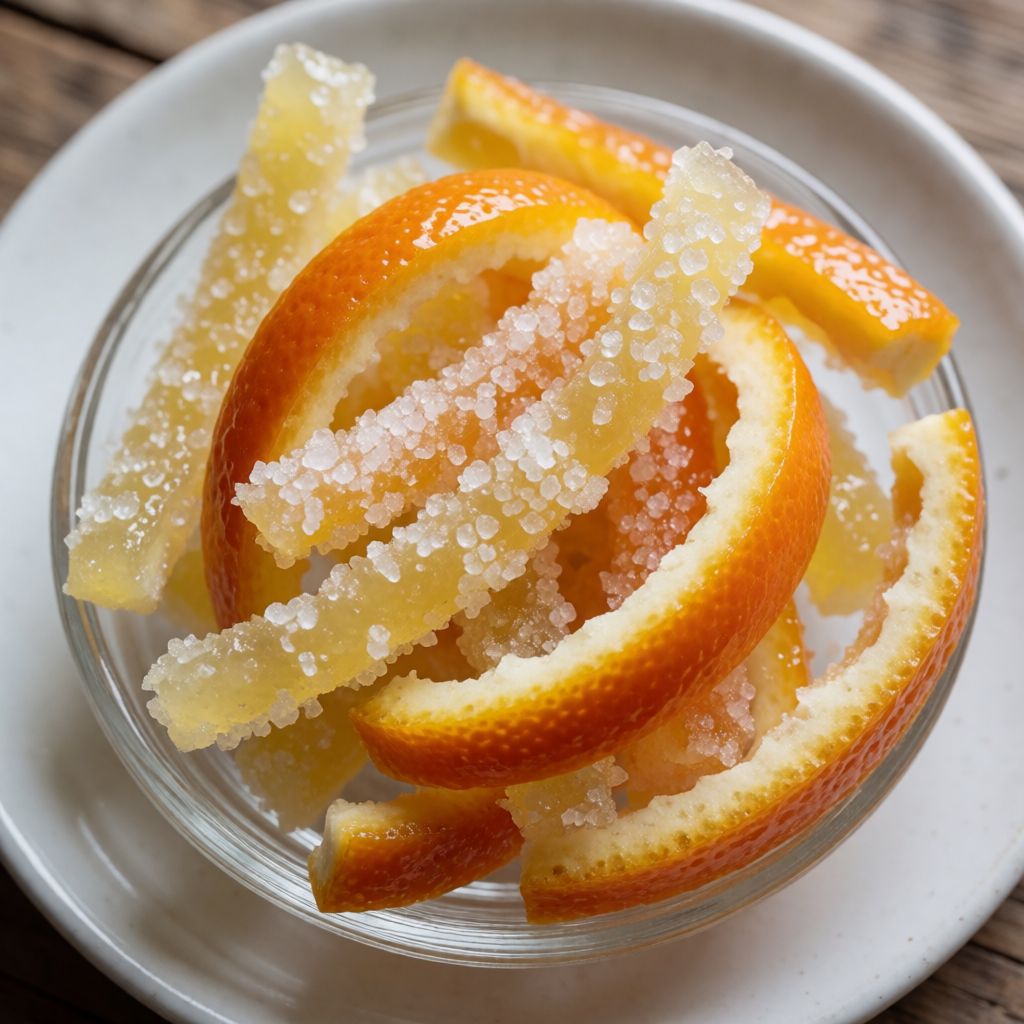
 AI photo
Candied Orange and Lemon Peel
Sweet, chewy candied citrus peel, perfect for snacking or decorating desserts.
Labels are worked out automatically from the ingredients and can be wrong. Check the packaging if it matters to you.
Ingredients
- 2 pcs Orange
- 2 pcs Lemon
- 300 g Sugar
- 1 tbsp Glucose syrup
- Water
- 4 tbsp Pearl sugar






Steps
Cut the citrus fruits along with the peel, then separate the peel from the flesh and trim away half of the white bitter pith.
Use a sharp knife.
Cut the peel into strips about 0.5 cm wide.
Put a pan of water on the heat and bring it to the boil.
Add the citrus peel and simmer for about 5 minutes.
5 minDrain the water, pour fresh water over the peel in the pan, bring to the boil and simmer gently for 5 minutes.
5 minDrain the water and set the peel aside for a minute.
1 minPour 300 ml of water into the pan with the sugar and bring to the boil.
Put the citrus peel back into the pan and reduce the heat.
Simmer gently, uncovered, for about 30 minutes.
30 minThen add the glucose syrup and stir.
Turn off the heat, cover with a lid and leave the peel in the syrup until the next day.
Remove the peel and roll it in pearl sugar.
Leave to dry on a rack at room temperature for 2 days, or in the oven at 50°C for about 3 hours.
180 min
What you're making here isn't jam, isn't marmalade, and it isn't a quick job either — it's the peel itself, turned from bitter rind into something you can eat on its own, the way the Victorians did at the end of a meal when they wanted something sharp-sweet after all that roast beef. The whole thing hangs on one mechanical fact: orange and lemon peel is dense, waterproof, and packed with bitter oils in the white pith. You can't just drop it in syrup and hope — you have to push water and sugar into a structure that's actively resisting you, and that takes repetition, not heat.
That's why the peel gets boiled twice in plain water before sugar ever touches it. Some say the double boil is there to "soften" the peel — no, it's there to leach out the bitter compounds (mostly limonin and the oils in the pith) that would otherwise sit under the sugar and ruin the finish. Boiling once gets some out; boiling again in fresh water gets more, because each change of water carries bitterness away with it rather than just redistributing it. Skip the second boil and you'll taste why it was there.
The long, slow simmer in syrup afterwards is doing something different: it's drawing water out of the peel's cells and replacing it with sugar solution, molecule by molecule, until the peel is saturated rather than just coated. This is slow because diffusion is slow — there's no shortcut heat trick that speeds it up without scorching the sugar first. Then leaving it in the syrup overnight finishes the job cold, while you sleep, which is the cheapest kind of patience there is.
On the ingredients, start with the fruit. Use oranges and lemons with unwaxed, unsprayed skin if you can get them — the wax on supermarket citrus is there to stop moisture loss in transit, not for you, and boiling it twice mostly deals with it, but unwaxed is one less thing to think about. Trimming away half the white pith isn't fussiness: that pith is where the bitterness concentrates, and leaving all of it on means the double boil has more bitterness to fight against; leaving none of it on means the strip has no backbone and falls apart in the syrup. Half is a compromise learned by someone standing at a stove, not a rule carved in stone.
Cut the strips to roughly 0.5 cm and keep them even — this isn't about looks, it's about diffusion again. A strip twice as thick takes much longer than twice as long to saturate, because sugar has to travel from the outside in, and uneven strips mean some pieces are perfect while others are still bitter and raw-tasting inside. A sharp knife matters here for the same reason a sharp knife always matters with citrus peel: a dull blade crushes the oil glands instead of slicing through them, and crushed glands release more bitter oil onto the surface you're trying to clean.
The sugar is just sugar — ordinary granulated, nothing special, since its job is simply to be sugar in solution. Glucose syrup earns its place for a specific reason: it's less prone to crystallising than sucrose alone, so it keeps the syrup glassy and workable rather than turning grainy on you overnight. If you don't have glucose syrup, a spoon of golden syrup or liquid glucose from a baking aisle does the same job; honey will work in a pinch but brings its own flavour, which isn't always what you want sitting next to orange.
Pearl sugar is the coarse, hard-grained sugar you'd associate with Belgian waffles — if you can't find it, crushed sugar cubes or a very coarse demerara gives you the same bite and the same dry shell, just with a bit more colour and molasses flavour than the clean white crunch of pearl sugar.
On drying: the oven method at a low, barely-warm 50°C is the UK-kitchen-friendly version — most home ovens don't hold a low temperature with great accuracy, so check the peel rather than trust the dial, and pull it the moment it's firm and no longer tacky to touch, because overdrying just turns it leathery. The rack-at-room-temperature route over two days asks for nothing but a cool spot away from damp and the patience not to poke at it — and that patience really is the main ingredient in this recipe, more than the sugar.
This makes a small batch — enough for one person's tin of something sharp to nibble with tea, or to chop into a fruit cake, not enough to can and give away. If you want more, scale the fruit and sugar together and keep the water-to-sugar ratio the same; the timings for the boiling and the syrup simmer stay roughly where they are, because they're governed by how fast water and sugar move through the peel, not by how much peel is in the pan.