
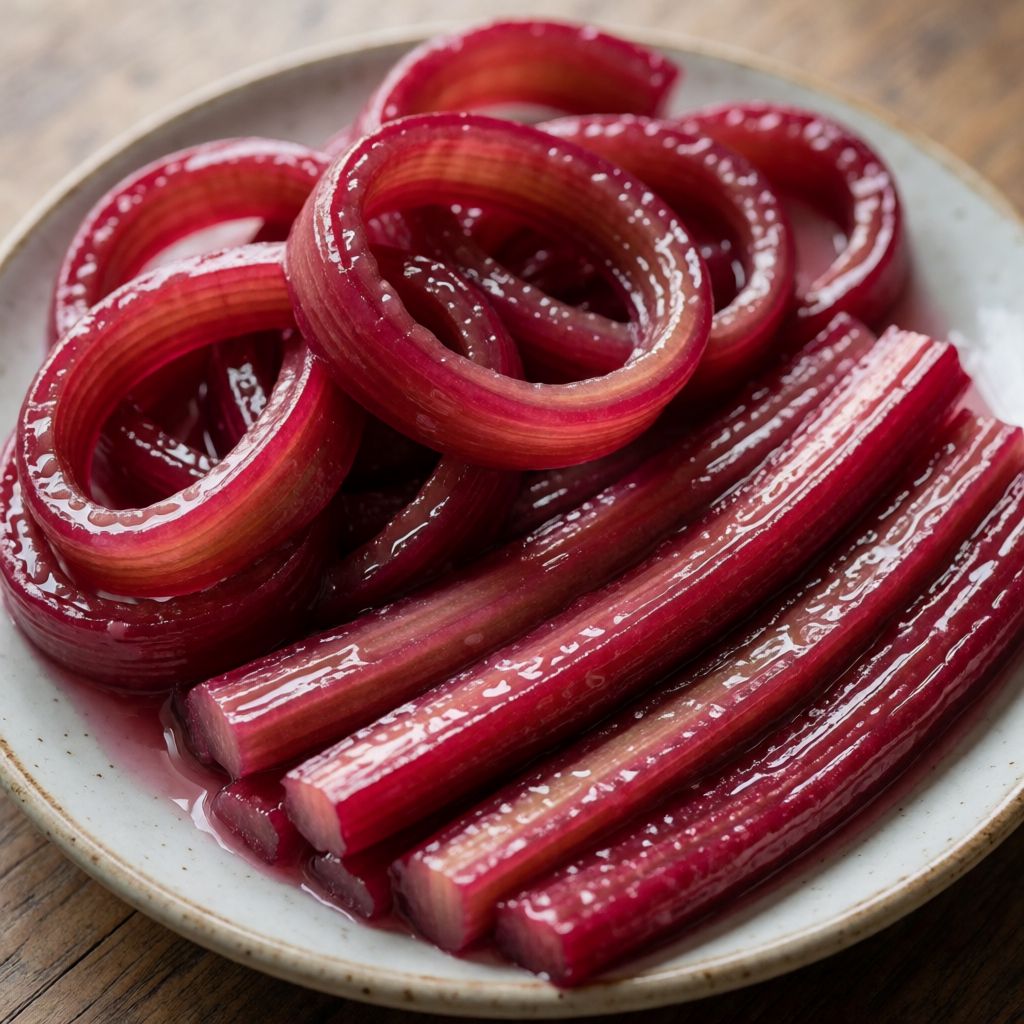
 AI photo
Candied Rhubarb Strips
Thin rhubarb strips are boiled in sugar syrup, then dried and curled into sweet candied treats.
Labels are worked out automatically from the ingredients and can be wrong. Check the packaging if it matters to you.
Ingredients



Steps
Thoroughly clean the rhubarb stalks and remove the leaves. Using a potato peeler or vegetable peeler, cut long, flat strips.
Bring the water and sugar to the boil in a saucepan. Remove from the heat and add the rhubarb strips. Stir well, using kitchen tongs if you like.
Take out the strips one at a time and lay them in long rows on a baking tray lined with parchment paper.
Leave to dry for 6-8 hours, or in the oven at 60°C for 40 minutes.
40 minRemove, let cool for a few minutes, then wind the strips around chopsticks or spoon handles.
Leave to dry overnight on the kitchen counter.
What was changed
The oven temperature range was replaced with a single value .
What you're making here isn't a dessert in the usual sense — it's a confection, a little sugared curl you'd set beside the teacup, not after the roast. Three stalks of rhubarb become a few dozen thin ribbons, coated once in hot syrup, then dried until they hold a shape on their own. Think of it as rhubarb learning to behave like a boiled sweet.
What decides whether this works is the strip itself, long before any syrup touches it. Pull the peeler the full length of the stalk in one stroke — a short, choppy strip dries unevenly and snaps where it's thick, bends where it's thin, and you end up with half a tray of flat, stubborn pieces that refuse to curl. The strip has to be thin enough to flex like a ribbon, not a stick. That's the whole trick of this recipe: thickness, not sugar, is what makes it bend or break.
Some say you have to peel rhubarb the way you peel a potato, to get the skin off. No — here the peeler isn't removing anything, it's cutting. Rhubarb skin isn't tough or bitter the way potato skin can be; you're using the peeler purely as a slicing tool to take off a long, even ribbon, stringy fibres and colour and all. If you tried to actually skin the stalk first, you'd have nothing left to curl.
Choose rhubarb for firmness, not size. A good stalk snaps with a clean, slightly wet crack when you bend it — that's turgor, water pressure inside the cells, and it's what you're relying on to get a strip that peels in one long piece instead of crumbling into short shards. If the stalks bend without a snap, they've already started to dry out in storage, and your ribbons will tear.
Forced rhubarb — the pale pink, early-season stalks grown in the dark, famously around Wakefield's old "Rhubarb Triangle" — is thinner, less fibrous and milder, so it curls more willingly and needs slightly less sugar to balance it. Thicker, deep-red maincrop rhubarb from midsummer is more sour and more stringy; it still works, just expect a firmer ribbon and lean a little more on the syrup. There's no real substitute for rhubarb's particular sourness — this isn't a recipe you adapt to another fruit, it's built around that one sharp note against sugar.
Sugar is only there to dissolve clean into the water and coat the strip; caster sugar dissolves fastest, granulated is fine too, just give it longer in the water before it clears. Don't reach for brown sugar or honey here — their own flavour would sit on top of the rhubarb instead of just setting it, and the dish would stop being about rhubarb at all. The water's only job is to carry the sugar; there's nothing to substitute it with and nothing to season it with either.
On the drying: 60°C in the oven isn't a cooking temperature, it's a dehydrating one — low enough that nothing browns or caramelises, it just lets water leave the strip steadily. Most home ovens don't trust their own dial that low, so go by the strip, not the clock: it should feel tacky-dry and bend without cracking when you take it out, not yet brittle. If your oven's lowest setting runs hotter, prop the door slightly or just give the strips longer on the counter instead — six to eight hours of ordinary room air does the same job, slower.
The moment that actually decides whether you get a curl or a flat strip is the winding. It has to happen while the ribbon is still warm and pliable, within a few minutes of coming out of the oven or off the tray — wait too long and the sugar has already set it straight, and no amount of coaxing round a chopstick afterward will put a curl in. This is where patience is the real ingredient twice over: once in the slow drying, and once in not rushing the shaping before the strip's ready, or skipping straight to it before the strip has cooled just enough not to tear.
Served with tea, with milk in it the way it's drunk here, these make more sense than as a stand-alone pudding — three stalks giving you enough curls for twenty-five small nibbles is really a sign of what they are: not a course, but something passed round once the main plates are cleared, a sweet thing to have alongside a cup rather than instead of one.