
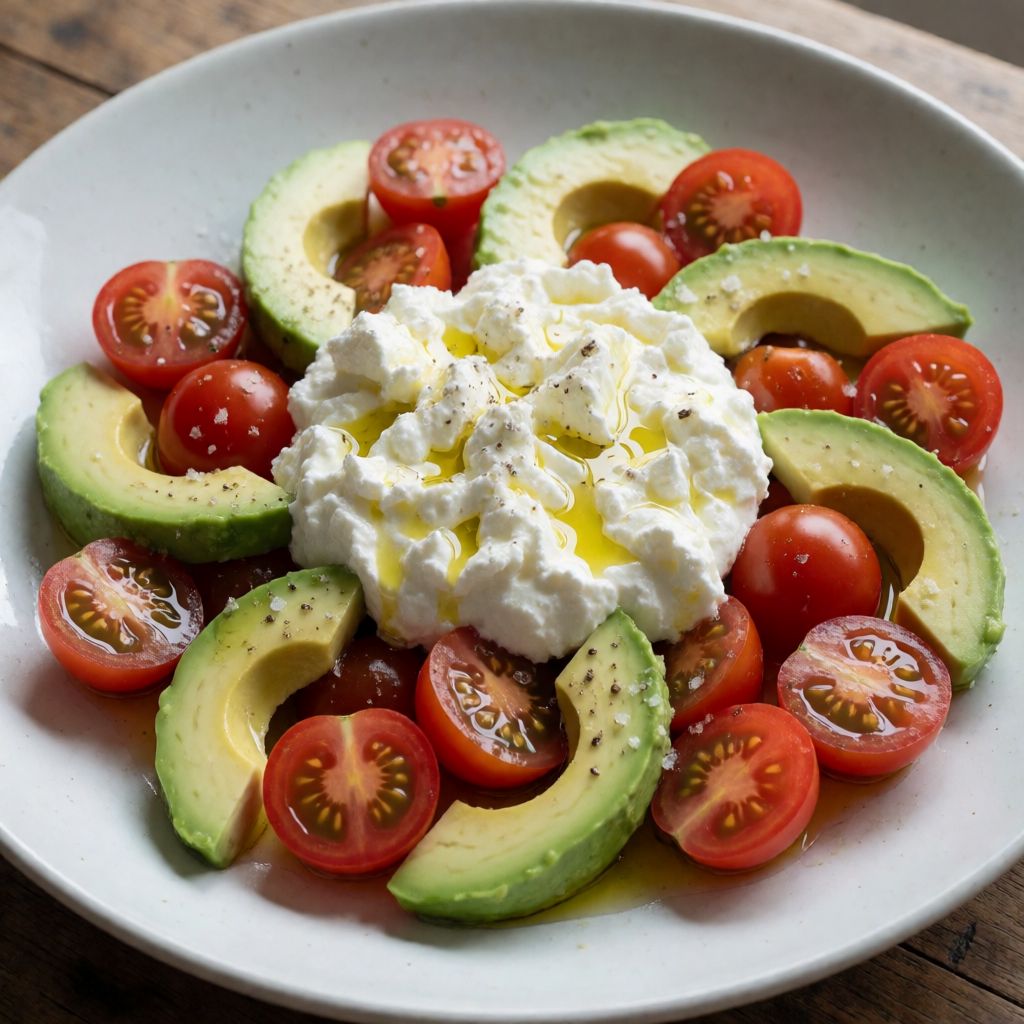
 AI photo
Caprese with Stracciatella, Cherry Tomatoes and Avocado
A fresh Caprese-style salad with creamy stracciatella, cherry tomatoes and avocado, layered in a ring mould.
Labels are worked out automatically from the ingredients and can be wrong. Check the packaging if it matters to you.
Ingredients
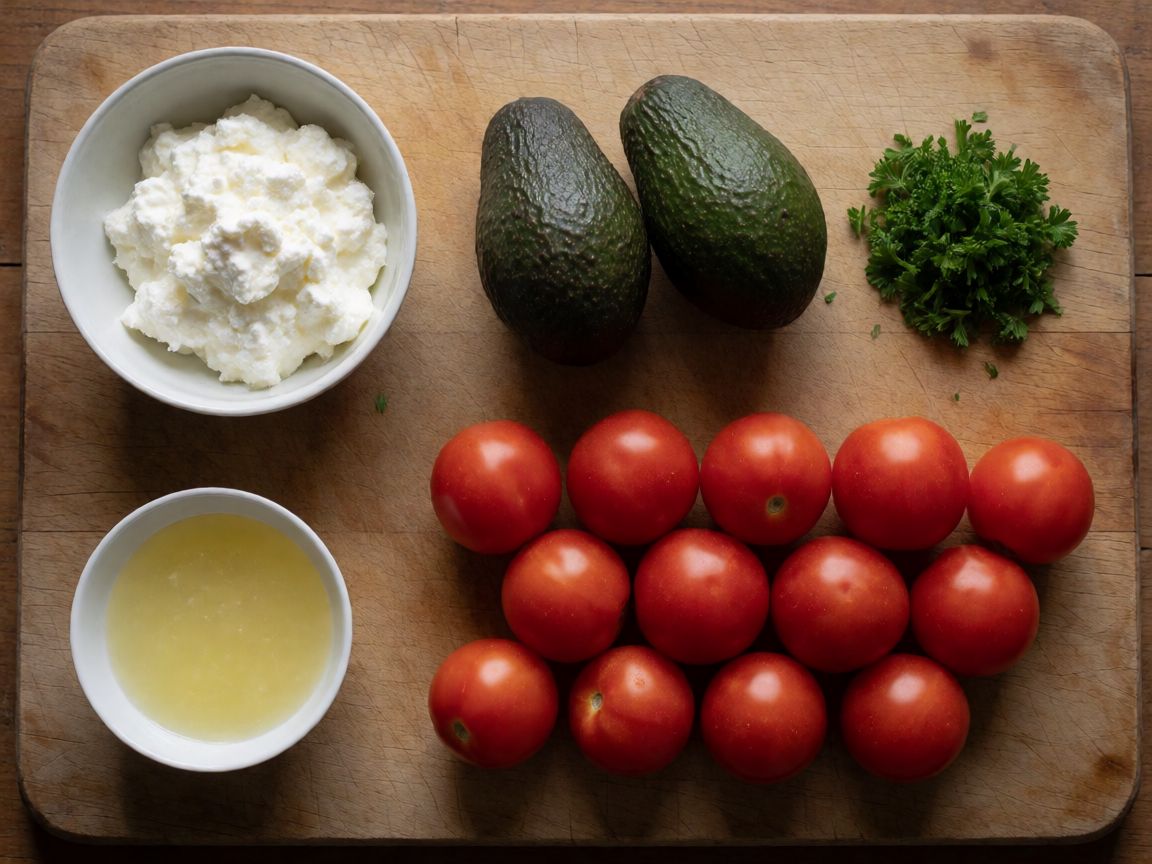
- 250 g Stracciatella cheese
- 2 pcs Avocado
- 12 pcs Cherry tomatoes
- Olive oil to taste
- Lemon juice
- Salt to taste
- Parsley






Steps
Wash the cherry tomatoes thoroughly, pat them dry, and cut into wedges.
Peel the avocado, remove the stone, and cut into small cubes.
Transfer the avocado cubes to a bowl and season with olive oil, lemon juice and salt.
Shape the dish in layers using a round food ring: place the avocado cubes, then a layer of stracciatella, then a layer of cherry tomatoes.
Garnish the top with parsley leaves and serve.
Call it Caprese if you like, but nothing here gets fried, boiled, or even warmed. This is construction, not cooking — you're building a stack of three soft things that have never agreed to hold a shape on their own, and the ring is what makes them behave. Take the ring away too soon, or build with ingredients that are too wet or too soft, and you get a puddle with good intentions. That's not a failed recipe — that's physics, and the recipe already knows it: build, serve fast, let it fall apart on the plate in front of the eater, not in your hands before that.
Some say Caprese must be mozzarella, tomato, basil, red-white-green, full stop, anything else is a crime against Capri. No — because the original idea was never a fixed trio, it was a principle: a mild milky cheese, an acid-sweet tomato, a fat to carry both, a green herb to cut through the fat. Mozzarella and basil were simply what the island had. Avocado and parsley are what your flat has, and they do the same three jobs — fat, freshness, green — so the logic holds even though the ingredients changed.
What actually decides whether this works is timing, not technique. Salt the tomatoes too early and they weep — their water runs out onto the stracciatella and turns a clean layer into a soggy one. Cut the avocado and leave it bare for five minutes and it goes grey-brown at the edges before anyone's even sat down. Neither is a flaw in the recipe. Both are the recipe punishing you for doing things in the wrong order.
Avocado first, because it's the one ingredient you can't fix after the fact. In most UK shops it arrives hard as a cricket ball — picked unripe on purpose, so it survives the ship. Don't test it by squeezing the whole fruit in the shop; that bruises the flesh under the skin before you've even paid for it. Press gently near the stem end instead, or just buy it four or five days ahead and let it sit on the counter — it ripens off the tree, slowly, at room temperature, no fridge involved. The fridge actually stalls ripening, which is handy if you're ever too early and need to buy time, useless if you're already late.
The lemon juice on the cut avocado isn't seasoning, it's chemistry: the acid slows the enzyme that turns cut avocado brown in open air. Skip it and in ten minutes your pale green cubes look tired even though nothing's actually gone off. Use real lemon, squeezed, not the bottled stuff with a long shelf life — bottled juice has had its brightness traded for stability, and brightness is the entire point here.
Stracciatella is simply the soft, creamy inside of mozzarella — literally the shreds and cream scraped out from the centre during mozzarella-making, once a by-product cheesemakers ate standing up in the dairy, now sold on its own because somebody noticed people would pay extra for exactly that bit. If you can't find it, buy a ball of good, fresh mozzarella and tear it open — the loose, milky centre is the same texture, just not pre-separated for you. Avoid anything labelled mozzarella but rubbery and squeaky when cut — that's been made for pizza, to melt and stretch, not to be eaten cold and soft. You want the kind that leaks a little cream when you break it.
Cherry tomatoes: the criterion is flavour concentration, not size. On-the-vine ones, still attached to their little green stems, are usually sweeter — they've been left on the plant longer because the stem makes them harder to damage in transit, so there's less pressure to pick them early. Dry them properly after washing; any water left clinging to the skin dilutes the dressing and waters down the one acidic, sharp note in the whole dish.
Salt goes on last, and only just before serving — on the avocado it's fine early since it's already dressed and sealed with oil and lemon, but hold off salting the tomatoes until the very end, right before you build, or they'll have given up their water onto your cheese layer by the time you serve.
Parsley stands in for basil here, and the criterion for that swap is simple: a green herb with its own sharp, grassy smell, not a decorative garnish. Flat-leaf parsley works because it's assertive enough to be noticed next to fat and acid — curly parsley is milder and mostly there for looks, so if that's all you've got, use more of it. Basil itself, if you happen to have some, is not cheating; it's the original logic reasserting itself.
As for the ring — any round cutter will do, a scone cutter, the rim of a tin with both ends removed, whatever's in the drawer. Press each layer down gently with the back of a spoon before adding the next; that compacting is what lets the stack survive the lift of the ring, for the few seconds it needs to survive it. After that, it's allowed to slump a little on the plate. That's not the dish failing — that's the dish being soft, which was rather the point.