
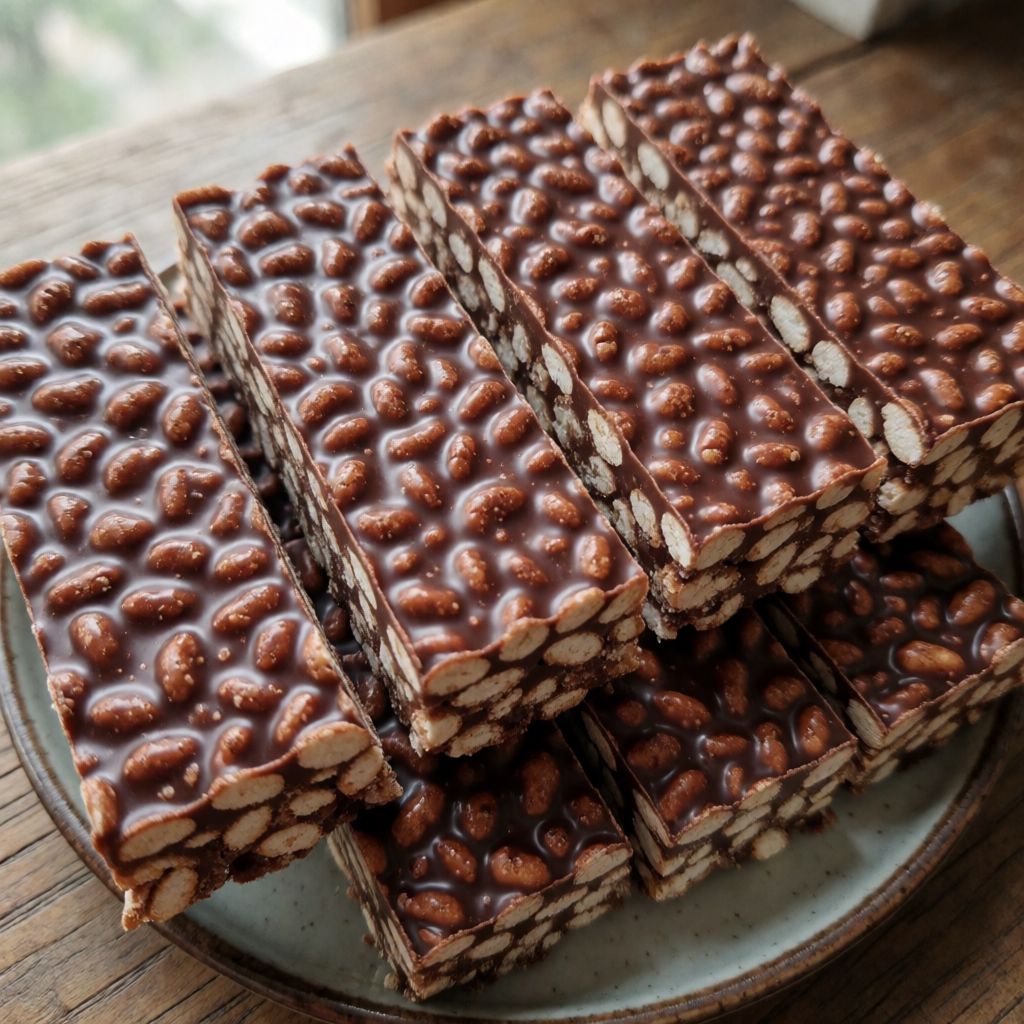
 AI photo
Puffed Rice Chocolate Bars
Crunchy puffed rice bars coated in melted milk chocolate and chilled until firm.
Labels are worked out automatically from the ingredients and can be wrong. Check the packaging if it matters to you.
Ingredients
- 550 g Milk chocolate
- 100 g Puffed rice
- 20 g Butter soft


Steps
Line a rectangular tin (e.g. 30x25cm) with baking paper.
Weigh out 100g of chocolate and melt it slowly in a bain-marie, stirring constantly.
Pour the melted chocolate, still warm, into the tin and spread with a spatula so the surface is smooth and even.
Melt another 300g of chocolate in a bain-marie, stirring until soft and creamy.
Add the soft butter, cut into pieces, and keep stirring until it has completely melted.
Put the puffed rice in a large bowl and immediately add the chocolate melted in the bain-marie.
Mix both ingredients with a spatula to get a smooth, dense mixture.
Transfer the mixture into the tin, which has already been coated with melted chocolate.
Smooth the surface of the rice mixture so the bars come out smooth on top.
Melt the last 150g of chocolate in a bain-marie and pour it, still warm, over the puffed rice.
Cover the tin with cling film and put it in the fridge for about 2 hours to speed up setting.
120 minOnce the mixture has fully set, cut the puffed rice chocolate bars with a sharp knife.
This is three skins of chocolate wrapped around a middle of rice and air — a base you pour and spread, a thick choc-and-rice mortar on top of that, and a thin lid poured last. Nothing goes in an oven. The whole thing sets by cooling, the way a jelly sets, not by baking. What decides whether it works isn't the rice or the chocolate on their own — it's whether the three pours actually weld into one bar. Get the timing wrong and you don't get a chocolate bar, you get three loose chocolate biscuits stacked in a tin, which fall apart the second you cut them.
Each pour has to meet the one below it while that one is still warm enough to take a bond. Pour the base, let it go hard and cold before the rice mixture goes on, and you've built a fault line — the knife will find it even if your teeth don't, and the top layer will lift clean off like a lid. That's the one thing this recipe actually tests you on: working at the pace the chocolate sets, not the pace you'd like to work at.
Some call this a 'no-bake treat' and file it next to the American marshmallow rice bars, as if melting chocolate were as forgiving as melting marshmallow. It isn't — marshmallow glue stays soft and sticky however long you take; chocolate glue has a closing window, and once it's shut, it's shut. That's the whole difference between a bar that holds together when you pick it up and one that doesn't.
The bain-marie isn't ceremony, it's a ceiling on heat. Chocolate scorches and turns grainy well below the temperature your hob can reach directly — melt it in a pan over a flame and you'll get a seized, dull paste before you've even noticed it's too hot. A bowl sitting over a pan of water that's barely moving, not hard-boiling, caps the heat at something chocolate can survive, and lets you fix problems with a spatula instead of a thermometer. If a single drop of that water gets into the bowl, though, the chocolate will seize anyway — go stiff and grainy in seconds. That's not a heat problem, it's a water problem, and it's the real reason people say chocolate is 'difficult': it isn't touchy about heat, it's touchy about damp.
You melt the chocolate in three separate lots because each lot has a different job, not because the recipe likes ceremony. The first 100g is glue for the tin — it has to go in warm and spread thin so the base bonds to the bottom instead of sitting as a separate disc. The 300g in the middle is mortar — it has to be soft enough to coat every grain of puffed rice without drowning it, which is why the butter goes in here and nowhere else. Butter is fat added on top of the chocolate's own fat; it keeps the set mixture a little pliable, so it gives slightly under a knife instead of snapping into shards. Leave it out and the middle sets closer to a chocolate shard than a bar — edible, just unpleasant to bite into. The last 150g is the lid, poured warm enough to flow into one smooth sheet rather than sitting in blobs.
For the chocolate itself, look for a bar that lists cocoa solids and milk, not one calling itself 'chocolate flavour' coating. Cheap coating bars swap cocoa butter for a vegetable fat that melts differently and sets with a dull, slightly rubbery snap rather than a clean one — fine for icing a cake, wrong for something built layer by layer that needs to hold its own shape. Dark chocolate works if you want it less sweet, but lean a touch harder on the butter, since dark sets firmer on its own and can turn brittle instead of giving a clean bite.
Puffed rice here means the plain, unsweetened sort — light, hollow grains with almost no flavour of their own, there purely for crunch and air. Sweetened breakfast cereal will work in a pinch, but you're then adding a second sugar hit on top of milk chocolate, and the bar tips sweet instead of balanced. There isn't a substitute that keeps the same texture; cornflakes or puffed wheat give crunch, but a flatter, different bite — at that point you've made a different tray bake, not this one.
Butter should be soft, not melted, when it goes in — soft so it blends into warm chocolate smoothly, not so liquid it cools the chocolate down and risks it setting lumpy before the rice goes in. Unsalted gives a cleaner read on the chocolate's own sweetness; salted is fine if that's what's in the fridge, it just flattens the flavour very slightly. There's no trick to the butter — any plain one does the job.
Two hours in the fridge is the lower bound, not a deadline — check by pressing the surface lightly through the cling film; it should resist, not dent. Don't push it into the freezer to save time: a fast chill can shock the surface into a dusty white bloom, cosmetic rather than dangerous, but the clearest sign in this whole recipe of rushing a step that only works slowly. Patience here isn't virtue for its own sake, it's the mechanism by which the fat sets evenly instead of in a hurry and badly. Once it's properly firm, a sharp knife through cold chocolate and crisp rice gives a clean cut rather than a crumbling one — and that clean edge is your real sign it's ready, better than any clock.