
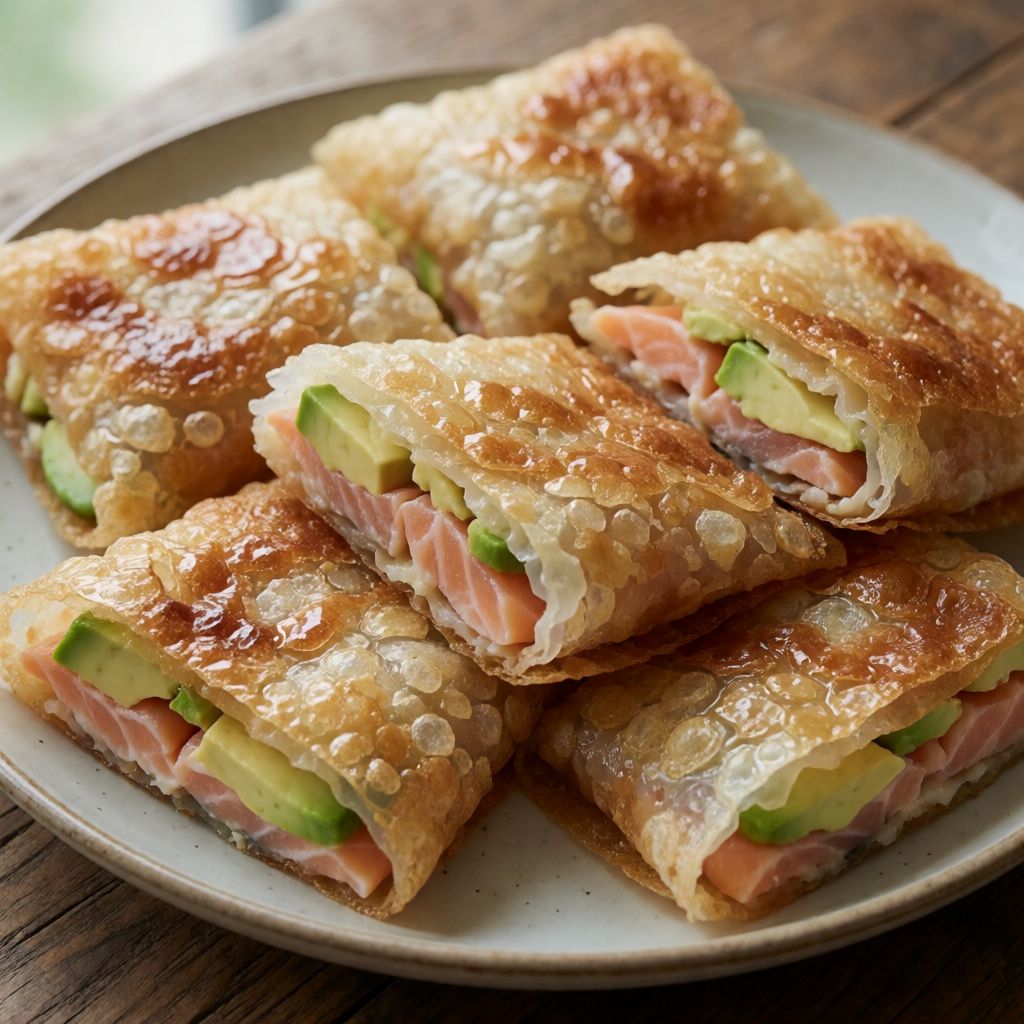
 AI photo
Crispy Rice Paper with Salmon
A crunchy snack of fried rice paper topped with spiced salmon, smoked salmon and avocado.
Labels are worked out automatically from the ingredients and can be wrong. Check the packaging if it matters to you.
Ingredients
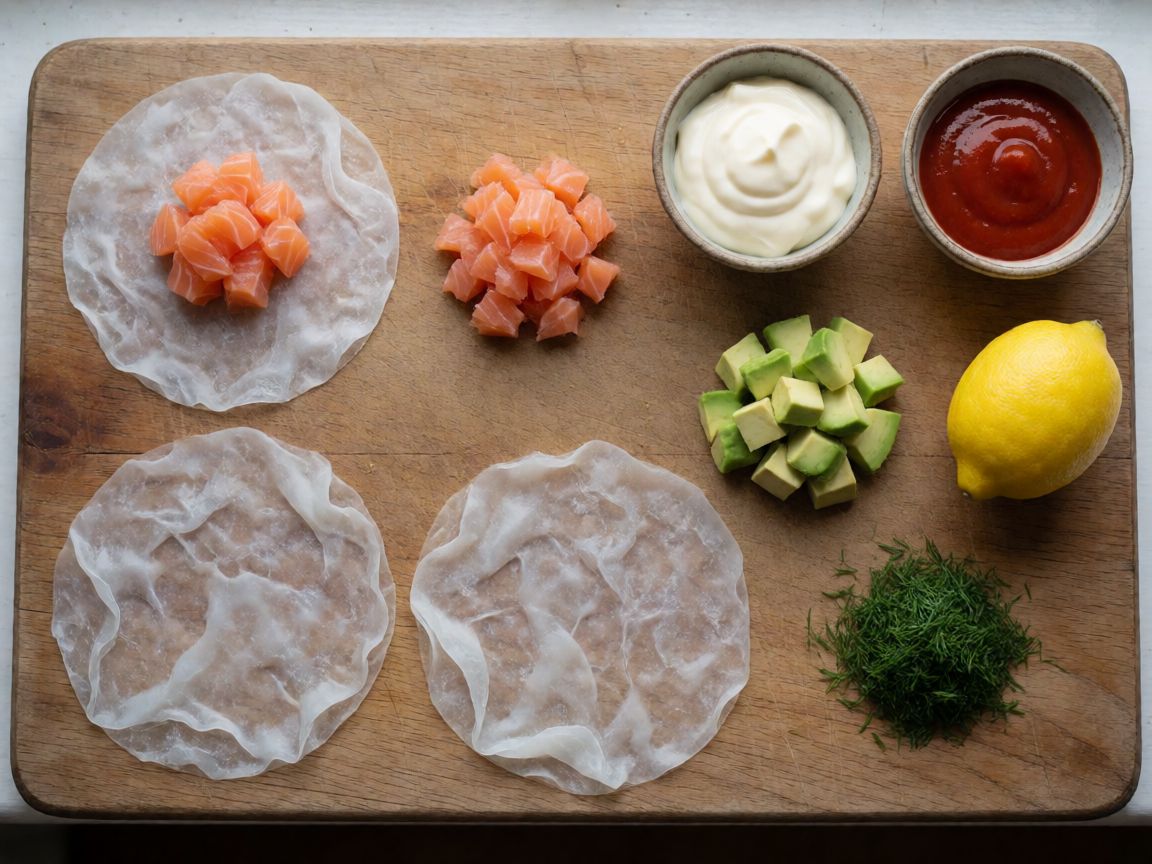
- 4 pcs Rice paper
- 200 g Salmon cut into small cubes
- 100 g Smoked salmon cut into small cubes
- 1 pcs Avocado cut into small cubes
- 1 tbsp Mayonnaise
- 1 tbsp Sriracha chilli
- 1 pcs Lemon finely grated zest and juice
- 1 bunch Dill finely chopped, fresh
- Salt
- Black pepper fresh
- 3 tbsp Vegetable oil
- 1 bunch Dill fresh









Steps
Mix the salmon, smoked salmon, avocado, mayonnaise, sriracha and grated lemon zest in a bowl, season with lemon juice to taste.
Let it rest in the fridge for at least 15 minutes, or leave for a few hours.
15 minTake it out of the fridge 30 minutes before serving.
30 minPour oil into a frying pan so it covers the base, and heat over high heat.
Place one sheet of rice paper in the pan and let it puff up and turn crispy.
Remove from the pan and cool on a rack while the next sheet of rice paper puffs up.
Break the puffed rice paper into suitably sized pieces.
Top the puffed rice paper with the salmon mixture and sprinkle with dill.
Serve immediately.
This is raw salmon tartare sitting on a cracker — except the cracker used to be a sheet of plastic-looking rice paper, and five seconds in hot oil turned it into something between a prawn cracker and a crisp. That transformation is the whole trick of the dish. Get the oil hot enough and the paper blisters, bubbles, goes bone-dry and shatters when you bite it. Get it wrong — oil too cool, paper left in too long — and you get a sad, leathery, chewy disc that tastes of oil, not of anything crisp.
What decides whether it works is almost entirely that one step with the rice paper, because everything else is assembly, not cooking. The salmon mixture is raw fish dressed and chilled — no heat, no technique failure possible beyond bad fish or bad timing. The rice paper is the only thing in the recipe that undergoes an actual transformation, and it happens in about the time it takes to say "oh, that's puffing up now."
Some say rice paper needs soaking in water first, like for spring rolls. Don't — that's a different use of the same product. Soaked rice paper goes soft and pliable, for wrapping. Here you want it bone-dry going into hot oil, because it's the trapped moisture inside the dry sheet flashing to steam that makes it puff. Wet paper in oil just goes greasy and limp.
Patience shows up twice here, not once: fifteen minutes minimum for the tartare to firm and the flavours to find each other, and then — easy to skip, don't — half an hour back at room temperature before serving, because fridge-cold fish tastes of nothing. Cold numbs your tongue before flavour gets a chance.
Start with the salmon itself, because this is the one ingredient where quality isn't negotiable: it's raw, so it needs to be sold as such — ask for sashimi-grade or "suitable for raw consumption" at the fish counter, not whatever's cheapest that day. In a UK supermarket that usually means the pre-packed "for raw eating" salmon portions, or a proper fishmonger who'll tell you straight if it's fit for it. This isn't snobbery, it's the only safety control you have, because nothing in this dish gets cooked to kill anything off.
The smoked salmon alongside it isn't decoration — it's doing a job the raw fish can't do on its own: salt and that cold-smoke depth, so the tartare has a savoury backbone instead of just tasting like cold fish and mayonnaise. If you're short, any cold-smoked fish works on the same logic — smoked trout, even smoked mackerel if you don't mind a stronger flavour nudging things off-course.
Avocado goes in cubed, not mashed, because the whole point of a tartare is contrast of little distinct pieces, not a paste. Pick one that gives slightly under thumb pressure near the stem — rock-hard and it won't cube cleanly, it'll bruise and crumble instead of cutting.
Mayonnaise and sriracha together are just a fat-plus-heat dressing, nothing mystical — mayonnaise coats and carries flavour, sriracha brings chilli heat and a bit of vinegar sharpness. If sriracha isn't in your cupboard, any chilli sauce with some acidity in it does the same job — the test is "hot with a sour edge," not a specific bottle.
The oil for frying the rice paper needs no taste of its own, because its only role is to transmit heat fast and even — a shallow pool of it in a wide domestic frying pan, not a deep-fryer, and that's fine: you're not deep-frying, you're flash-crisping a sheet thin enough that it doesn't need to be submerged. Vegetable, sunflower, any neutral oil does it. Olive oil's flavour would fight the delicate puffed paper for no reason.
Lemon does two separate jobs that people conflate: the zest is aromatic oil, rubbed through the mix for scent; the juice is acid, added at the end "to taste" because fish varies in how much brightness it needs, and acid also firms the texture of the raw salmon slightly, the same principle as a ceviche, just gentler and shorter. Dill, finely chopped in the mix and left whole on top, gives you two textures of the same flavour — one blended in, one as a fresh hit when you eat it — and if you haven't got dill, go for something equally grassy and a little aniseedy, like fennel tops, rather than something punchier like coriander which would change the whole character.
On a UK hob, be honest about one thing: your pan's "high" is not a professional burner's high, so don't expect the first sheet to puff in a blink — watch it, don't time it, and once you've done one sheet you'll know your pan's rhythm for the rest. And once it's puffed and cooled on a rack, it turns brittle within a minute of meeting the cold tartare on top, so build each piece and get it to the table — this is not a dish you can plate up and leave standing while you finish your tea.