
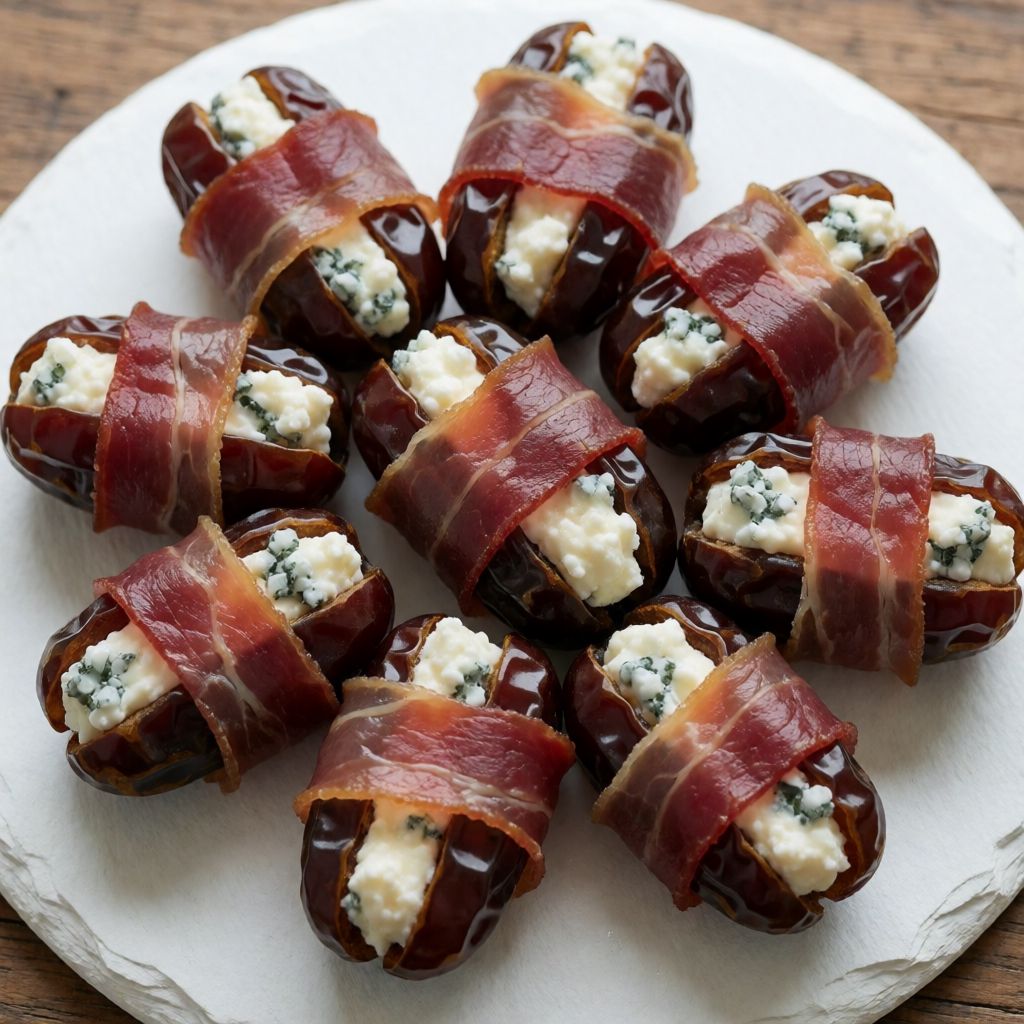
 AI photo
Dates with Blue Cheese and Serrano Ham
A simple antipasto: fresh dates stuffed with blue cheese and wrapped in serrano ham.
Labels are worked out automatically from the ingredients and can be wrong. Check the packaging if it matters to you.
Ingredients
- 6 pcs Dates
- 40 g Blue Cheese
- 50 g Serrano Ham


Steps
Make a slit along each date and remove the stone inside.
Put a little blue cheese inside and wrap each date in a slice of serrano ham.
This is not cooking, it is balance — three ingredients, no heat, and the whole dish lives or dies on the ratio between them. A date is sugar wearing skin. Blue cheese is salt and mould and fat. Serrano ham is salt and fat without the mould. Put them together in the wrong amounts and you get either a sweet that overwhelms, or a cheese that bullies the date into silence. Get it right and each bite does three things at once — gives, melts, chews — and that is the whole trick.
Some say you should warm these through, under a grill, just enough to soften the cheese and crisp the ham. No — because the moment you add heat you lose the exact contrast that makes this work. Cold-set blue cheese is dense and creamy against a date's chew; melted, it turns runny and loses its bite, and the ham, dried further by heat, goes leathery instead of giving. The whole point is textures staying separate in your mouth and meeting only on the tongue, not fused in a pan.
What actually decides whether this works is not technique — there is barely any — but choice of ingredient. A tired, dry date collapses under a knife instead of opening cleanly, and gives nothing back when you bite it; a weak blue cheese crumbles instead of yielding. Buy well here, because there's no cooking later to disguise a poor choice.
Serves 6 as a nibble before the proper food starts — one date each, maybe two if people are shameless about it, which they usually are.
Start with the date. You want one that's still slightly sticky to the touch, plump rather than wrinkled tight — medjool, usually, because it's the one sold properly ripe in most UK shops rather than the small hard pitted ones in boxes meant for baking, which have gone past soft into leathery. A good date takes a slit from a sharp small knife without tearing, and that matters: a torn date won't hold the cheese, it'll just weep it out the side once wrapped.
Blue cheese: what you need is one soft enough to push into the slit with the flat of a knife, not one that shatters into gravel. Stilton works well here and is the easy British answer — pick a piece that's creamy near the rind rather than the dry, crumbly centre of an older wedge. If stilton feels too aggressive for you, a dolcelatte is milder and spreads even more willingly. The test, always: can you smear it, or does it fall apart on the knife? If it falls apart, warm it a little on the counter — fridge-cold blue cheese is often just stiffer than it needs to be, not actually a different texture.
Serrano ham, in practice in a UK kitchen, is whatever thinly sliced dry-cured ham your shop carries — Parma is the obvious substitute and nobody at the table will mind. What you're actually buying is fat and salt in a wrapper thin enough to cling to a date without smothering it. Too thick a slice and it won't wrap tight — it'll spring back open, or sit as a separate lump of meat rather than a skin around the date. Ask for it sliced thin, almost see-through; that's not delicacy for its own sake, it's what lets the ham mould itself round an odd-shaped date instead of fighting it.
There's a history worth a sentence here, not a lecture: dates sweetened food in regions without easy sugar long before sugar was easy anywhere, and pairing them with cured pork and hard cheese is a tapas-bar economy — three shelf-stable things that keep well, assembled fast, sold cheap, no stove needed. That's also exactly why it suits you at home: nothing here asks for a kazan or a grill, just a knife and a counter.
The only patience required is this — once wrapped, let them sit a few minutes before eating, at room temperature if the cheese came straight from the fridge. Five minutes lets the cheese soften back toward spreadable and the ham's fat lose its chill, so the first bite doesn't feel like three cold separate things. It isn't a long wait. But it's the difference between a dish that's merely assembled and one that's actually ready.