
 AI photo
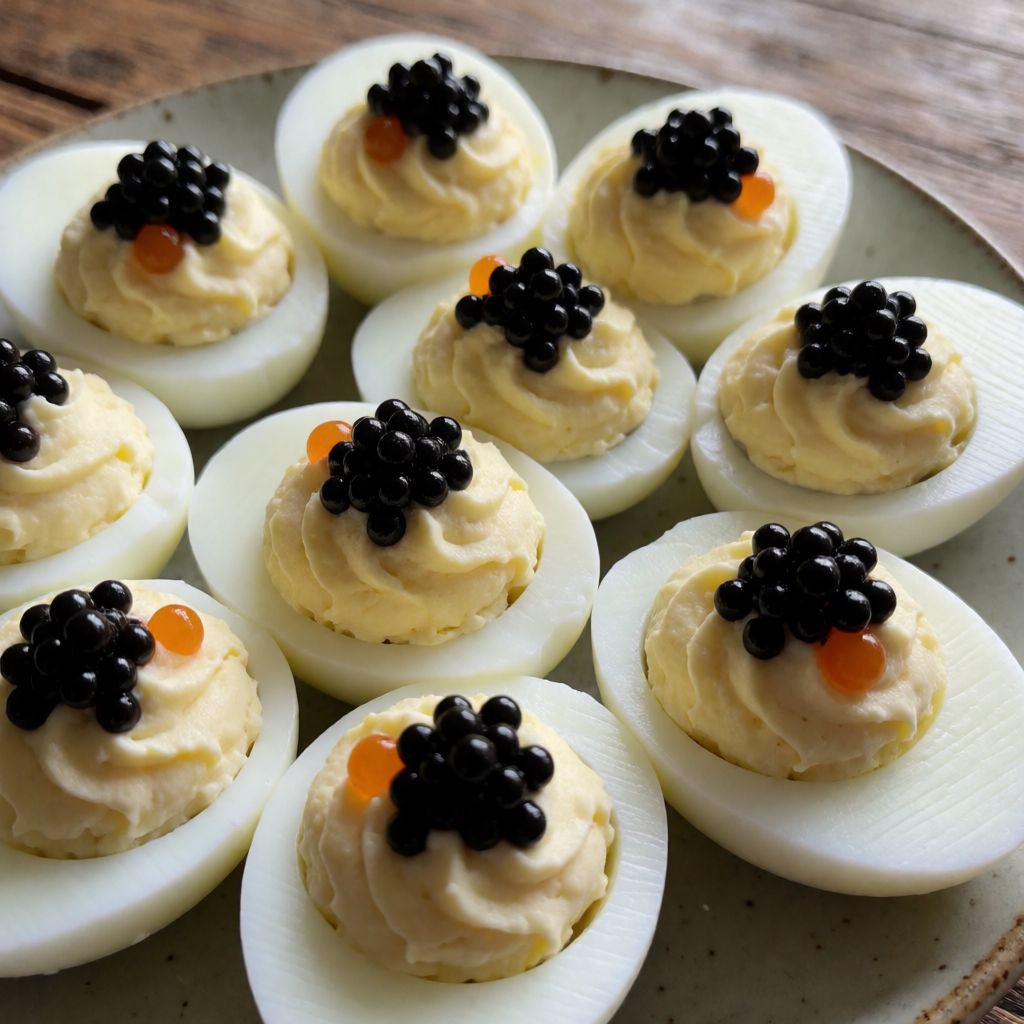
Stuffed Eggs with Roe
Creamy stuffed eggs topped with roe, a simple and elegant starter for any gathering.
Labels are worked out automatically from the ingredients and can be wrong. Check the packaging if it matters to you.
Ingredients
- 6 pcs Eggs
- 3 tbsp Mayonnaise
- 1 tsp Dijon mustard
- 50 g Lumpfish roe
- Salt
- Black pepper freshly ground
- 1 bunch Dill fresh, for garnish






Steps
Place the eggs in a pan of boiling water and cook for 9 minutes.
9 minCover the eggs with cold water and leave to cool.
Peel the eggs, cut them in half and carefully remove the yolks.
Set the egg whites aside on a serving plate.
Put the yolks, mayonnaise, Dijon mustard, salt and pepper on a plate and mash with a fork until smooth and creamy.
Gently fold the lumpfish roe into the cream, keeping a little aside for garnish, then transfer the mixture to a piping bag fitted with a star nozzle.
Pipe small swirls of the cream into the egg whites, and garnish with a little roe and dill.
What was changed
The original roe was swapped for Lumpfish roe, as it is easier to find in British supermarkets.
This is party food, not a meal: six eggs become twelve neat two-bite shells, each one holding back its own yolk, piped in as a cream and crowned with a few beads of roe. Twelve people, one bite each — that's the whole arithmetic of it. Nothing here should surprise you on the way in: no grey ring round the yolk, no rubbery white, no cream that slides off the spoon like wet flour.
What decides whether it works happens at two moments only, both before the mayonnaise ever gets near the bowl: the boil, and the stop of the boil. Everything after — mashing, mustard, roe, piping with a star tip — is dressing on top of a white and yolk that were either timed right or weren't. Get those two moments right and the rest is just assembly.
Some say a fresh egg makes a fresh dish, so always use the freshest eggs you can find. Not for boiling. A fridge egg that's sat a few days peels clean, in big calm sheets; an egg laid yesterday fights you shell fragment by shell fragment, because the white is still gripping the inner membrane tight. The grip loosens as the egg breathes out a little gas through the shell over days. So for this one, let the eggs sit before they see the pan — being a few days old here is a virtue, not a flaw.
Eggs: medium, uniform in size so your twelve halves sit level on the plate, and a few days old rather than fridge-fresh that morning, for the peeling reason already given. Doneness isn't a number you trust blindly — cut one open and look: the yolk should be one even pale yellow, firm enough to hold a knife mark but crumble, not rubber, when you press it with a fork. If it's chalky and dry at the centre, it went in too early or stayed too late — time is the floor here, not the ceiling.
Mayonnaise: this is the fat that carries everything else — salt, mustard, the smell of the roe — evenly through the yolk. Use a full-fat one; a "light" mayonnaise is mostly water and starch standing in for fat, and the cream it makes won't hold a swirl, it'll slump. If you've genuinely none in the house, soft butter loosened with a spoon of cream and a few drops of lemon does a similar job of binding fat to acid, though it won't taste quite like this dish anymore.
Dijon mustard: not for heat, for cutting. Egg yolk and mayonnaise together are a wall of fat, and the mustard's sharp acidity is what stops that wall tasting flat. English mustard will do the same job but it's considerably hotter, so use about half the amount if that's what's in your cupboard.
Lumpfish roe: small, dyed, cheap — and that's not a criticism, it's the whole reason it's on this plate instead of real caviar. It's the roe of a Northern fish, salted and coloured, sold as the affordable stand-in for sturgeon caviar that British party trays leaned on from the cocktail-party years onward, when nobody serving twelve people at a Sunday drinks do was buying actual beluga. What you want from it is pop and salt, not deep flavour — sturgeon caviar's subtlety would be wasted here anyway, drowned in mayonnaise. So the criterion for substituting is: any small, firm roe that bursts and tastes of brine. Keta or salmon roe works, bigger and orange rather than black. Fold it in gently, with a spoon turned over, not stirred hard — crush the pearls and the dye bleeds, and you get a muddy pink cream instead of a jewelled one.
Dill: fresh, not dried. Dried dill has given up its oil to the air in the jar and tastes mostly of hay — it won't cut through the richness the way a few torn fresh fronds will. No dill, use chives; they give green bite without arguing with the fish.
One more thing worth saying plainly: rest the yolk cream a few minutes before you pipe it. Straight off the fork it's often too soft to hold a star shape and will slump flat on the white, which looks like you didn't try. A star nozzle is only for looks — if you've no piping bag, a freezer bag with one corner snipped off does exactly the same job, and a plain spoon works too, it just won't stand up as proudly.