
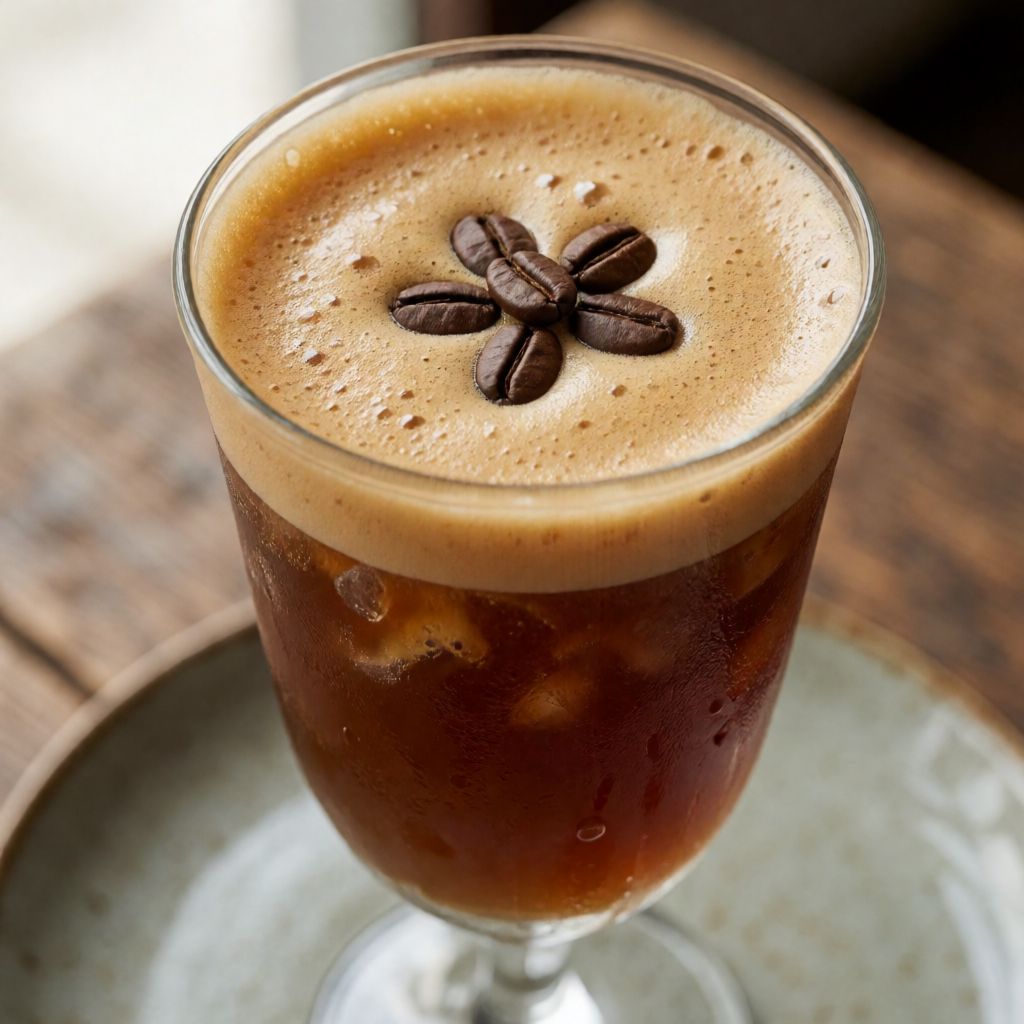
 AI photo
Caffè Shakerato
A bold Italian iced coffee cocktail, shaken hard with sugar and ice until frothy, then served in chilled glasses.
Labels are worked out automatically from the ingredients and can be wrong. Check the packaging if it matters to you.
Ingredients
- 3 pcs Coffee freshly brewed, hot
- 7 pcs Ice cubes
- 3 tsp Liquid cane sugar
- 3-4 pcs Coffee beans for garnish




Steps
About half an hour before preparing, put two martini glasses and a shaker in the freezer.
30 minTake the shaker out of the freezer, add the ice cubes, then pour in the hot coffee and the liquid sugar.
Shake vigorously for at least 20 seconds, or blend briefly in a blender.
Pour the drink into the chilled glasses, holding back the ice with a teaspoon.
Garnish with coffee beans.
Shakerato is espresso's answer to a summer that gets too hot for a proper cup: cold, foamed coffee with no milk, no cream, built entirely by shaking hot coffee against ice until it turns pale and silky on top. What decides whether it works isn't how hard you shake, it's the temperature gap. Hot coffee hitting ice creates the violent turbulence that builds the foam, the way a kettle poured too fast spits steam. Lukewarm coffee onto ice just gives you weak iced coffee with nothing sitting on top of it — drinkable, but not this.
Some say you need an actual cocktail shaker to do this properly — no, because what matters is a sealed container you can thrash about, not the name stamped on the side. A jam jar with a tight lid, shaken like you mean it, does the same job. A blender on a short pulse works through the same mechanism: agitation whipping air into a liquid that, thanks to coffee's oils and dissolved solids, can actually hold that air as foam. Shake plain water the same way and it just goes flat again. Coffee doesn't, and that's the whole trick.
Chilling the glasses first isn't fussiness, it's physics working for you instead of against you. A room-temperature glass warms the surface of the drink the second it's poured, and the foam you just built collapses before it reaches the table. Thirty minutes in the freezer, glass stings when you touch it — that's the cue, not the clock on the wall.
Coffee has to be strong, and it has to be hot, in that order. Strong because ice is going to melt into it whether you like it or not, and weak coffee diluted twice over becomes watery nonsense. Hot because the thermal shock against the ice is what drives the turbulence — pour already-cold coffee over ice and shake, and you get cold diluted coffee with a thin skin on it, not the thick tan cap this drink is known for. Espresso is the obvious choice because it starts concentrated, but a strong stovetop or moka brew does the same job if you make it deliberately stronger than you'd drink it black on its own.
The ice is doing two jobs at once: cooling the coffee down fast, and melting a little into it to bring the strength back from espresso-concentrate to something you can actually drink. Seven cubes for two glasses sounds like a lot until you remember some of that ice is meant to vanish into the glass as water — that's the plan, not an accident. Don't count cubes religiously; look at the poured drink instead. Thin and watery means you went heavy on melt and light on coffee.
Liquid cane sugar earns its place for one reason: it dissolves into something about to go very cold, and ordinary granulated sugar does not dissolve in cold liquid — it just sits at the bottom, gritty and sulking. If you've no liquid sugar in the cupboard, stir ordinary sugar into the coffee while it's still hot, before it meets the ice at all — same result, one extra step, no special syrup needed. Any plain sugar syrup will do; nothing with a flavour of its own, you're not building a different drink by accident.
The coffee beans on top aren't decoration pretending to be more than that — they float on the foam because they're light enough to, and they give you one more pass of roasted smell as you lift the glass. Skip them and nothing about the drink itself changes, only the photograph of it.
If tea with milk is your habit, resist the pull to soften this with anything dairy. The foam here isn't cream standing in for milk — it's just coffee and air, whipped together by the shaking, nothing poured in afterwards. Milk collapses that foam and turns the whole thing into a lesser drink: iced coffee with ideas above its station.
This exists because Italian bars in August already had two things sitting on the same counter — an espresso machine and a cocktail shaker, kept for the aperitivo crowd next door. Someone shook the two together rather than inventing new kit, and that's really the entire history of it. Not ceremony. A bartender solving the problem of hot espresso in heat nobody wanted to drink it in.