
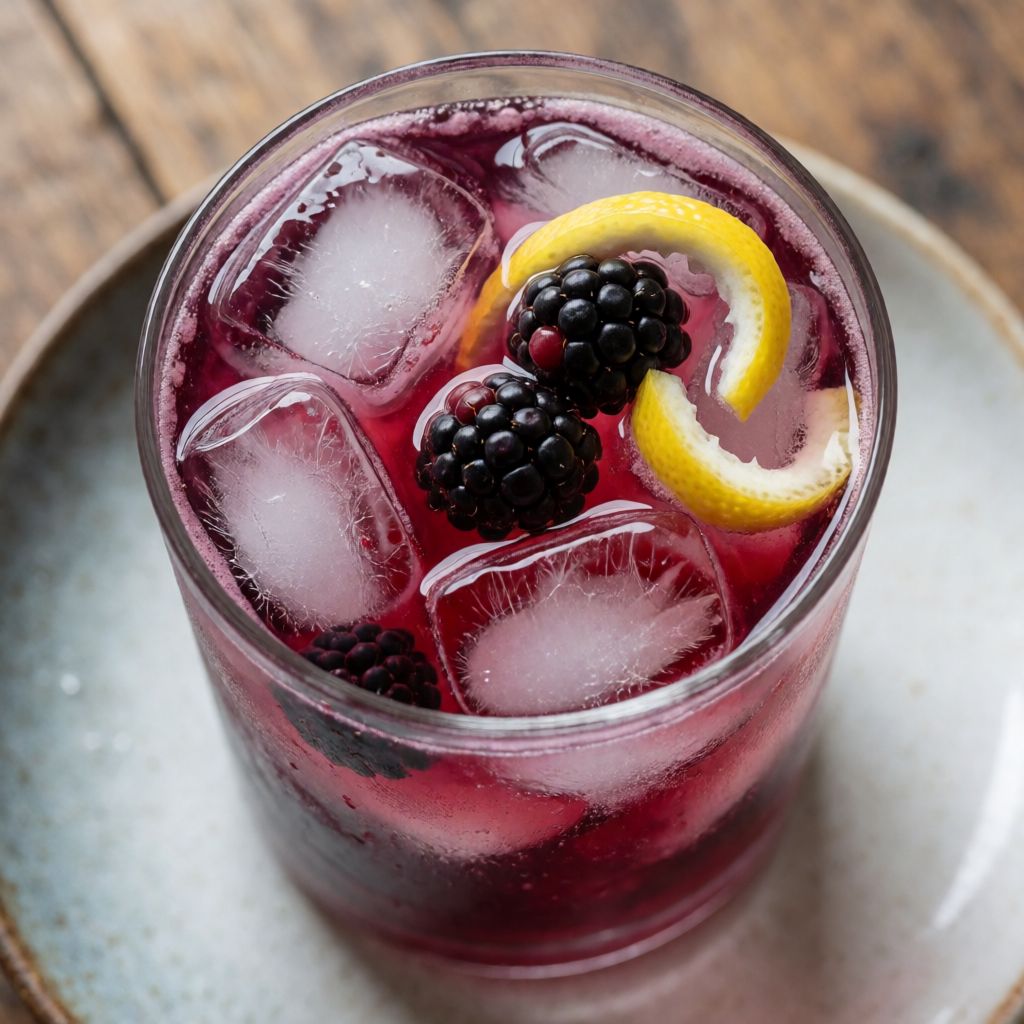
 AI photo
Gin and Blackberry Cocktail
A refreshing gin cocktail with blackberry syrup, fresh lemon juice and crushed ice.
Labels are worked out automatically from the ingredients and can be wrong. Check the packaging if it matters to you.
Ingredients
- 50 ml Gin
- 2 tbsp Lemon juice freshly squeezed
- 2 tsp Sugar syrup
- 4 tsp Blackberry syrup
- 200 ml Crushed ice
- 3 pcs Blackberries
- 0.5 pcs Lemon slice



Steps
Pour the gin, lemon juice and sugar syrup into a cocktail shaker with ice, then shake well.
2 minFill a glass with crushed ice and strain the shaker's contents over it.
1 minSlowly pour the blackberry syrup down the back of a spoon.
1 minGarnish with blackberries, a lemon slice and a straw, adding extra crushed ice if needed.
1 min
This is a gin sour wearing a cocktail bar's party clothes — lemon for acid, syrup for sweetness, gin for bite, and a spoonful of blackberry poured in afterwards so it sits as a dark line instead of vanishing into the drink. What decides whether it works isn't the garnish, it's the first ten seconds in the shaker: how cold you get it and how much water comes off the ice while you do it.
Shaking is not for show and it doesn't "bruise" the gin — that myth belongs to muddled herbs, not clear spirits. What shaking actually does is two jobs at once: it chills the liquid fast by smashing it against ice, and it lets a little of that ice melt into the drink on purpose. That melted water is not a flaw, it's a third of the recipe you can't measure with a spoon. Too little shaking and the drink is warm and sharp; too much and it's watery. You're aiming for the shaker going properly cold to the touch — your hand telling you what a thermometer would.
Then you strain it over fresh crushed ice, not the ice you just shook with. That first ice is already half-melted and tired — it's done its job of chilling and diluting. The second lot, crushed small, has far more surface touching the drink than a cube would, so it keeps cooling the glass steadily as you drink rather than sitting there inert. That's the whole reason for crushed ice over cubes here: more surface, faster cold, at the cost of the drink thinning out if you let it sit too long. Drink it, don't admire it.
Gin: pick a dry, juniper-led one — nothing pre-sweetened or already flavoured with fruit, because you're adding your own sweetness and your own fruit, and two flavoured things fighting in one glass rarely ends well. No gin in the cupboard? Vodka will hold the cold-sour-sweet shape of the drink but you lose the bitter herbal backbone that makes it a gin sour rather than just a sour.
Lemon juice has to be fresh-squeezed, and this is where people cut corners with a bottle from the fridge door. Bottled juice is kept stable with preservatives that flatten the sharp top note — it still tastes of lemon, just a duller, one-dimensional version of it. Squeeze it yourself; it takes less time than finding the bottle. Lime will do the same acid job in an emergency, with a slightly different, greener edge.
Sugar syrup exists for a reason that has nothing to do with bartending ritual: granulated sugar does not dissolve properly in a cold, shaken drink. Chuck in a teaspoon of sugar and you'll find half of it sitting gritty at the bottom of the glass, because cold liquid dissolves sugar slowly and you're only shaking for a couple of minutes. Syrup is just sugar that's already done its dissolving in hot water, so it mixes in instantly however cold the drink is. Make your own — equal parts just-boiled water and sugar, stirred till clear, cooled, kept in the fridge for weeks — and you'll never buy it again.
Blackberry syrup is doing two jobs: colour, and a tart edge against all that sweetness. Any dark berry syrup with real sharpness in it will stand in — blackcurrant cordial used neat rather than diluted, crème de mûre, or your own blackberries simmered down with a little sugar and pushed through a sieve to catch the seeds. Avoid anything that's mostly citric acid and food colouring; it'll look right and taste thin.
Crushed ice is the one place a British kitchen shows its limits — most freezers here make cubes, not snow. Bag a few cubes in a clean tea towel and go at them with a rolling pin; it's loud, it's a bit daft-looking, and it works. Don't skip the crushing and just drop cubes in — you'll have cold spots and warm spots in the same glass instead of even chill throughout.
The blackberries and lemon slice on top aren't only for looking nice in a photo — bite a blackberry mid-drink and you get a concentrated hit of what the syrup only hints at, and the lemon slice sits near your nose with every sip, which does more for the smell of the drink than for the taste. Small things, but they're there to be used, not just admired.