
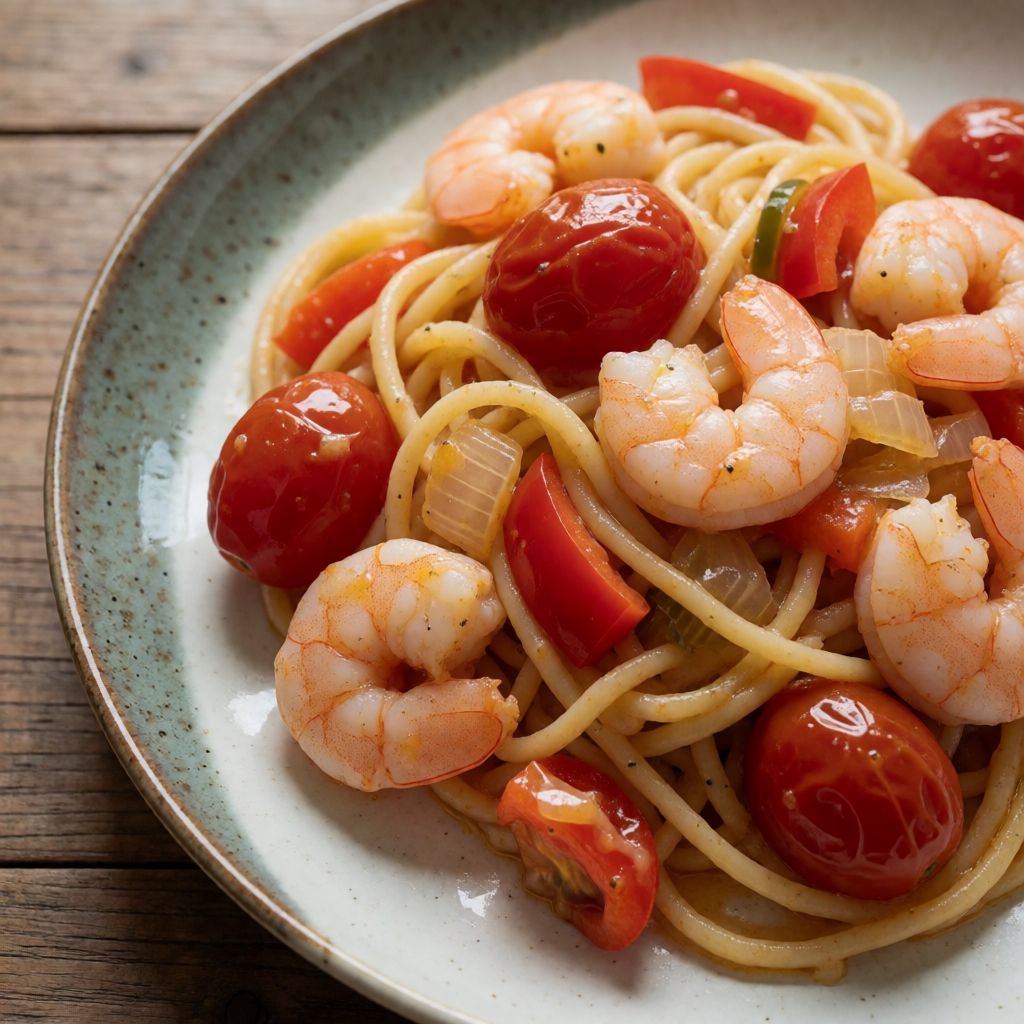
 AI photo
Mezze Maniche with King Prawn Sauce
A quick Italian-style pasta tossed in a spicy prawn and cherry tomato sauce.
Labels are worked out automatically from the ingredients and can be wrong. Check the packaging if it matters to you.
Ingredients
- 500 g Mezze Maniche
- 300 g King Prawns
- 6 pcs Cherry Tomatoes
- 2 pcs Dried Red Chilli
- 1 pcs Onion
- Vegetable Oil to taste
- Salt to taste
- Parsley to taste






Steps
Bring a large pot of water to the boil for the pasta.
In a wide frying pan, heat the oil and fry the dried red chilli together with a piece of onion, taking care they don't burn, then remove them and put them in a mortar.
3 minRemove the piece of onion, add the fresh cherry tomatoes cut into quarters and a little salt.
Cover with a lid and wait two minutes.
2 minTake the king prawns, cut them in half and add them to the pan with the tomatoes. Crush the chilli and add it to the sauce.
Cook for 5 minutes, drain the pasta and tip it into the pan with the sauce, tossing to combine the ingredients.
5 minToss well and serve hot.
What was changed
Mantis shrimp has been replaced with King Prawns, which is easier to find in British shops.
This is a shellfish arrabbiata stripped down to its working parts: oil made hot and fragrant with chilli and onion, a few tomatoes collapsed into a loose sauce, prawns dropped in right at the end so the sweetness stays in them and not in the pan, then tube pasta tossed through to carry it all. Mezze maniche — "short sleeves" — are cut the way they are so the ridges and the open tube trap sauce rather than let it slide off, which matters more here than with a smooth noodle, because this sauce is thin and wants somewhere to sit.
What decides whether it works is sequence, not skill. The chilli and onion go into the oil first and come out before anything else goes in — that's not decoration, that's because capsaicin and onion's sulphur compounds dissolve into fat, and fat carries flavour further than water does. Leave them in the pan past that point and they scorch, and scorched chilli tastes of ash, not heat. The tomatoes go in next and get a lid — or a plate, since most flats don't have a lid that actually fits a wide frying pan — because they need to steam in their own liquid for those two minutes, not fry dry and leather at the edges.
A note on the servings line before anything else: it says 1, which can't be right — 500 g of pasta and 300 g of prawns is a dish for four people with a decent appetite, maybe three if someone's greedy. Worth flagging because a single diner following this literally would end up with three days of leftover pasta and no clear idea why.
On the oil: "vegetable oil" here is doing a job, not adding a flavour, so the real criterion is any oil with no smell of its own — sunflower, groundnut, a flavourless rapeseed. Extra virgin olive oil is the wrong tool at this stage even though it feels more "Italian": heated hard enough to fry chilli without burning it, a good olive oil's own bitterness comes forward and sits on top of the prawn's sweetness instead of under it. Save the good oil, if you have one, for drizzling at the very end, off the heat, where its flavour actually gets tasted rather than cooked off.
Dried red chilli: the heat lives in the pale pith around the seeds, not the seeds themselves — people shake the seeds out thinking they've saved themselves, and mostly they haven't, because the membrane is still there doing the work. Frying it whole in the oil, then crushing it in a mortar afterwards, is the point where the heat gets spread evenly through the sauce instead of concentrating in whoever bites the one piece of chilli that didn't dissolve. No mortar — the flat of a knife blade on a board, or the back of a spoon against the side of a bowl, does the same job: rupture the cell walls, release what's inside. If you've only got chilli flakes, use them, but add them straight to the oil rather than trying to fry and crush something that's already in pieces.
Onion here isn't a base that stays in the dish, which is worth saying because most people's instinct is to fry onion and leave it. It's taken out once it's given the oil its sweetness, because by the time the tomatoes and prawns are ready, a long-fried piece of onion would have gone past soft into bitter and would do nothing for the sauce except get in the way. If you leave out the onion entirely you lose a little of that rounded sweetness underneath the chilli heat, but the dish still stands — it just reads a touch sharper.
Cherry tomatoes, cut in quarters: the small, sweet, thin-skinned kind is chosen because it collapses into sauce inside two minutes under cover, which a large, thick-walled tomato won't do — you'd either undercook it or need twice the time and lose the quick-sauce logic of the whole dish. No cherry tomatoes, use the ripest, smallest tomatoes you've got, or a small tin of good chopped tomatoes with most of the liquid drained off, since what you want is concentrated sweetness and body, not extra water to boil away on a domestic hob that won't give you the fierce, even heat of a professional stove.
Prawns: raw, not pre-cooked, is what this recipe needs, because pre-cooked prawns only have one direction left to travel, which is overdone. Frozen raw king prawns, defrosted properly rather than tipped in icy, work as well as fresh — just pat them dry first, because water hitting hot oil is how you get a sauce that spits and thins out. Cutting them in half isn't only about stretching 300 g across four portions, though it does that too; halved prawns cook through in the same couple of minutes the sauce needs to finish reducing, so the pasta, sauce, and prawns all arrive done at the same moment instead of you juggling timers.
And a word on why there's no cheese here, since it's the question someone always asks about seafood pasta: hard, salty cheese brings a fat and a saltiness that sits over the top of shellfish and tomato and mutes exactly the delicate, briny sweetness the whole dish exists to deliver. It's not superstition, it's just that two strong, competing flavours cancel each other out, and this dish only has room for one. Patience is the other ingredient nobody lists: the two minutes under the lid, the gentle few minutes the prawns need — rush either and you're eating something closer to boiled seafood with tomato on the side.