
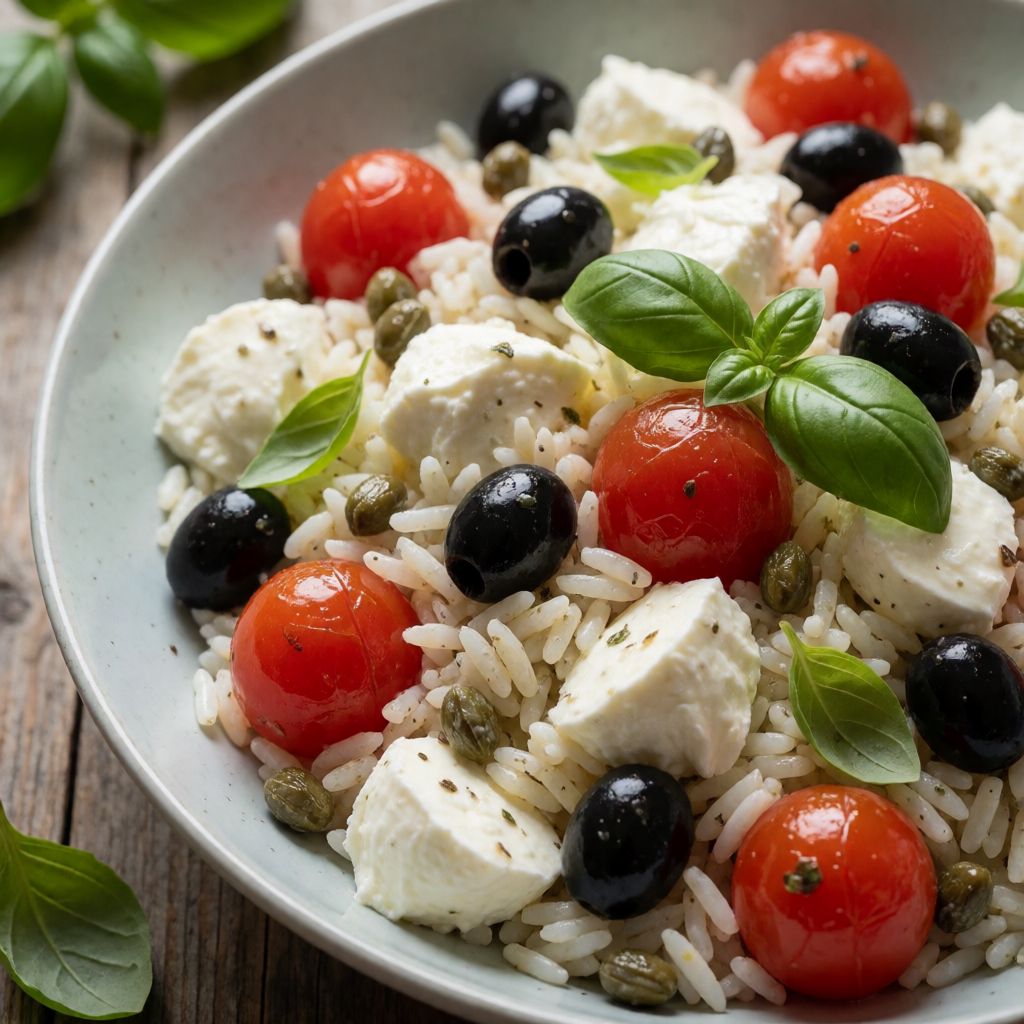
 AI photo
Mediterranean Rice Salad
A light Mediterranean-style rice salad with mozzarella, cherry tomatoes, olives, capers and basil.
Labels are worked out automatically from the ingredients and can be wrong. Check the packaging if it matters to you.
Ingredients
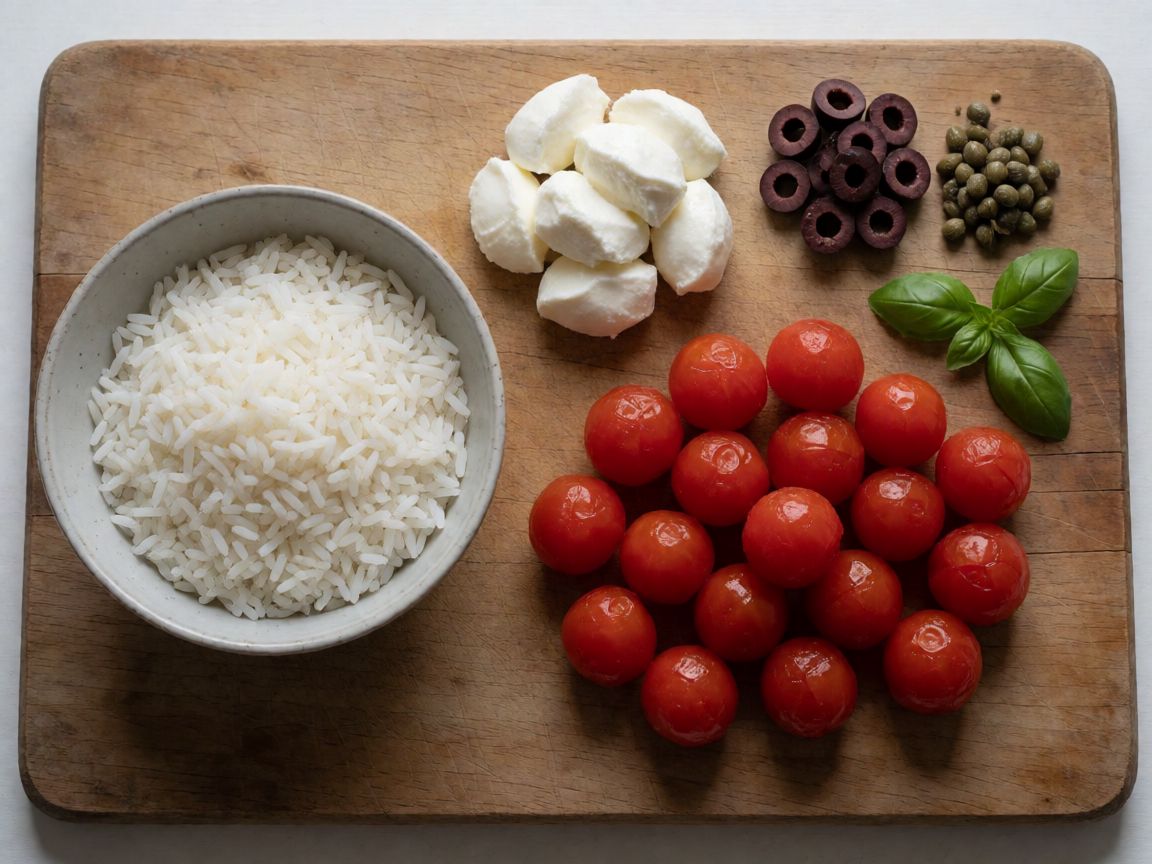
- 200 g Arborio or parboiled rice
- 200 g Mozzarella
- 15-20 pcs Cherry tomatoes
- 30 g Black olives, pitted
- 1 tsp Capers
- 6 pcs Basil leaves torn by hand
- Salt to taste
- Olive oil to taste








Steps
Cook the rice in salted boiling water, following the time stated on the pack.
While the rice is still slightly firm, drain it and rinse under cold water to stop the cooking.
Transfer the cooled rice to a large bowl.
Cube the mozzarella and rinse the cherry tomatoes, cutting them into quarters.
Add the mozzarella, tomatoes, olives, capers and the basil leaves, torn by hand, to the rice.
Mix well and chill in the fridge for 30 minutes to let the flavours combine.
30 minDrizzle with olive oil just before serving.
This is a cold rice salad built like a deconstructed Caprese: grains standing in for bread, mozzarella and tomato still doing the job they'd do on a plate with basil and oil. Rice is the only thing that meets heat — everything else goes in raw, and nothing gets cooked at the end.
What decides whether it holds together, literally, is the moment you drain the rice. Pull it while it's still a touch firm, then shock it under cold water straightaway. That rinse does two jobs at once: it stops the cooking (residual heat would keep softening the grains on the counter) and it washes off the surface starch — which is exactly what glues grains into one lump as they cool. Skip it, and by the time you open the fridge thirty minutes later you have rice porridge wearing tomatoes.
Some cooks treat rinsing cooked rice as heresy — and they're right, for a risotto or a pilaf, where that starch is the whole point, the thing that makes the sauce cling. This is the opposite dish. It wants cold, separate grains that don't stick to each other or to anything else, so here rinsing isn't a shortcut, it's the correct move.
The chill afterwards isn't dead time, it's the step where this turns from a diced inventory into a salad: salt moves off the surface and into the rice, the oil — added only at the very end — stays bright instead of going flat and oily, and the mozzarella firms back up after being cut so it doesn't collapse to paste under a fork. Thirty minutes is a floor, not a deadline. Longer never hurts it; shorter, and it still tastes like separate ingredients that happen to share a bowl.
Arborio or parboiled — the recipe gives you a choice because they solve the same problem two different ways. Arborio is bred to carry a heavy coat of starch on the outside of each grain; that's what makes risotto creamy, and it's exactly why, used cold, it needs that rinse — without it the same starch turns against you and glues everything shut. Parboiled rice (sold in the UK as easy-cook, on every bag in the supermarket) has already been steamed under pressure before milling, so its starch sets inside the grain rather than on the surface — it comes out of the pot naturally separate, more forgiving if you time it slightly wrong. If you're using neither, the test is simple: any rice that holds its shape cold and doesn't turn gluey. Pudding rice and sushi rice are bred for stickiness — wrong tool. Basmati will do at a pinch, though it's drier and won't carry the dressing as well.
Mozzarella means the fresh kind sold in its own brine, not the dry block bred for pizza, which exists to melt and stretch in an oven and has no job to do cold. You want a cheese that's wet, mild, gives a little resistance to the knife, and weeps a bit of milk when you cut it — that weeping is the criterion. Short of it, a young feta or mild bocconcini does the same cool, salty, crumble-under-the-fork work.
Quarter the cherry tomatoes rather than halving them — not for how it looks on top, but because more cut surface means more juice bleeds into the rice while it chills, seasoning it from the inside rather than sitting on top as decoration.
Olives and capers are both concentrated salt-and-acid, and the small quantities are deliberate: olives bring fat and a bitter edge, capers a sharp vinegar snap. Push past what's written and they stop seasoning the salad and start being the salad. Out of capers, a few chopped cornichons or even some lemon zest gives a similar sharp jolt, though not quite the same bite.
Olive oil goes on last, not before, and that's not fussiness — cold oil, left to sit in the fridge for thirty minutes, partly sets and turns sluggish, and whatever flavour it has gets absorbed into the rice before you ever taste it on your tongue. Added at the end it's still fluid, still smells of itself, and you taste it rather than just feel it. For once the usual rule — pick any oil with no smell of its own — is the wrong advice: nothing here is cooked to carry flavour for you, so you want an oil with character, a decent extra virgin.
Salt the rice water the way you'd salt pasta water, seasoning once from the inside rather than patching it on at the end. There's no deeper tradition behind this dish than convenience — it's a make-ahead salad, built for the day you don't want the hob on at lunchtime, borrowing the flavours of a Caprese and turning them into something that travels, keeps, and stretches a cup of raw rice into lunch for four. That's the real economics of grain salads generally: cheap bulk, expensive flavour, no reheating required. And no kazan needed either — a colander and a bowl that fits in your fridge is the whole of the kit.