
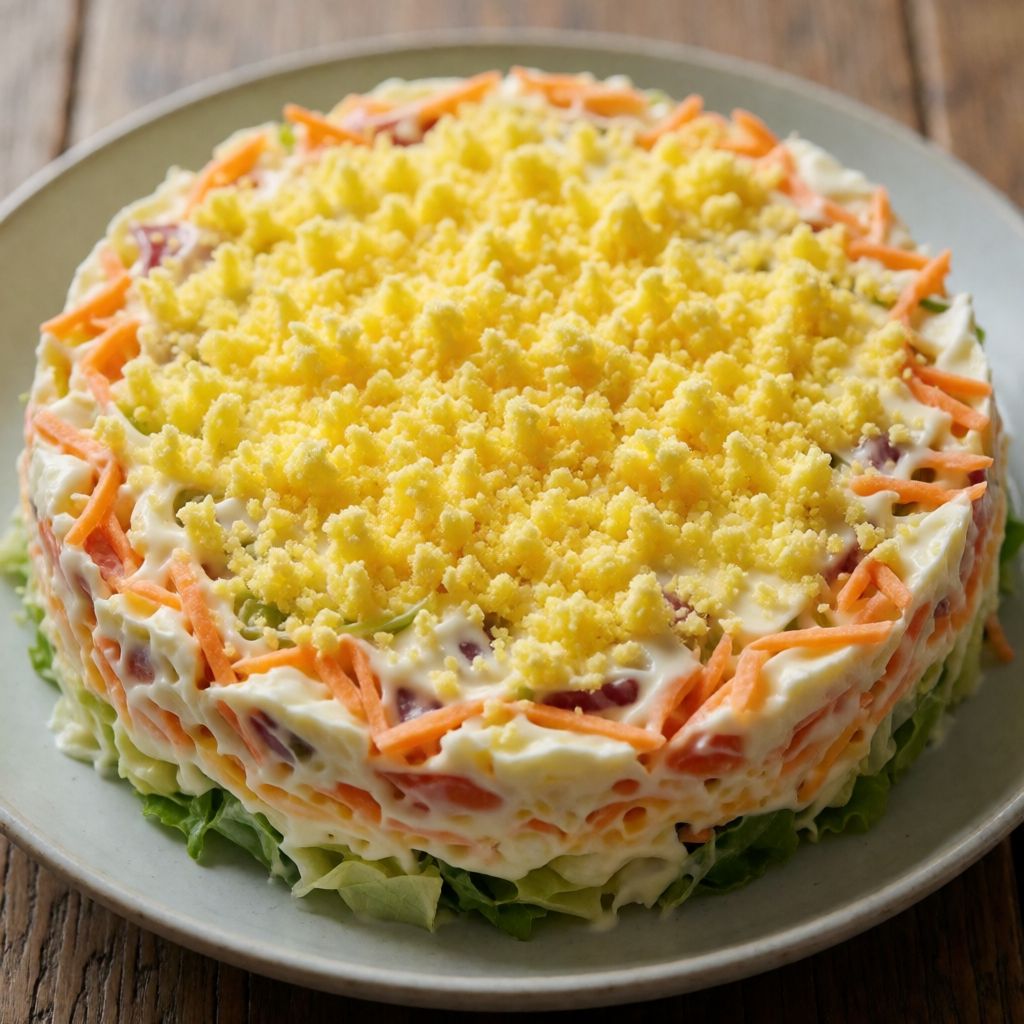
 AI photo
Mimosa Salad
A layered potato, carrot, egg and tuna salad topped with a sunny pattern of egg yolk and white.
Labels are worked out automatically from the ingredients and can be wrong. Check the packaging if it matters to you.
Ingredients
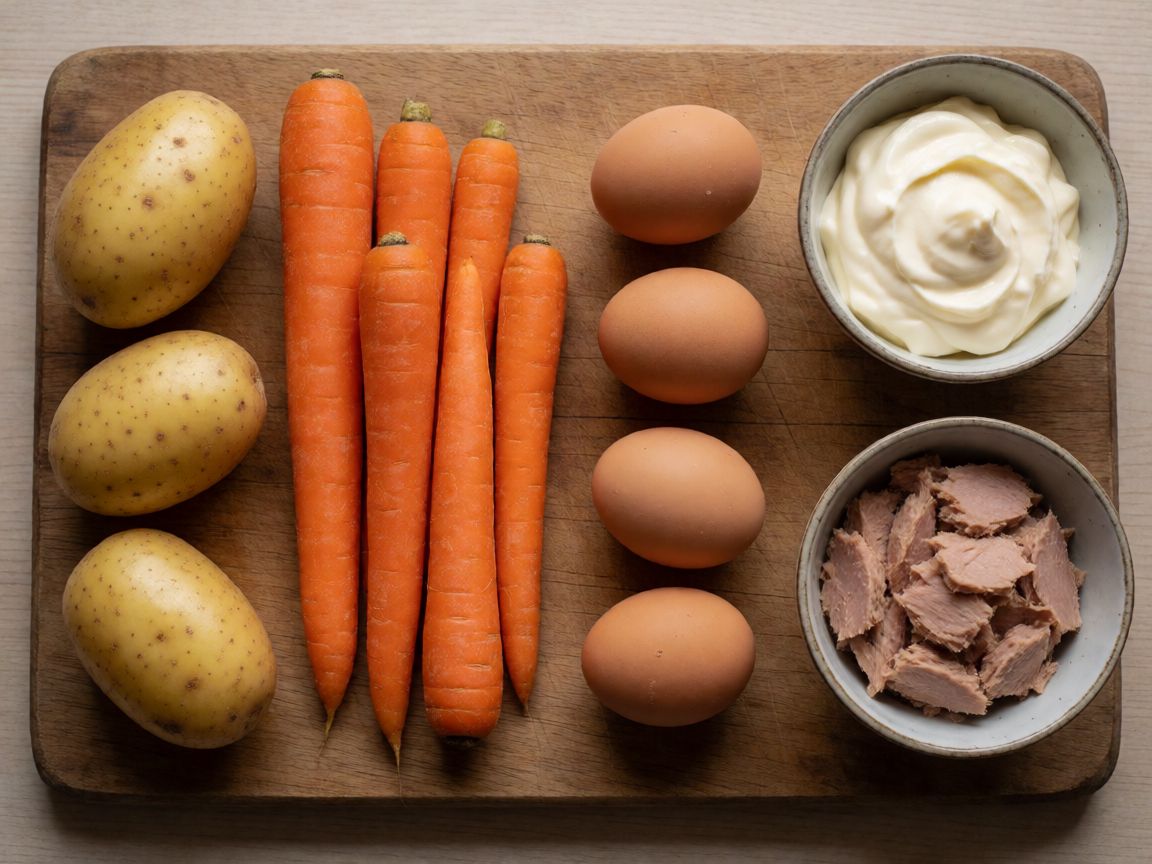
- 4 pcs Potato
- 5 pcs Carrot
- 6 pcs Egg hard-boiled
- 500 g Mayonnaise
- 250 g Tuna canned

Steps
Set aside one carrot and three eggs for garnish.
Cut the remaining vegetables into large cubes.
Arrange the ingredients in layers in a clear glass bowl, starting with the vegetables.
Layer in this order: potato, tuna, mayonnaise, carrot, tuna, mayonnaise, egg, tuna, mayonnaise, potato.
Grate the egg whites using the coarse side of the grater, and crumble the yolks.
Form a 'sun': yolks in the centre, whites around them.
Make carrot flowers and place them on top.
Mimosa is not a salad you toss — it's a salad you build, like a wall, and the whole dish depends on each layer staying a layer. Cut into it with a spoon and you should see stripes: potato, fish, mayonnaise, carrot, fish, mayonnaise, egg, fish, mayonnaise, potato, each one distinct. That's the engineering of it. Lose the stripes and you've just made expensive tuna mayonnaise.
What decides whether it holds together: water. Potato, carrot, tuna, egg — every one of them can weep liquid into the mayonnaise, and mayonnaise has no defence against that. It loosens, slides, and by the time you serve it the stripes have slumped into a beige pond. So the real craft here is drainage and cooling, not seasoning — get the tuna bone-dry, cool the vegetables right through before a knife touches them.
The crown — the yolk-and-white 'sun', the carrot flowers — isn't decoration for its own sake. It's the only clue the diner gets before cutting in. Hidden inside, the salad is just geology; the top is the only part that announces what this is.
Some say mimosa must be made with canned salmon or sprats, never anything humbler — no, because the dish was born from using whatever tinned fish sat on the shelf in winter. Tuna does the job on the same terms.
Start with the potato and carrot, because they set the rule for everything after them: boil them whole, in their skins, in water that's properly on the boil, not a shy simmer. The skin is a seal — peel and chop them raw before boiling and they drink water like a sponge, and that extra water is exactly what turns your mayonnaise to soup three hours later. Judge doneness by feel, not a clock: a knife point should slide into the potato with no resistance, and a fork should bend the carrot, not snap it. Then — and this is the part people skip — let them go properly cold before you peel and cube them. Warm vegetables melt the mayonnaise on contact, and that's where the weeping starts.
Cube large, not small. It feels wasteful when you're used to chopping everything fine, but a small cube loses its shape under the weight of the layers above it, and the whole thing mashes into one texture the moment you cut through. Large pieces keep their edges, and the edges are what make the cross-section read as layers instead of paste.
The tuna is the other weak point. Drain it hard — tip the tin, press the fish against the side with a fork, squeeze out everything you can. Canned fish carries brine or oil that mayonnaise cannot absorb; it just sits there and leaks sideways through your layers. If tuna isn't to hand, any firm, mild tinned fish works on the same logic — canned salmon, mackerel, even sardines with the backbone picked out — as long as it's drained hard and flaked, not left wet.
On the mayonnaise: buy full-fat, something thick enough to hold a ridge on the back of a spoon. 'Light' mayonnaise is mostly water with an opinion, and in a dish built entirely on water control, that's the wrong tool for the job. Five hundred grams sounds like a lot for six people, but it's spread thin across four separate layers of binding, not spooned on top — split it mentally into quarters before you start so you don't run short on the last layer.
The eggs do double duty: three go into the body of the salad as a layer, three are kept whole for the top. Grate the whites on the coarse side of the grater, because that texture holds mayonnaise like gravel holds water — it won't go slick and shiny. The yolks you crumble by hand or push through a sieve, because that dry, fine, yellow fluff is what gives the dish its name — it should look like the mimosa flower, not like chopped egg.
Patience is the ingredient nobody writes on the list. Build the salad, then put it in the fridge and leave it alone — a few hours at least, overnight if you can manage it. That rest is what lets the mayonnaise actually bind each layer to the one beneath it, instead of just sitting on top like a lid. Cut it straight after building and you get collapse, not stripes. This isn't a dish you rush to the table; it's one you plan backwards from the hour you want to eat it.