
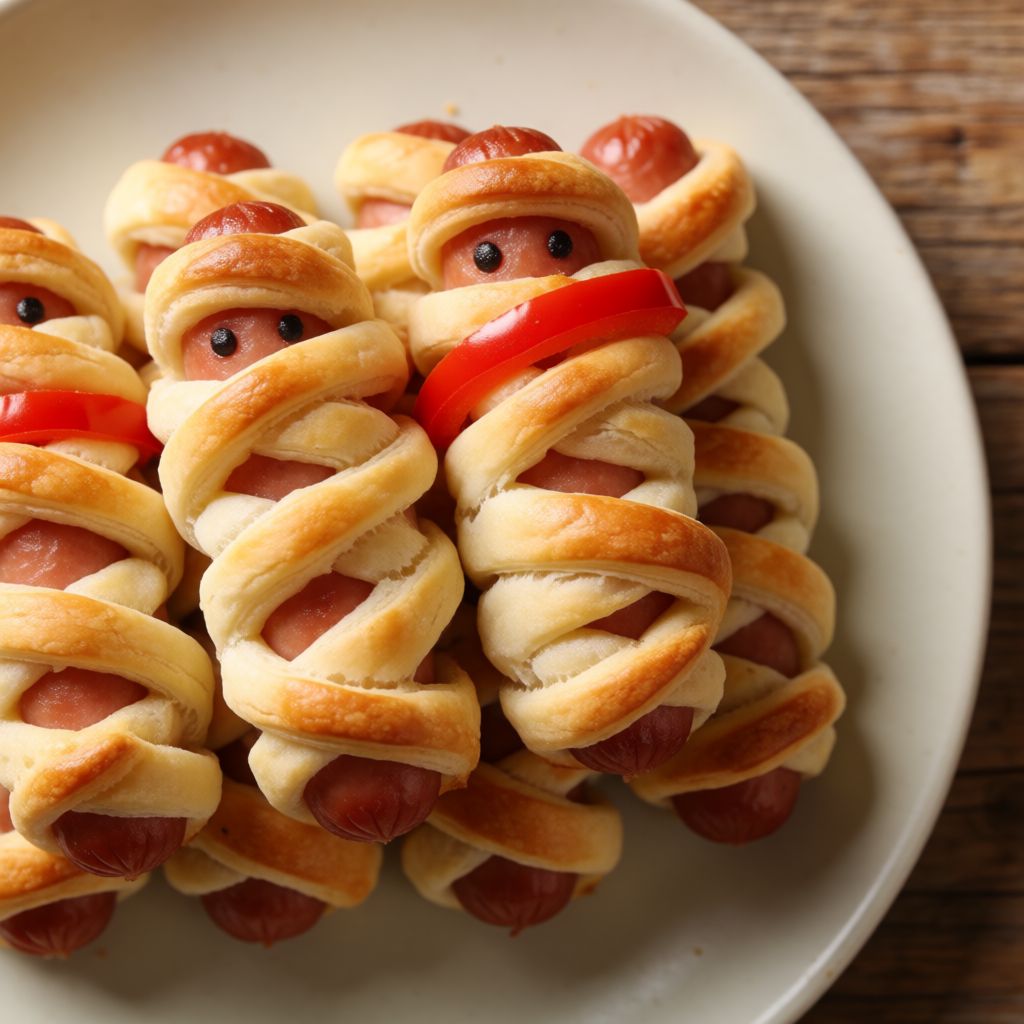
 AI photo
Sausage Mummies for Halloween
Fun puff pastry sausage mummies with clove eyes, a playful Halloween snack for the whole family.
Labels are worked out automatically from the ingredients and can be wrong. Check the packaging if it matters to you.
Ingredients
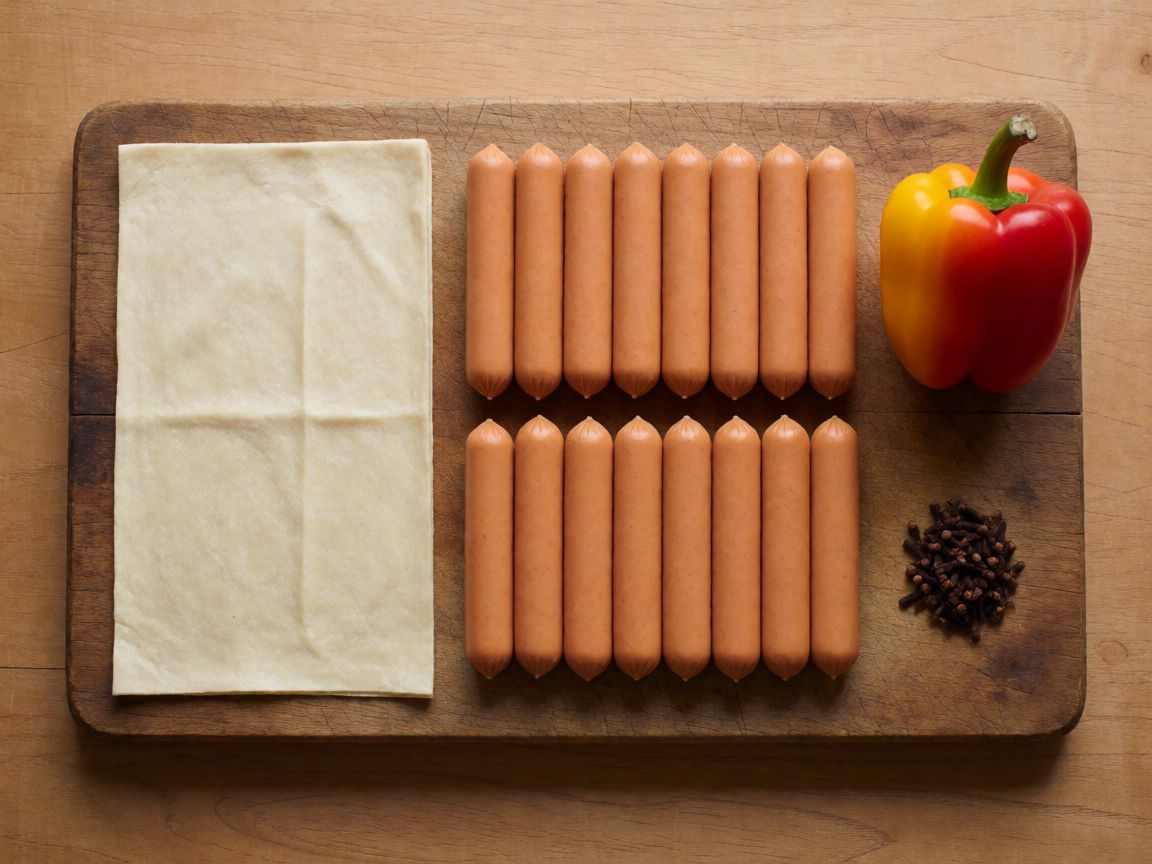
- 1 pcs Puff pastry
- 15 pcs Frankfurter sausages
- 1 pcs Pepper
- Cloves to taste


Steps
Unroll the puff pastry and cut it into strips about half a centimetre wide.
Wrap each sausage with a strip of pastry in a spiral, leaving a small gap uncovered at one end.
Brush the pastry with beaten egg yolk for a nice golden finish.
Bake in a fan oven preheated to 180°C until golden brown.
25 minDecorate with cloves to form the eyes, then serve.
These are cocktail sausages dressed up as mummies for Halloween, and this isn't Sunday roast food - 15 sausages and one sheet of pastry stretches to about 8 people as a nibble to pick at, not a meal to sit down to. The whole dish lives or dies on one mechanical fact: puff pastry puffs because steam is trying to escape between layers of butter and flour, and it pushes hardest wherever the resistance is weakest. Leave a gap in the spiral at one end and that gap becomes the face - the sausage tip peeking through, which you then give eyes with two cloves. That gap isn't decoration for its own sake; it's doing a job, letting the wrap read as a bandaged mummy instead of a blind white parcel.
What decides whether this looks like bandages and not a sad white slug is the width of your strips and how tight you wind them. Thin strips - about half a centimetre, think shoelace, not ribbon - wrap round several times, overlapping like real bandages. Cut them wider and you get two or three fat turns that look like nothing at all, and worse, those overlaps stay doughy in the middle, because there's more raw dough stacked on itself there, less surface to brown, less room for steam to lift it into flakes.
Puff pastry is a piece of kitchen engineering, not a shortcut. Thin layers of dough rolled and folded around butter, again and again, so that in the heat the water in the butter turns to steam and shoves each layer off its neighbour. Doing this by hand is slow and fussy - roll, chill, roll again - which is exactly why "proper" puff pastry got the reputation of a trained pastry chef's trick, not something you knock out on a Tuesday. A shop-bought block (320-375g covers a sheet comfortably) is made by the same mechanism with the same butter layers; buying it doesn't make the mummies lesser mummies. What you can't swap in is shortcrust - it has no layered butter, nothing to puff, so you'd get a flat, crumbly log with none of the ridged bandage look, because that look depends entirely on lamination, not on the pastry simply being pastry.
Frankfurters are the right sausage because they're pre-cooked and smooth-skinned, which matters more than it sounds. The pastry strip needs a clean, slightly tacky surface to grip so it doesn't unravel in the oven, and a cured smooth sausage gives you that. A raw fresh sausage would shrink and weep fat as it cooks, pulling away from the pastry and opening gaps, and it needs far longer in the oven than the pastry does - you'd end up either burning the wrap or serving pink sausage underneath it. Cocktail sausages work the same way, by the same logic; just match your strip width to how fat they are.
The pepper earns its place at that gap you left when wrapping - a thin strip tucked into the exposed sausage tip reads instantly as a little red tongue sticking out of the bandages, which is most of the joke of the whole dish. Any crisp vegetable that holds a bright colour and a clean edge when sliced thin would do the same job; red pepper is just the cheapest, most available one in a British veg drawer.
Cloves give the eyes because they're small and dark and have a natural point that sinks into sausage without a knife - press two in above the gap and you have a face. One real warning, not a myth: pull them out before anyone eats. A whole clove is woody and bitter, and biting into one unannounced is the surest way to ruin the joke. They're there to be looked at, not chewed.
The egg yolk wash is what gives you gold-brown shine instead of a pale, matte bake. Yolk is mostly fat and protein, and brushed on thin it browns and sets glossy in the heat - visually doing for pastry what a sugar glaze does for a bun. Use the whole egg and you risk a film of white bubbling into uneven crisped patches before the yolk's colour even develops; yolk alone browns more evenly. If egg's awkward in your kitchen, a brush of milk gives some colour - softer, less like gold bandages, more like a suntan, but it won't ruin anything.
And patience, plainly, is the ingredient the list leaves out. Cold pastry rolls and cuts into strips cleanly, keeping its layers distinct; pastry that's sat warming on your worktop turns greasy under your hands, and once the butter smears into the dough instead of sitting in sheets, it can't puff no matter how hot the oven runs later. So don't let the sheet sit out while you faff with cloves and pepper - cut your strips, wind them on, get the tray in the oven, and let the chill you paid for in the freezer do its actual job.