
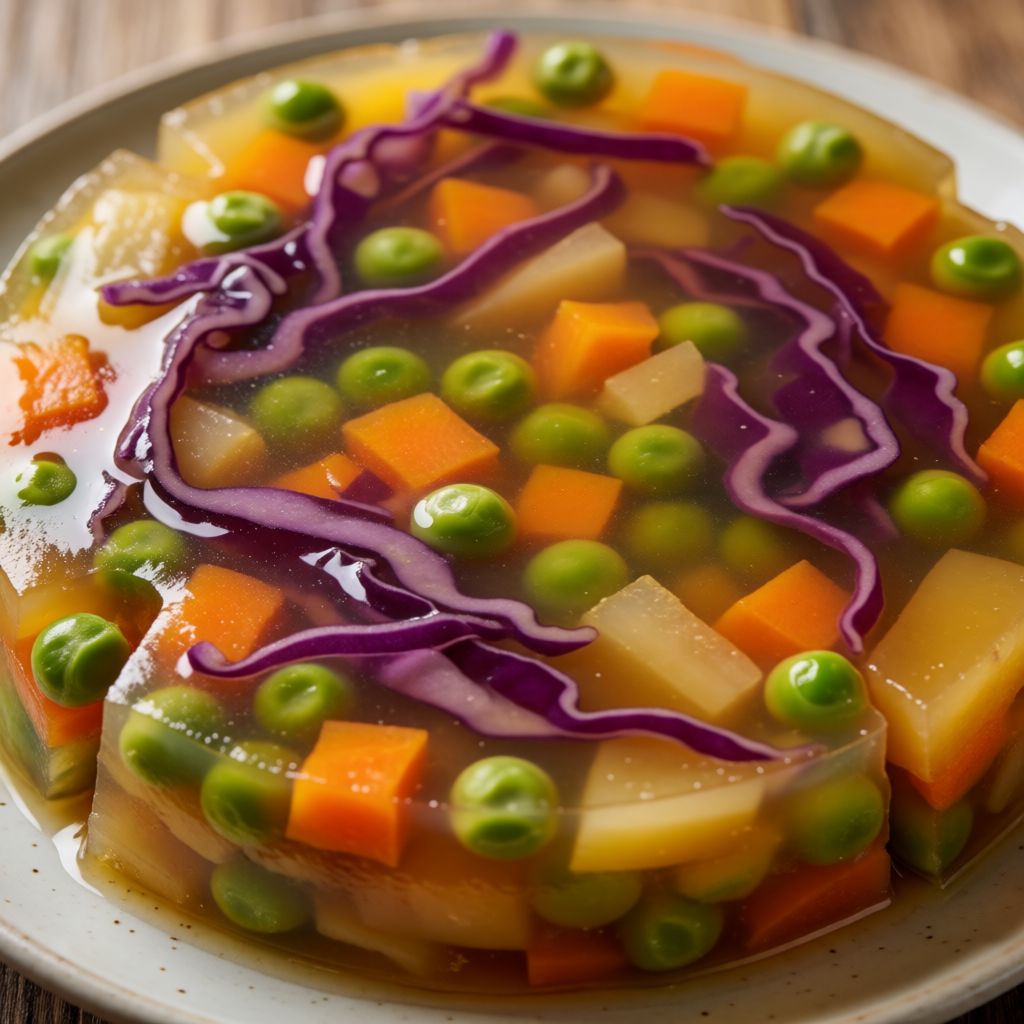
 AI photo
Vegetable Aspic
A colourful layered vegetable aspic set in gelatine, built up in stripes of peas, red cabbage and carrot.
Labels are worked out automatically from the ingredients and can be wrong. Check the packaging if it matters to you.
Ingredients




Steps
Boil the peas in salted water until soft.
15 minWash and peel the carrots, cut into cubes, then boil in salted water.
10 minWash the red cabbage, remove the outer leaves and the core, and slice into strips. Set aside 50 g.
Drain and spread the vegetables on plates to cool.
Put the gelatine in a bowl, cover with cold water and leave to swell.
10 minDrain, add hot water, then the remaining water and the beer at room temperature.
Pour 1–2 tbsp of the gelatine mixture into the bottom of the moulds and place in the fridge.
10 minAdd a layer of red cabbage, cover with the gelatine mixture and place in the fridge.
Add the peas, spoon over a little more gelatine mixture and place in the fridge.
10 minRepeat with the carrot, forming the final layer of the aspic.
10 minChill the moulds in the fridge for at least 3 hours, until the aspic is fully set.
180 min
This is a cold vegetable terrine held together not by cream or butter but by gelatine and a little beer — three layers of colour, stacked and set, so that when you turn it out of the mould you see stripes: dark red cabbage, green peas, orange carrot. What decides whether it works is not the vegetables at all. It's the gelatine ratio and your patience with the fridge.
Think of it as a savoury jelly dessert, the kind your gran might have made with tinned fruit, except here the "fruit" is peas and carrot, and the liquid isn't fruit juice but gelatine dissolved in water and beer. The beer is doing a job: a little bitterness and malt flavour against vegetables that, on their own, taste mostly of salted water. Leave it out and you get something edible but flat — swap it for a light stock with a pinch of mustard or vinegar if beer isn't in the house, because what you need is acidity and savour, not alcohol as such.
Each layer has to set before the next goes on, or the vegetables don't sit in neat bands — they drift and mix, and you get mud instead of stripes. That's why the recipe keeps sending the mould back to the fridge for ten minutes between each addition: it's not decoration, it's structural. Skip it and the whole thing still tastes fine, it just won't look like anything.
Gelatine is the one ingredient here that isn't forgiving, so get the ratio right rather than guessing. 20 g of powdered gelatine to roughly 250 ml of liquid (your water plus beer) gives a set firm enough to hold its shape out of the mould but still wobble a little when you nudge the plate — that wobble is the point, it's what tells you it's a jelly and not a rubber block. Too little gelatine and it won't release from the mould cleanly; too much and you get something closer to a boiled sweet. If you only have leaf gelatine, weigh it the same and soak it in cold water the same way — the soaking step exists because gelatine added dry to hot liquid clumps instead of dissolving evenly, leaving hard flecks in your finished aspic.
The peas and carrot are boiled separately because they cook at different speeds and you want each to keep its own shape and colour, not go grey and mushy together in one pot. "Carrot bends, doesn't snap" is your cue there — bite one straight from the pan; if it still has a snap, it needs more time, and if it collapses, you've gone too far and it'll disintegrate in the layer rather than hold a shape.
Red cabbage is mostly there for colour rather than bulk — 50 g is a garnish amount, not a vegetable course. Raw, sliced thin, it keeps a bit of crunch and a deep purple that bleeds very slightly into the gelatine around it, which is part of the look, not a fault. If you don't have red cabbage, any vegetable with strong natural colour and enough rigidity to sit in a layer will do — thin-sliced raw beetroot, for instance, though it will bleed harder and stain the whole jelly pink rather than staying in its band.
The beer wants to be flat and at room temperature when it meets the gelatine — cold, fizzy beer straight from the fridge will fight the dissolving gelatine and can throw bubbles into your set layer. Any beer with some malt character works; a pale ale or a mild bitter rather than anything heavily hopped, since bitterness on top of vegetables can tip savoury into unpleasant. No beer in the house — use stock or even just water with a pinch of mustard powder, you lose some depth but keep the principle: liquid with some flavour of its own, not plain water throughout.
This feeds eight as a starter or part of a cold spread, which tells you something about when it was meant for — a buffet dish, made well ahead of a gathering, not a weeknight plate. The three hours of fridge time plus the gradual layering is the real cost of this dish: there's no shortcut that compresses it, no higher heat that speeds gelatine setting faster than cold does. Plan your day around the fridge, not around the hob, and start it long before anyone's hungry.