
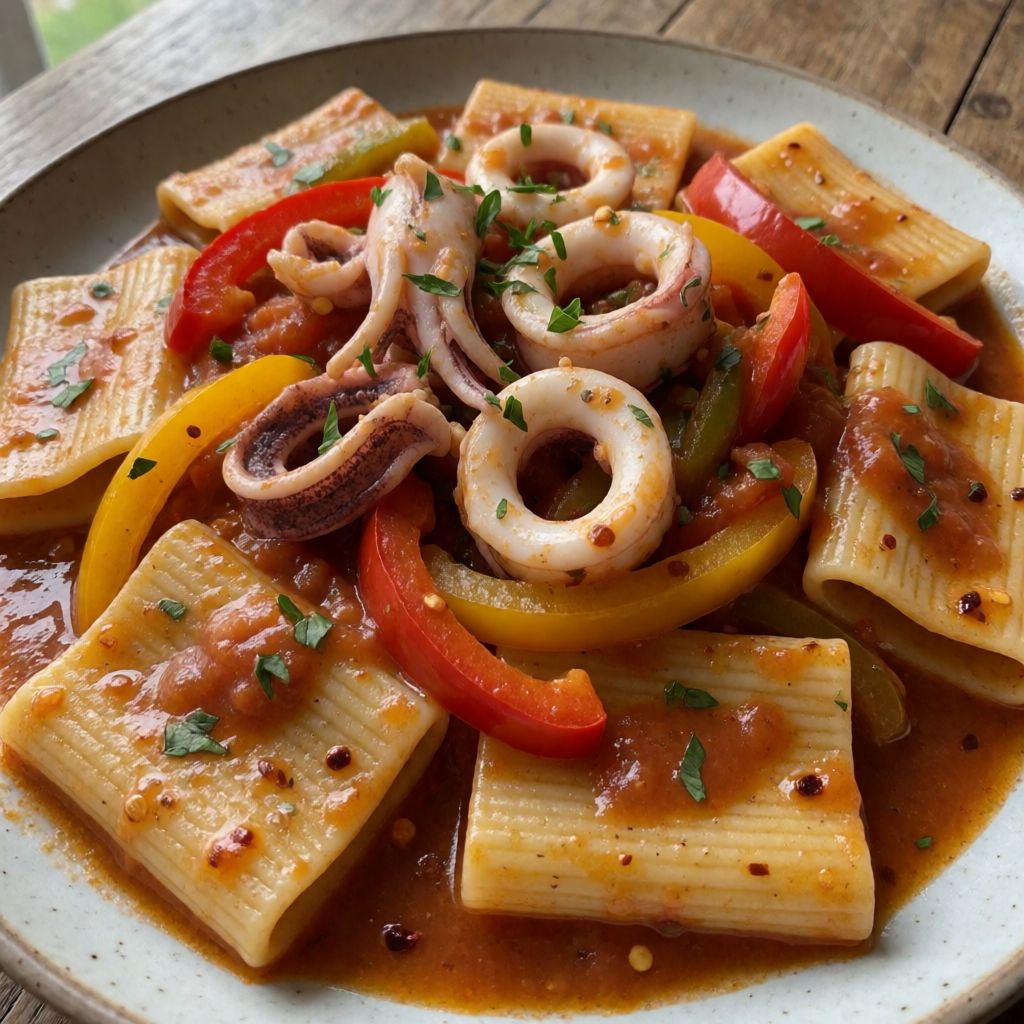
 AI photo
Paccheri with Squid and Peppers in Tomato Sauce
A hearty pasta dish of squid, bell peppers and olives simmered in a rich tomato sauce.
Labels are worked out automatically from the ingredients and can be wrong. Check the packaging if it matters to you.
Ingredients
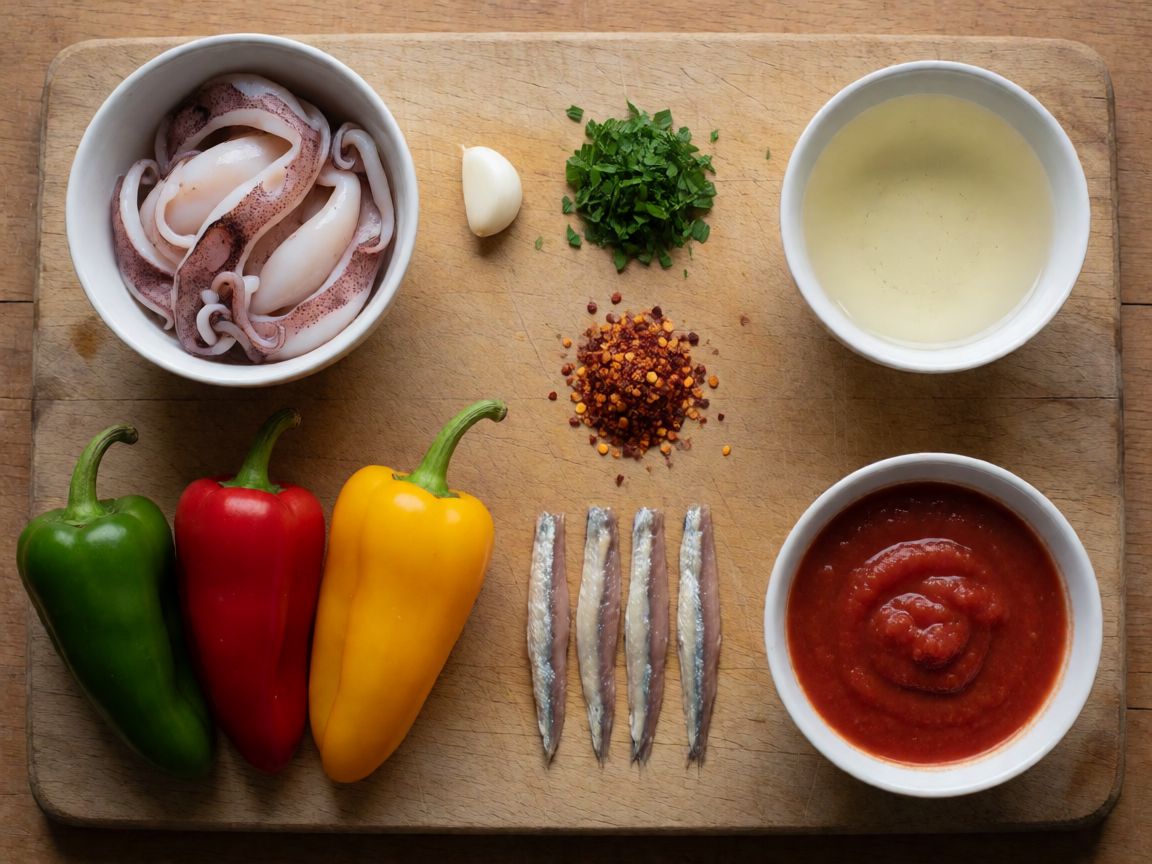
- 500 g Squid
- 1 clove Garlic
- 1 bunch Parsley to taste
- 1 pinch Chilli flakes to taste
- 2 pcs Bell pepper
- 4 pcs Anchovies
- 120 ml White wine
- 200 g Tomato passata
- 1 tbsp Taggiasca olives
- 2 tbsp Olive oil for frying
- 1 pinch Salt to taste
- 320 g Paccheri pasta












Steps
Finely chop the parsley, garlic and anchovies, add the chilli flakes, and fry this mixture in olive oil.
Add the squid, cut into pieces, and fry quickly.
Add the diced bell pepper.
Pour in the white wine, let it evaporate, then cook over low heat.
30 minPour in the tomato passata, continue cooking and add salt and the Taggiasca olives. It is ready when the thickest piece of squid reaches 63°C inside.
Cook the paccheri until al dente, drain and toss with the sauce.
Paccheri is that fat, tube-shaped pasta that looks like it's wearing someone else's coat — and that's the point. The wide hole catches sauce inside and out, which means it needs a sauce with body: this one, squid and peppers cooked down with wine and tomato, is built for exactly that job. A thin, watery ragù would slide off; this one clings, pools in the tube, and that's the whole reason you chose paccheri over spaghetti in the first place.
What decides whether this dish works is not the sauce, it's the squid. Squid has two states and nothing in between: tender in the first ninety seconds of real heat, or rubbery for the rest of its life if you let it sit in a simmering pot. That's why it goes in fast, over a pan hot enough to seize it almost on contact, and why it then gets lifted back out of real heat for the slow simmer — some recipes skip that lift and just leave the squid in the sauce for thirty minutes, and that's where "squid is always chewy" comes from. No — squid is chewy when it's cooked twice as long as it needs, once at high heat and again at a simmer, with no rest between.
Some say squid needs long, slow cooking to go tender, the way you'd braise a tough cut of beef. No — squid has almost no connective tissue to break down; it's mostly muscle fibre and water, and long heat just wrings the water out and toughens the fibre that's left. The reason this recipe reads as a thirty-minute simmer is the sauce — the peppers softening, the wine cooking off, the tomato thickening — not the squid catching up to anything.
The anchovies and garlic are there to build a savoury base before anything else hits the pan — this is the Italian habit of melting anchovy into oil until it more or less disappears, seasoning everything from underneath rather than sitting on top as a fishy lump. If you don't have anchovies, use a good splash of fish sauce, added at the same stage; it does the same job of deep salt-and-sea flavour without the fillets. Leave it out entirely and the dish will taste thinner, not wrong — just flatter.
The squid itself: buy it already cleaned if your fishmonger offers it, tubes and tentacles, and don't be precious about frozen — squid freezes well and most of what you buy fresh has been frozen and thawed anyway. Cut it into pieces no thicker than your thumb; thick lumps mean the outside overcooks while the inside is still raw, thin strips mean nothing left to bite. If squid isn't available or isn't appealing, raw prawns work on the same two-minute logic — fast in, fast out, same failure if you leave them.
Bell peppers want to go in diced, not sliced into strips, so they cook at roughly the same rate as everything around them and don't turn stringy. Any colour works; red and yellow are sweeter, green sharper and more bitter, and either is fine — this isn't a dish where the colour of the pepper is load-bearing.
The wine's job is simple and often misunderstood: it isn't there for flavour so much as to deglaze the pan and start a slow evaporation that concentrates everything else. "Let it evaporate" means watch for the sharp, boozy smell to soften into something rounder — that's the alcohol gone, and what's left is acid and fruit, which is what balances the oiliness of the squid and olive oil. A dry white is what you want; a sweet one will tip the sauce sideways. No wine in the house — a splash of white wine vinegar cut with water does a rougher version of the same job, deglazing and adding acidity, though you lose the fruit.
Tomato passata is just sieved raw tomato — no cooking, no seasoning, nothing added — which is exactly why it's the right base here: it lets the sauce thicken on your terms rather than arriving half-thickened and oversalted like a tinned tomato sauce would. If you can only find chopped tinned tomatoes, blitz them smooth first; the texture of the lumps fights with the smoothness of the squid otherwise.
Taggiasca olives are small, dark, and mild rather than sharp — they're there to drop in little pockets of salt and savoury depth through the sauce, not to dominate a bite. Any small black olive in brine, pitted, will do the same work; what you're avoiding is a big, assertive green olive that turns every third forkful into "oh, that's an olive" rather than part of the sauce.
A note on patience, because it's doing real work here even though the recipe never says so directly: the thirty minutes isn't filler, it's the time the pepper needs to actually soften and the time the sauce needs to go from watery to something that will sit inside a paccheri tube rather than run straight through it. Rushing that stage gets you crunchy pepper in a thin sauce — the squid will still be fine, cooked properly at the start, but the dish around it won't hold together. And on an ordinary UK hob, without a wide shallow pan built for fast evaporation, you may find the sauce needs a few minutes longer than the recipe suggests to thicken properly — that's the pan, not you, and it's worth leaving it rather than turning the heat up and scorching the bottom.