
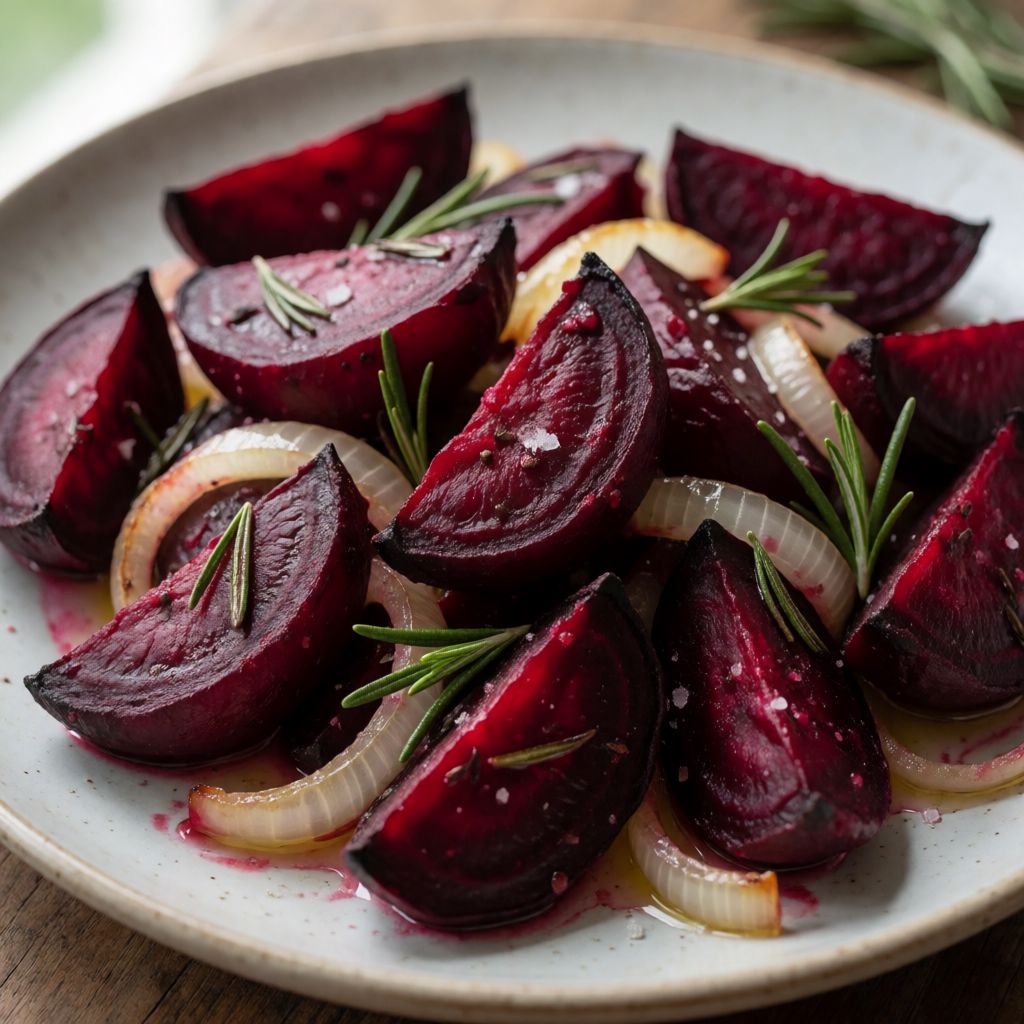
 AI photo
Roasted Beetroot
Simple oven-roasted beetroot wedges with onion, rosemary and olive oil – a light vegetable side dish.
Labels are worked out automatically from the ingredients and can be wrong. Check the packaging if it matters to you.
Ingredients





Steps
Preheat the oven to 150°C.
Thoroughly wash the beetroot under running water and dry it with kitchen paper or a clean tea towel.
Cut the beetroot into even wedges so it cooks through evenly.
Line a baking tray or roasting dish with baking parchment and place the beetroot on it.
Add the thinly sliced onion, rosemary, a pinch of salt and a little olive oil. Mix well.
Roast at 200°C for 15–20 minutes, checking occasionally so the beetroot doesn't dry out.
18 minServe hot, straight from the oven.
This isn't really "roasting a vegetable" in the sense of cooking it from raw — the beetroot's already boiled, soft through before it ever sees the oven. So the oven's job here is different: dry the cut surface, let the sugar already in the beet catch and darken at the corners, and carry the rosemary's smell (which only dissolves in fat, not water) into the oil clinging to everything. That's the whole mechanism — concentration and colour, not cooking.
The recipe gives you two numbers, a 150°C preheat and a 200°C roast. Don't worry about reconciling them to the degree — what matters is that the oven is already fully up to heat, steady, before the tray goes in. A domestic oven that's still climbing while the beet sits in it just means slower, patchier browning at the edges; the stable heat is what does the catching, not the exact figure on the dial.
So "how long" is close to the wrong question. The given 18 minutes is a floor, not a target. What tells you it's actually done: the cut faces go from wet maroon to a drier, almost matte dark red-brown, just catching at the corners; the onion slides from raw white to soft translucent gold; the kitchen smells of rosemary, not raw veg. Patience here is a small dose, not a large one, but it's still patience — don't keep pulling the tray to prod it, that drops the oven's heat and nothing ever catches.
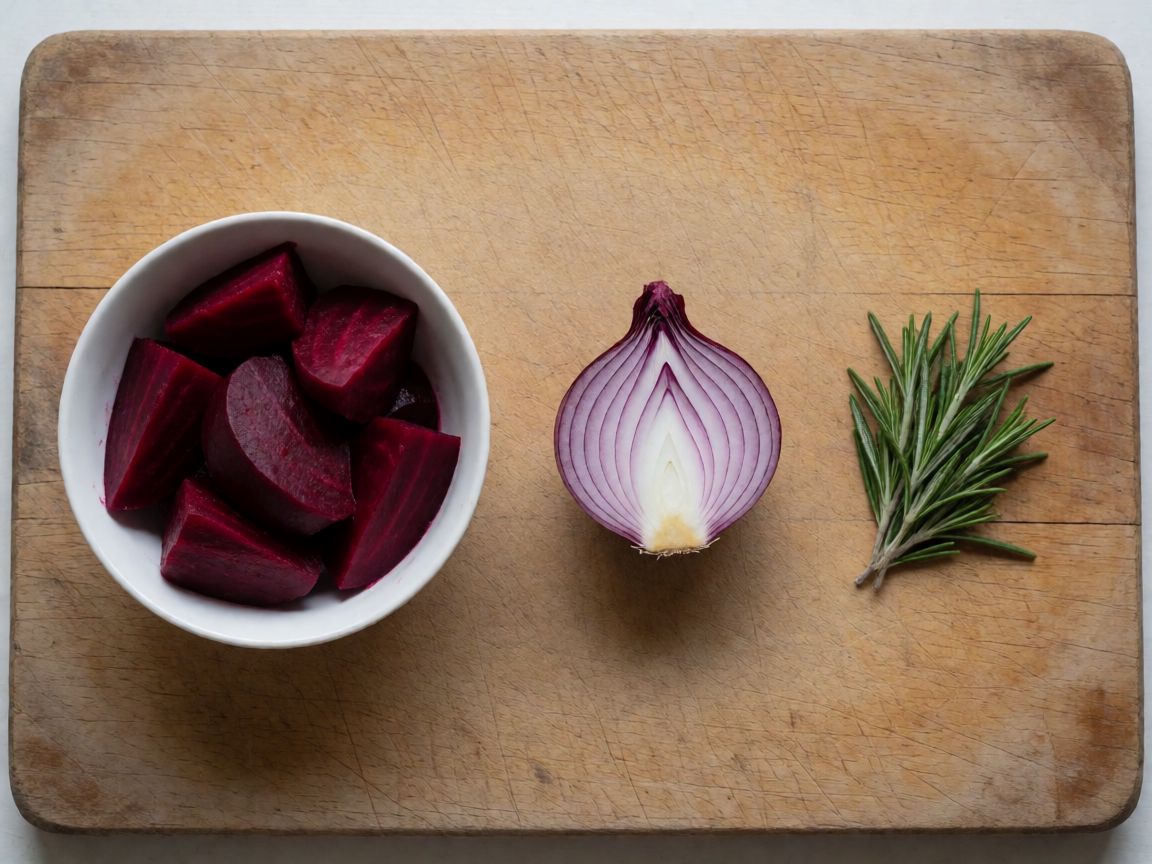
Beetroot — the whole premise rests on it being properly boiled through, soft to a fork with no resistance, before it goes anywhere near the oven. Home-boiled is fine, but in a British kitchen the vacuum-packed cooked beetroot from the supermarket shelf does the same job and saves you nearly an hour of boiling plus the business of peeling a hot beet, which stains hands and worktop a shade of purple that doesn't come off in one wash. If you only have raw beetroot, this stops being the same recipe — you'd wrap it whole in foil and cook it low and slow until it yields, which is a different, longer dish entirely, not a finishing roast.
Onion — half a bulb against 500 g of beet, feeding four, is a small amount on purpose: enough sweetness and fragrance in the background, not a mouthful of onion in every bite. Sliced thin, because it needs to soften in the same short window the beet needs to dry its surface — any thicker and you get raw, crunchy slivers sitting next to tender beet, which tastes like two different dishes on one plate. Red or white doesn't change much here; it's not doing the long, slow sweetening job an onion does in a stew, just contributing perfume.
Rosemary — a woody herb whose aroma is carried in oil, not water, which is exactly why it's listed as a bunch rather than minced fine: chop it small and under this kind of dry heat it scorches and turns bitter instead of fragrant. Keep the sprigs close to whole. Lift them out before serving if nobody fancies chewing a twig, or leave a couple in for the people who do — harmless either way.
Salt — a pinch, and it goes in before the tray does, not after plating. Salt needs contact time to draw a little moisture to the surface and concentrate what's underneath; sprinkled on at the end, it only seasons the top millimetre and does nothing for the vegetable itself.
Olive oil — doing two jobs at once: it's the solvent that picks up the rosemary's smell and spreads it over everything, and it's what lets the cut edges brown rather than simply dehydrate. The criterion for substituting is simple — any oil with no strong smell of its own and a reasonably high smoke point will carry the job just as well. Sunflower or rapeseed oil, both cheap and already in most British kitchens, work without complaint; you lose a faint peppery top note from the olive oil and nothing else.
Tray and parchment — not fussiness, protection. Beetroot juice stains a baking tray, an oven glove, a worktop, and scrubbing it out afterwards is nobody's idea of a good Sunday. There's an economic reason this dish exists as "roasted" rather than "boiled with onion," which would taste nearly as good: it's a Sunday-roast habit. The oven's already hot and holding steady for the joint, so a tray of beet goes in on a lower shelf on heat you're already paying for, rather than firing the oven up specially for a side dish that, on its own, barely justifies the electricity.