
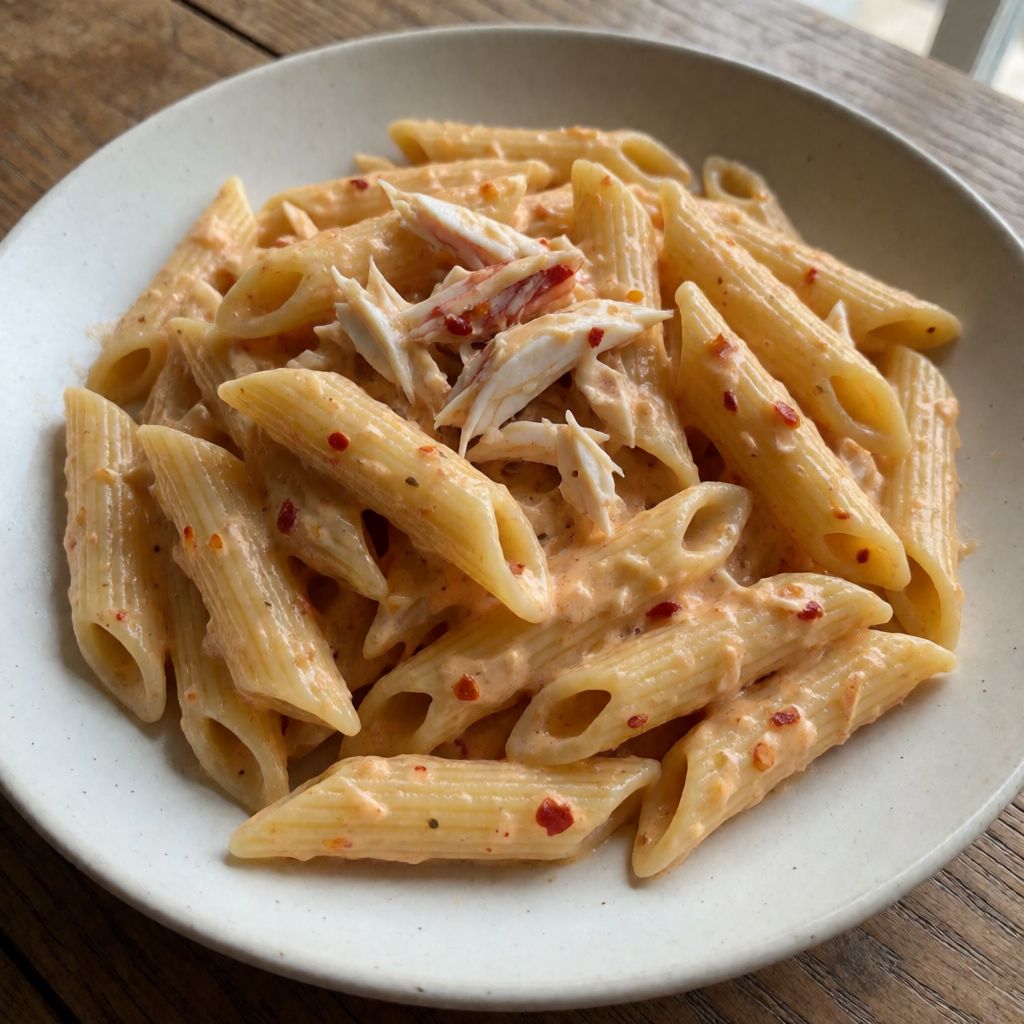
 AI photo
Penne with Crab Sauce
A pasta dish of penne tossed with a rich sauce made from fresh crab, vegetables and cherry tomatoes.
Labels are worked out automatically from the ingredients and can be wrong. Check the packaging if it matters to you.
Ingredients
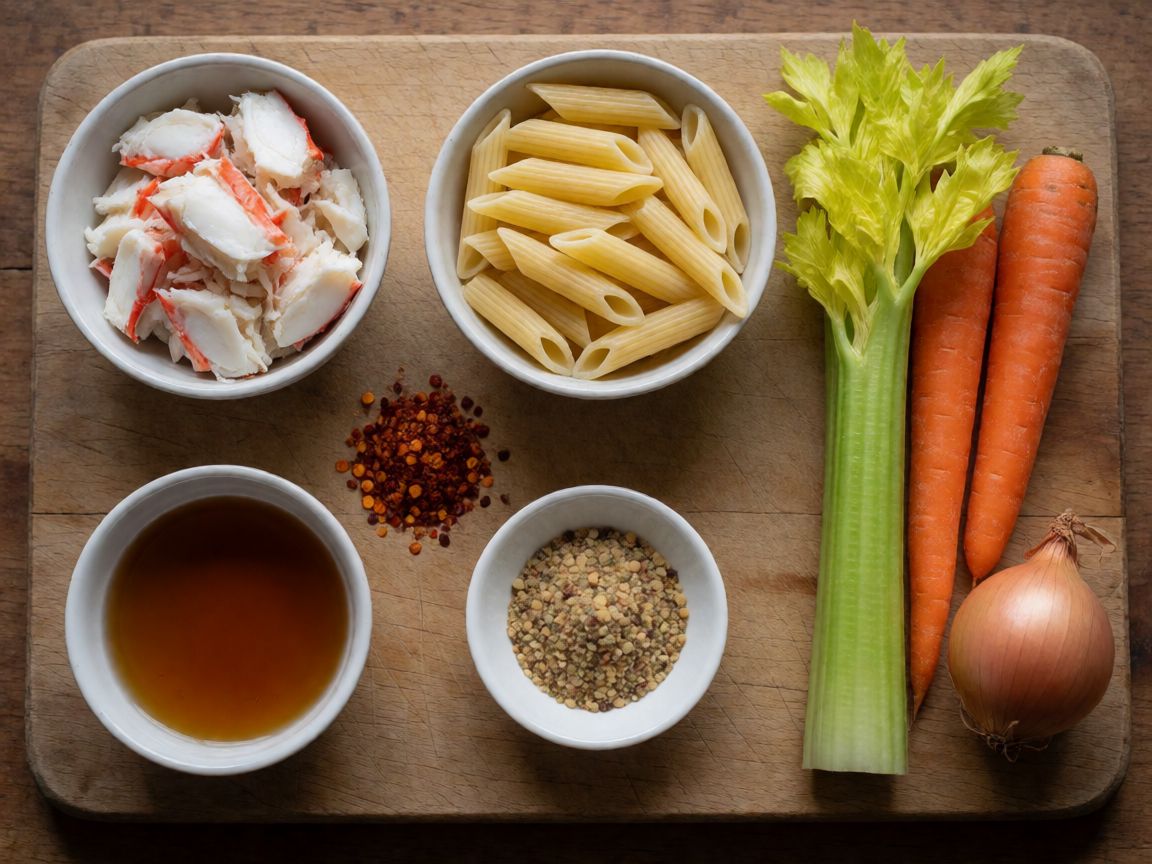
- 500 g Crab
- 400 g Penne
- Salt to taste
- Chilli flakes to taste
- Olive oil to taste
- 1 pcs Brandy a splash
- 1 pcs Celery stick
- 1 pcs Carrot
- 1 pcs Onion
- Soffritto mix to taste
- Parsley to taste
- 200 g Cherry tomatoes












Steps
Open the crabs, set aside the claws, and use the shells and vegetables to make a fish stock. Strain the stock.
In a pan, fry the soffritto in olive oil, add the crab meat and claws, pour in the brandy and let it evaporate.
Add the cherry tomatoes and cook for a few minutes, season with salt and chilli flakes to taste, and sprinkle with parsley.
Make sure the crab is heated to at least 63°C at its thickest part.
Cook the penne in plenty of salted water until al dente, then drain.
Add the pasta to the pan with the sauce and fry for a few minutes, stirring.
Serve, sprinkled with parsley.
This is a dish built backwards from waste. You buy whole crab not because it's fashionable but because the shells are where the flavour lives — the meat gives you sweetness, the shells give you the sea. Throw the shells away and you've got prawns-in-disguise with a nice brandy kick; keep them, simmer them into a stock, and you've got something that tastes like it came off a boat, not out of a tin.
What decides whether it works is restraint in two places. First, the stock: soffritto (onion, carrot, celery, chopped fine) sweated until it softens and turns translucent, not browned — brown here means bitter, and bitter stock ruins everything built on it afterwards. Second, the sauce itself has to stay loose and wet, because the pasta is going to drink from it at the end, and a dry sauce makes dry pasta, no amount of oil fixes that after the fact.
Some say you should cook crab meat long and hard "to be safe" — no, because crab is lean and fine-fibred, and five more minutes than it needs turns it from sweet shreds into string. The mechanism that actually matters is temperature, not time: the thickest piece of meat needs to pass through 63°C, and that's a destination, not a duration. Get a probe thermometer if you don't trust your eye — it's cheaper than ruining 500g of crab.
The brandy isn't there for ceremony. Poured in hot, it lifts the fat-soluble aromatics off the pan floor and burns away its own raw alcohol sharpness, leaving behind warmth without the bite. Let it bubble down properly — if it still smells like spirit, it hasn't finished its job.
On the crab itself: whole, raw, in shell, is what gives you both components — stock and meat — from one purchase. If your fishmonger only sells it pre-cooked and picked, that's fine, buy it, but then your stock has to come from fish bones or a good shop-bought fish stock, because the shells were doing double duty and you've lost half the job. In the UK you'll most often find brown crab; it's sweeter and softer-fleshed than the spider crab used in southern Italian versions of this, which is why the timing matters even more here — brown crab meat falls apart if you push it.
The soffritto — onion, carrot, celery — isn't decoration, it's the economic backbone of the whole dish: three vegetables that keep for a week in a drawer, turning a few hundred grams of expensive shellfish into a sauce for four people. This is peasant arithmetic applied to something that now reads as a treat. Any supermarket "soffritto mix" bag does the same job if you're not chopping your own; the ratio is roughly equal parts by weight, finely diced, no bigger than a fingernail, so they melt rather than crunch.
Chilli flakes and parsley are both "to taste" for a reason — this sauce is meant to taste of crab first, heat and green herb second. If you've no fresh parsley, dried will do in a pinch, but add it at the very end off the heat, because dried parsley loses what little flavour it has the moment it meets hot fat for more than a few seconds.
Brandy: any spirit with some backbone and no sweetness works — Cognac if you're feeling generous, a basic VS brandy if you're not, even a dry sherry at a push, though that changes the character slightly toward nuttiness. What you're avoiding is anything sugary like a liqueur, which will catch and burn rather than evaporate clean.
Cherry tomatoes go in near the end because their job is brightness and a little acid lift against the richness of crab and brandy — cook them too long and they collapse into a stew, losing the fresh burst you actually want. Olive oil: use one with little personality of its own for the base cooking, save a better, more fragrant one if you have it for a final drizzle at serving — strong frying oil fights the delicate crab, a finishing oil flatters it.
On the pan: a kazan or wok's wide surface doesn't matter here, what matters is a pan wide enough that when you add the drained penne back in, you can actually stir it through the sauce rather than stack it in a pile — a standard wide sauté pan from any UK kitchen does this fine. Cook the pasta properly al dente in the water first, because it finishes its last minute in the sauce absorbing flavour, not softening — if it's already soft going in, it turns to mush by the time it's picked up the crab.
And patience, here, means not rushing the brandy's evaporation and not rushing the crab's heat-through. Thirty minutes total sounds short for something built from a stock, a sauce, and a pasta cook running in parallel — it works only if you're organised, stock going while you chop, pasta water on to boil while the soffritto softens. That overlap, not speed, is what makes thirty minutes honest.