
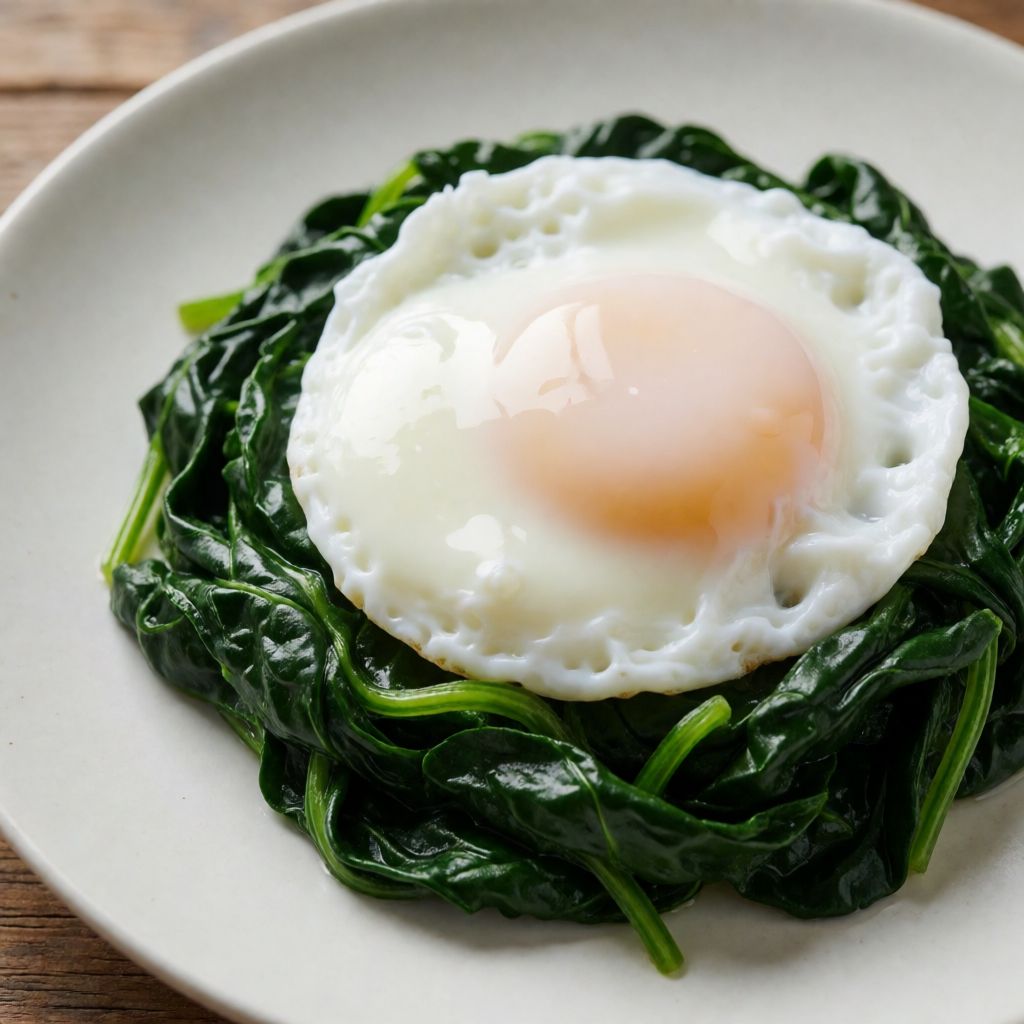
 AI photo
Poached Egg with Spinach
A simple poached egg served with wilted spinach, ready in minutes.
Labels are worked out automatically from the ingredients and can be wrong. Check the packaging if it matters to you.
Ingredients
- Water boiling
- 1 tbsp Apple cider vinegar
- 1 pcs Egg
- 65 g Spinach




Steps
Crack the egg into a bowl.
Reduce the heat under the water so it barely simmers, swirl the water in a circle, and carefully slide the egg from the bowl into the water.
The white will set around the yolk — you can gently help it with a spoon. Cook until the white is completely white (this happens quite quickly) while the yolk stays soft inside; this usually takes about 3 minutes.
3 minServing suggestions: spinach leaves, toasted rye bread, asparagus, salads, ripe summer tomatoes — depending on the season and your preference.
This isn't really a recipe so much as a technique wearing breakfast as a disguise. A poached egg is cooked by nothing but hot water and a trace of acid — no pan surface touches it, no fat helps it along. Whether it holds together as a neat parcel or falls apart into lace is decided in the first four seconds, the moment it slides off the spoon into the water.
What decides it: the state of the water, the age of the egg, and whether the white has somewhere gentle to go. Water at a full boil tumbles and tears; water trembling at the edge of a simmer gives the protein time to firm up into one piece instead of shredding into wisps. A fresh egg's white is thick and clings to itself; a few-weeks-old egg runs thin and will fray apart in the pot however carefully you cook it — and no amount of vinegar fixes that.
Some say you need a special poaching cup or a little plastic whirlpool gadget to get a round egg. No — those steam the egg in its own cup, and you get something closer to a halved boiled egg: firm all through, no loose silky edge. The whole appeal of a poached egg is that ragged, soft-skinned shape water alone gives it.
The spinach isn't cooked into anything here — it's a bed, chosen by season, not a component with its own technique. The whole dish rises or falls on the egg; the greens exist so the yolk has somewhere to run when you cut in.
Water: fill an ordinary saucepan — no kazan needed, nothing deep or fancy — enough to cover the egg by a couple of inches. Bring it up, then pull the heat back until the surface just trembles, the way a kettle looks a few seconds after you've switched it off: small bubbles breaking at the edges, nothing rolling in the middle. That's the whole trick. A hard boil throws the loose edges of white around violently before they've set, and you end up fishing out scraps instead of an egg.
Vinegar: acid speeds up how fast egg protein sets — it tightens the white quickly, before it has the chance to spread into feathers. A tablespoon in a pan of water, not poured onto the egg itself. The myth that poached eggs taste of vinegar doesn't hold up at this dilution — you won't taste it. Pick any acid with no smell of its own: cider vinegar, white wine vinegar, even a squeeze of lemon. Skip balsamic — it has a flavour and a colour of its own, and both will show.
Egg: this is the one ingredient where freshness does more work than any technique. Crack it into a bowl first, as the recipe says — that's not fuss, it's insurance: you catch shell, you catch a blood spot, and you see straight away whether the white sits up thick and domed (fresh) or spreads out thin and watery (old). A tired egg will shred in the pot no matter how gently you swirl the water or how much acid you add. If the supermarket egg has been sitting in the fridge a few weeks, that's the actual reason it falls apart — not your pan, not your heat.
The swirl mentioned in the method does real work: a slow current pulls the loose outer strands of white in toward the body of the egg instead of letting them drift off on their own. You don't need a whirlpool machine for this — a spoon stirred once round a small saucepan makes enough current. Once the egg's in, leave it alone. Poking at it tears the white while it's still soft enough to tear.
Doneness is a colour and a feel, not a clock: the white goes from a translucent, almost snotty grey to a fully opaque matte white — that happens quite fast, as the recipe notes — and the yolk still gives softly when nudged with the spoon. Three minutes is where to start checking, not where to stop; a very cold egg straight from the fridge, or a slightly deeper pan, can take closer to four. Don't rush pulling it early out of impatience — patience here is the actual ingredient, the one that turns a scrappy mess into a neat egg.
Spinach and the rest are not cooked in any real sense — 65g, a loosely packed fistful, wilts a little just from the egg's warmth and whatever poaching water clings to it when you lift it out with a slotted spoon. Rest it a moment on a plate lined with kitchen roll — the ordinary flat's answer to a cooling rack — to shed the extra water before it meets the spinach. What you build around it — toasted rye, asparagus, a ripe summer tomato — is seasonal thrift more than tradition: whatever's good that week goes under the egg.