
 AI photo
Pommes Anna
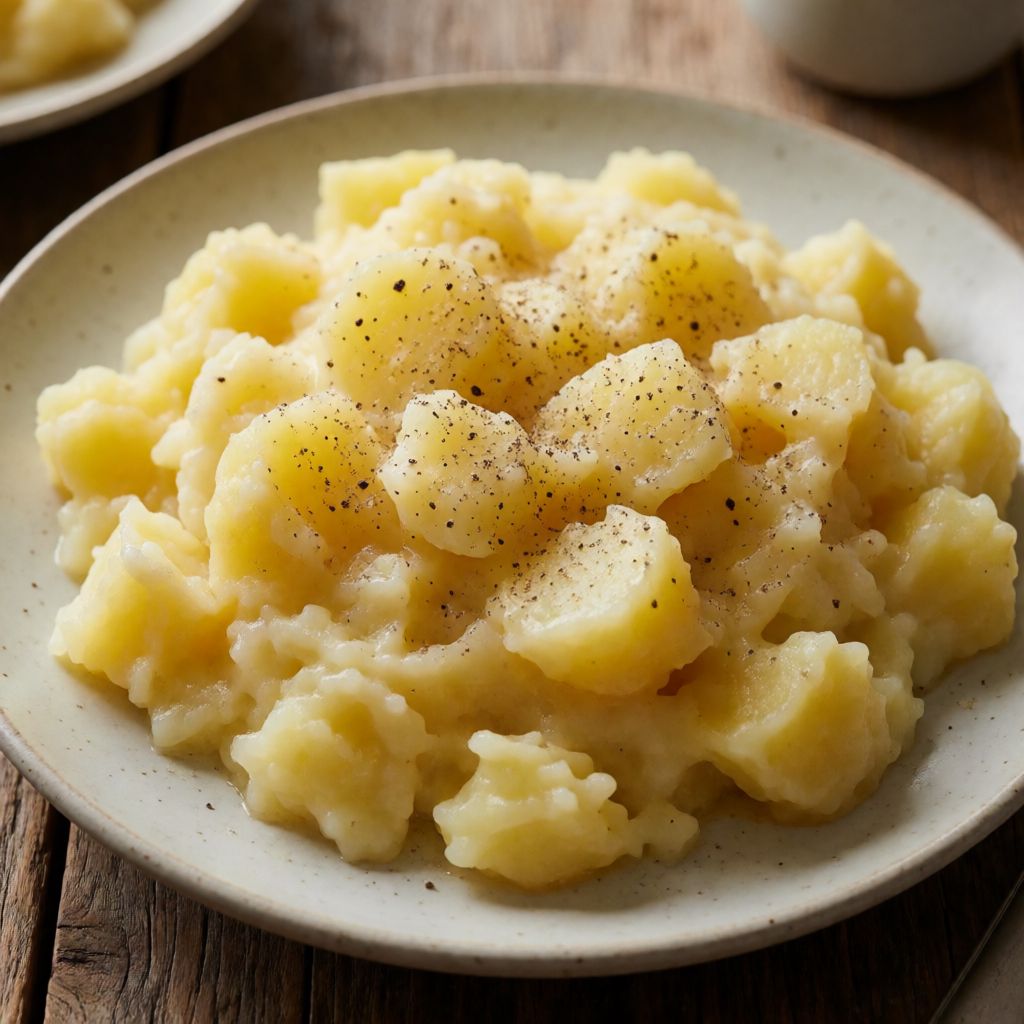
Thinly sliced potatoes baked in butter until golden, then pressed, chilled and pan-fried into crisp squares of Pommes Anna.
Labels are worked out automatically from the ingredients and can be wrong. Check the packaging if it matters to you.
Ingredients
- 1 kg Potato peeled
- 100 g Butter
- Salt to taste
- Black pepper freshly ground



Steps
Cut the potatoes into thin slices about 1 mm thick, preferably using a mandoline so they are evenly sized. Pat the slices dry with a clean tea towel.
Melt the butter slowly over the lowest heat and pour the clarified butter, leaving behind the white sediment at the bottom, into a bowl.
Line a heatproof dish (24 x 14 cm) with baking paper. Layer the potatoes and butter, brushing each layer with butter and sprinkling with salt and black pepper every 4 layers, until the potatoes and butter are used up.
Cover the dish with a lid, baking paper or foil and bake in a preheated fan oven at 180°C for 50-60 minutes.
55 minCheck the potatoes are done with a skewer. Remove from the oven once tender. Cover tightly with baking paper and weigh down with a press while the potatoes cool and firm up.
Put the potatoes in the fridge for at least 8 hours, or overnight.
480 minBefore serving, take the dish of potatoes out of the fridge and cut the chilled layers into neat, even squares with a sharp knife.
Heat a frying pan with the leftover butter that has collected in the potato dish.
Fry the Pommes Anna squares for about 2 minutes on each side, turning until a nice golden crust forms all over.
8 min
What was changed
The oven temperature was adjusted to to match the UK's display increments.
Pommes Anna is not a gratin and it is not chips. It is thin discs of potato, stacked like roof tiles, glued together by nothing but starch and butter, baked until they fuse into one block, then chilled hard, cut into squares and fried only at the very end for colour. What decides whether it holds together or falls apart on the plate is almost entirely about thickness and dryness of the slices, and whether you give the block time to actually set before you touch it with a knife.
Some say Pommes Anna is deep-fried potato cake. No — it spends most of its life in the oven under a lid, cooking gently in its own steam and butter, with barely any colour at all. The frying pan only comes in at the end, for two minutes a side, purely to put a crust on something that is already cooked through. If you fried raw slices straight off, you'd get burnt edges and a raw centre — the two-stage cooking exists precisely so the inside has time to turn tender while the outside stays pale, and only gets its crust once everything underneath is already soft.
The 1 mm slice is not fussiness for its own sake. Potato releases starch as it cooks, and that starch is the glue holding every layer to the next — too thick, and the middle of each slice never gelatinises properly before the dish is pulled out, so you get a stack of separate discs rather than one cake. A mandoline earns its keep here because a knife, however good you are with it, drifts in thickness over 1 kg of potato, and one fat slice in the pile is enough to leave a raw streak when you cut your squares later.
Potato: you want a floury, starchy variety — Maris Piper or King Edward do the job in a UK kitchen — because the whole dish is held together by released starch, not by egg or cream. A waxy potato like Charlotte or a new potato stays firm and slick when cooked and simply refuses to bond to its neighbour; you'd get a stack of coins, not a cake. If floury potatoes aren't to hand, any variety sold as good for mash or baking will behave the same way, because that's the same starch content doing the work in both dishes.
Pat the slices dry before layering for a reason that has nothing to do with tidiness: surface water sits between the butter and the potato and turns to steam in the oven, and steam pushes layers apart instead of letting butter bond them. A tea towel does this better than paper towel, which tends to shed onto wet starchy potato and leave lint behind.
Butter: clarified, and this is not a chef's affectation. Whole butter is roughly a sixth water and milk solids. Melt it slowly and that water cooks off, and the milk proteins sink and brown — left in, they'd scorch during the long bake and turn bitter, and you'd taste it in every layer. Pouring off the clear gold fat and leaving the white sediment behind is simply removing the part that burns and keeping the part that fries. If you've no patience for clarifying it yourself, ghee does exactly the same job, because it's the same process done for you. Any neutral fat with no smell of its own and a high smoke point — a mild oil, for instance — will hold the layers together structurally, but you lose the flavour that's really the point of using 100 g of butter on 1 kg of potato in the first place.
Salt and pepper only every few layers, not every one, because seasoning the whole stack evenly matters more than seasoning it heavily — six layers of potato with no seasoning between a scattering of salt taste unseasoned in the middle and over-salted at the seams if you're not careful. Season as you go so the whole block tastes the same when you finally cut into it, not just the top and bottom.
A proper Pommes Anna pan is a round, heavy, lidded copper thing designed so the dish can be flipped out whole and sliced into wedges like a cake. Nobody doing a Sunday roast owns one, and you don't need it — a lined rectangular dish and a flat object with some weight on top for the pressing stage does the same mechanical job: compress the layers while they're still warm and pliable so trapped air and excess fat get squeezed out, leaving a dense block rather than an airy, crumbly one. A full tin of beans or another dish sat on top works as well as any proper French press.
The dish itself started as bistro cooking in nineteenth-century Paris, not as aristocratic food — a way of making cheap potato impressive by using a lot of expensive butter and a long, patient method, which is roughly the same economics as a good Sunday roast: ordinary ingredients, made to earn their place through time and technique rather than cost.