
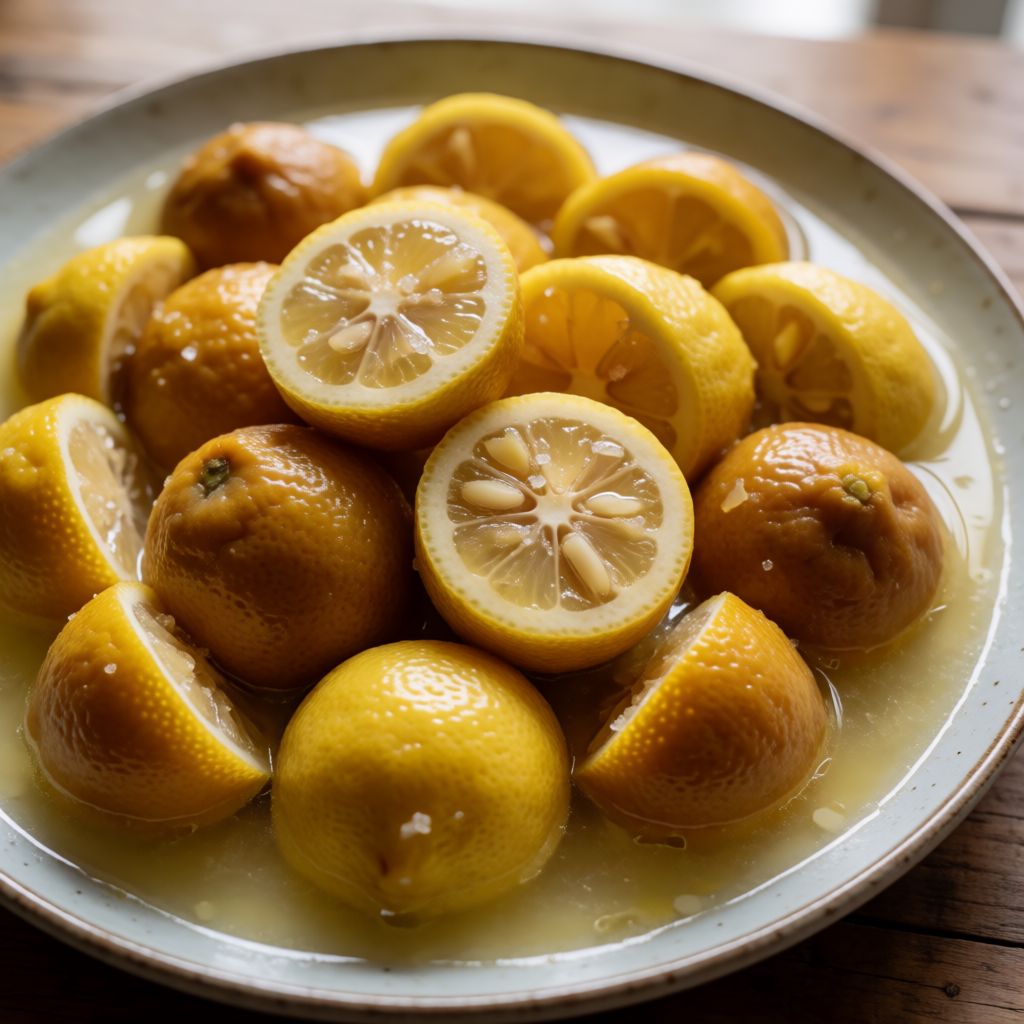
 AI photo
Preserved Lemons
A simple preserved lemon recipe using whole lemons, salt and fresh lemon juice, left to cure in a dark cupboard.
Labels are worked out automatically from the ingredients and can be wrong. Check the packaging if it matters to you.
Ingredients
- 500 g Lemon
- 200 g Salt
- 100 ml Lemon juice freshly squeezed



Steps
Wash and scrub the whole lemons thoroughly with a brush, as both the peel and the flesh will be used.
Cut the lemons into cubes and remove any pips.
Layer the lemon cubes and salt in a clean, scalded preserving jar.
Press the lemons down firmly and sprinkle the remaining salt on top.
Press the lemons down firmly again so that they release enough juice.
Pour in the lemon juice, seal tightly with the lid, and leave to stand in a dark cupboard.
43200 min
This is not a lemon you eat fresh — it is a lemon you have made patient. Whole fruit, flesh and rind together, cut small and buried in salt until the sharp, bitter, raw thing turns into something soft, jammy, almost sweet-salty, that you shave slivers from for months after. The mechanism is simple and old: salt pulls water out of the lemon's cells by osmosis, that water joins the juice you press out of it, and the pieces end up sitting in their own brine. In that strong-salted liquid, the moulds and spoilage bacteria that need air or weak salt to live simply can't — only a slow, mild fermentation carries on, and it is that slowness, over weeks, that softens the tough pith and bitter rind you would never eat raw.
Some say you only need the zest, that the flesh and pith are waste. No — because this whole method depends on cutting the fruit small enough that salt reaches everywhere, pith included, and dissolves its bitterness from the inside rather than just seasoning the surface. Cube it, don't zest it.
What actually decides whether this works is not the salt amount or the waiting — it's whether every piece of lemon stays under the liquid line. Press down hard, twice, for exactly that reason: any cube that pokes above the brine dries at the surface and that dry patch is where mould starts, not from dirty hands or a dirty jar, but from air meeting lemon with no salt-water barrier between them.
Lemon, 500 g of it: buy the thinnest-skinned ones you can find, because you're eating the peel and pith, not throwing them away. Scrub them properly — not for show, but because any wax or spray residue sitting on the skin gets trapped once the rind softens in the salt, and you'll be tasting that too, in every future spoonful, for a month.
Salt, 200 g: this is not seasoning here, it's the preservative barrier, so skip ordinary table salt with its anti-caking agents and iodine — they can dull the colour and slightly interfere with the slow fermentation you're relying on. Use coarse sea salt or any plain salt sold without additives. The near 40% ratio to lemon weight isn't arbitrary — go much lower and you risk a brine too weak to hold back spoilage over thirty days; this amount is a floor, not a preference.
Lemon juice, 100 ml, freshly squeezed: its job is to top up the brine if the pressed lemons don't release enough juice of their own — juicier fruit needs less, drier fruit more, which is why you add it after pressing rather than guessing upfront. If you've genuinely no fresh lemons left to squeeze, a bottled juice with nothing but lemon in it will do the same job; it's acid and liquid you need here, not freshness for its own sake.
Scalding the jar matters for the same reason washing the fruit does — it clears out wild yeast and mould spores that would otherwise get a head start in the first days, before the salt concentration has built high enough to keep them down.
The history behind salting whole lemons comes from exactly the problem the dark cupboard solves: before refrigeration, a Mediterranean or North African kitchen had lemons in abundance for part of the year and none for the rest, and salt was cheap and always on hand. Burying the surplus in it was the only way to carry that sourness through winter cooking. Britain has its own version of this same salt-economics — salted butter, bacon, pickled walnuts in the pantry — so the logic isn't foreign even if the lemon itself feels like a borrowed guest here.
Once it's made, don't think of it as a single-serving condiment — one jar like this seasons many Sunday roasts over several months: a few slivers worked into the gravy or the fat under chicken skin, chopped small into a salad dressing to cut through roast lamb. And the thirty days sealed in the cupboard is not downtime to rush past — it is the actual recipe. There is no shortcut version of patience here; the lemon needs the full month to stop being raw and start being this.