
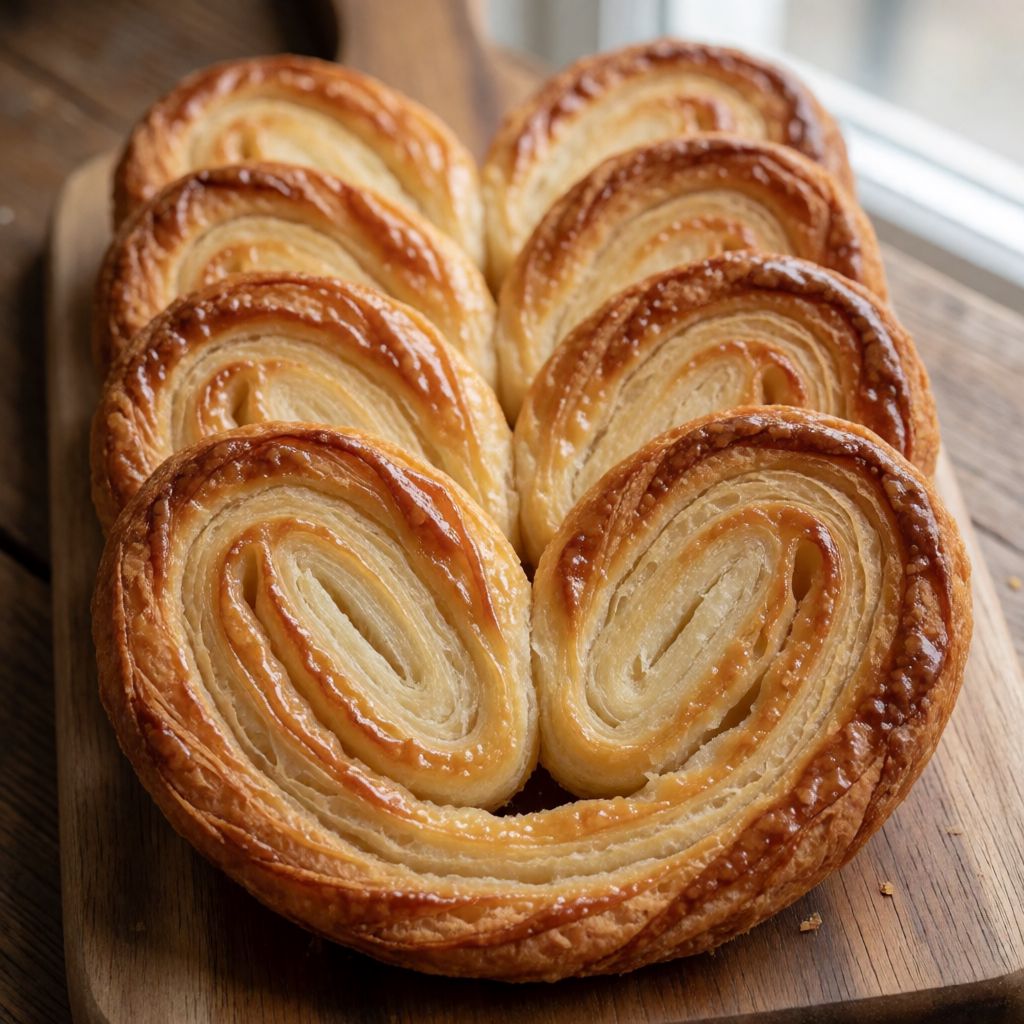
 AI photo
Palmiers (Puff Pastry Fans)
Crisp, golden puff pastry fans caramelised with sugar – a simple, classic treat.
Labels are worked out automatically from the ingredients and can be wrong. Check the packaging if it matters to you.
Ingredients
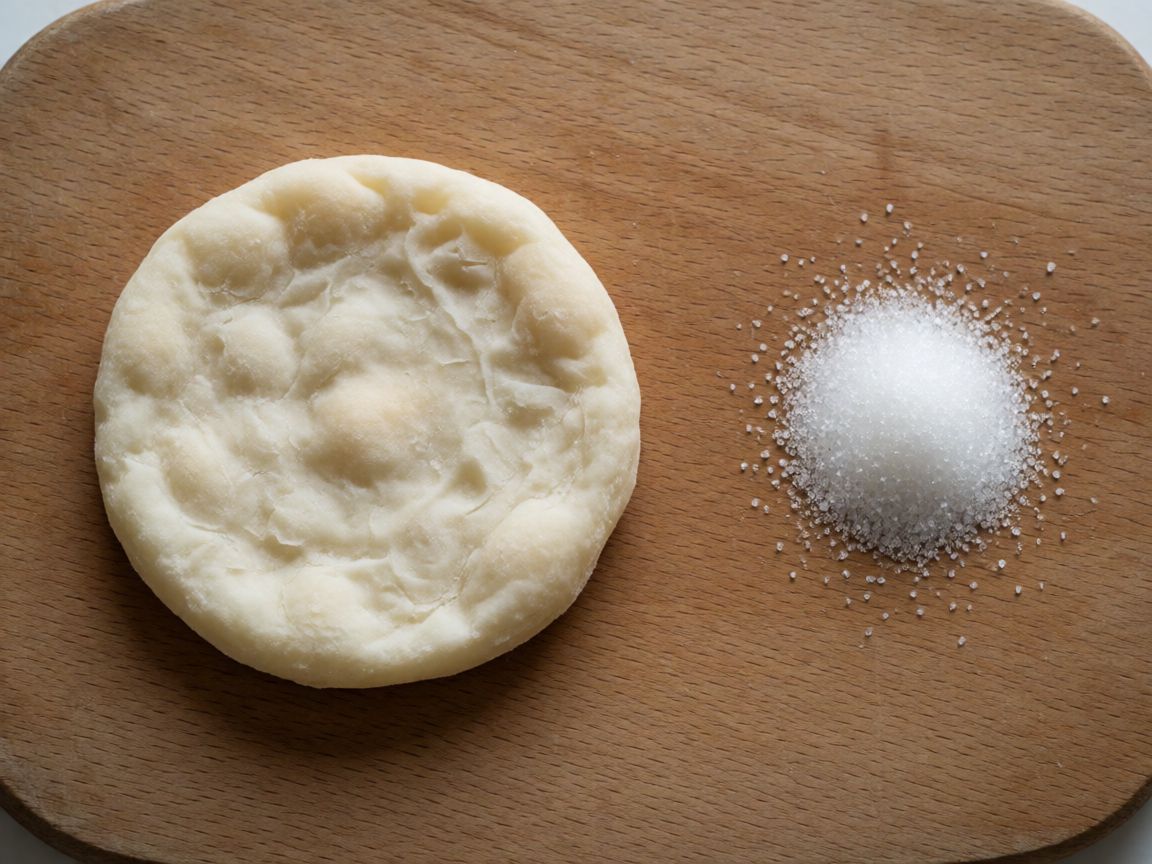
- 1 pcs Ready-rolled puff pastry
- 80 g Sugar
- Water as needed


Steps
Unroll the puff pastry together with its baking parchment.
Sprinkle the surface evenly with sugar. Add cinnamon if you like.
Roll both edges of the pastry towards the centre, forming two tight, compact rolls.
Put in the fridge.
15 minUsing a knife, cut into slices about 1 cm thick and lay them on the parchment.
Dissolve the remaining sugar in the water and brush this syrup over the biscuits.
Bake in an oven preheated to 200°C.
15 minTurn the pastries over, gently press with a spatula and bake for a few more minutes.
5 min
This is two scrolls of sugared puff pastry, rolled from the outside edges in towards the middle, chilled, then sliced into discs and baked until the cut faces turn hard amber while the middle stays soft and leafy. The shape — a heart, or a palm leaf if you squint, which is where the name comes from — isn't decorative fussing, it's just what happens when a tight spiral of pastry opens up under heat.
What decides whether it works is temperature of the dough, not of the oven. Puff pastry rises because it's made of thin sheets of fat between thin sheets of dough; when heat hits, water in the dough flashes to steam, and that steam, trapped by the fat, shoves the layers apart. If the fat has already gone soft and started soaking into the dough — because you handled the roll too long on the worktop, or skipped the chill — there's nothing left to push against, and you get a flat, dense biscuit instead of a fan of crisp wings.
Sugar does two jobs at once: it caramelizes on the outside for crunch and colour, and it pulls moisture out of the surface, which is what lets that outside crisp rather than stay soft. The fifteen minutes in the fridge is a lower bound, not a deadline — what you're waiting for is the roll to firm up enough that a knife goes through clean, without dragging the layers sideways or squashing them flat. You'll feel the difference the moment the blade meets resistance instead of mush.
Two hundred degrees is the point hot enough to flash the dough's water into steam fast, before the butter has time to fully melt and drain away — go lower and the fat renders out before the structure sets, go higher and the sugar on the surface chars before the centre has cooked through. Your oven's dial can lie to you by a surprising margin, so don't trust the number alone: wait for the cut edges to go a proper deep amber, the way an onion turns from gold to ginger, not the pale straw colour that looks nearly there but isn't.
The flip halfway through, with the gentle press of a spatula, isn't fussing either. By the time the underside has set, the sugar beneath it has melted into a thin syrup sitting against the parchment — left there it scorches. Turning the pastries exposes that side to direct heat evenly, and the press flattens the two faces so they both crisp rather than one staying soft and curled. A palmier that's still domed in the middle hasn't finished; you want it flat and dry-crisp all the way through, not just browned at the tips.
On the pastry itself: an all-butter ready-rolled puff gives you a cleaner result than one made with margarine or a vegetable-fat blend, because butter melts at a fairly sharp, known point, producing one decisive burst of steam. Fat blends melt over a wider range and tend to leave things slightly greasy rather than crisp. If all-butter isn't on the shelf, don't worry — ordinary ready-rolled puff still puffs, it's just a shade flatter in flavour, not in structure.
Caster sugar coats the surface more evenly than granulated, because the finer crystals melt sooner and spread into a thin film rather than sitting in gritty clumps; granulated will still work, it just needs a little longer at the edges before it caramelizes properly — judge it by colour, not the clock. Cinnamon is offered as an option in the method, not as tradition demanding it: it costs nothing to add and changes nothing about how the pastry behaves, so use it if the smell pleases you and skip it if it doesn't.
The sugar-water brushed on before baking does the same job as glazing a loaf of bread: a thin wash that caramelizes quickly on the surface, giving shine and a slightly harder shell, separate from the sugar baked inside the layers. Don't assume the inner sugar is enough and skip this — the brushed layer is the one your eye and your teeth meet first.
They're an easy match for tea with milk — sharp caramelized sugar on the outside, plain pastry in the middle, which sits well against milk rather than fighting it, unlike something richer. And patience really is the ingredient doing the most work here: rush the chill and you'll get flat sugared crisps that taste fine but never opened into fans; give it the full rest and the oven does the rest of the work for you.