
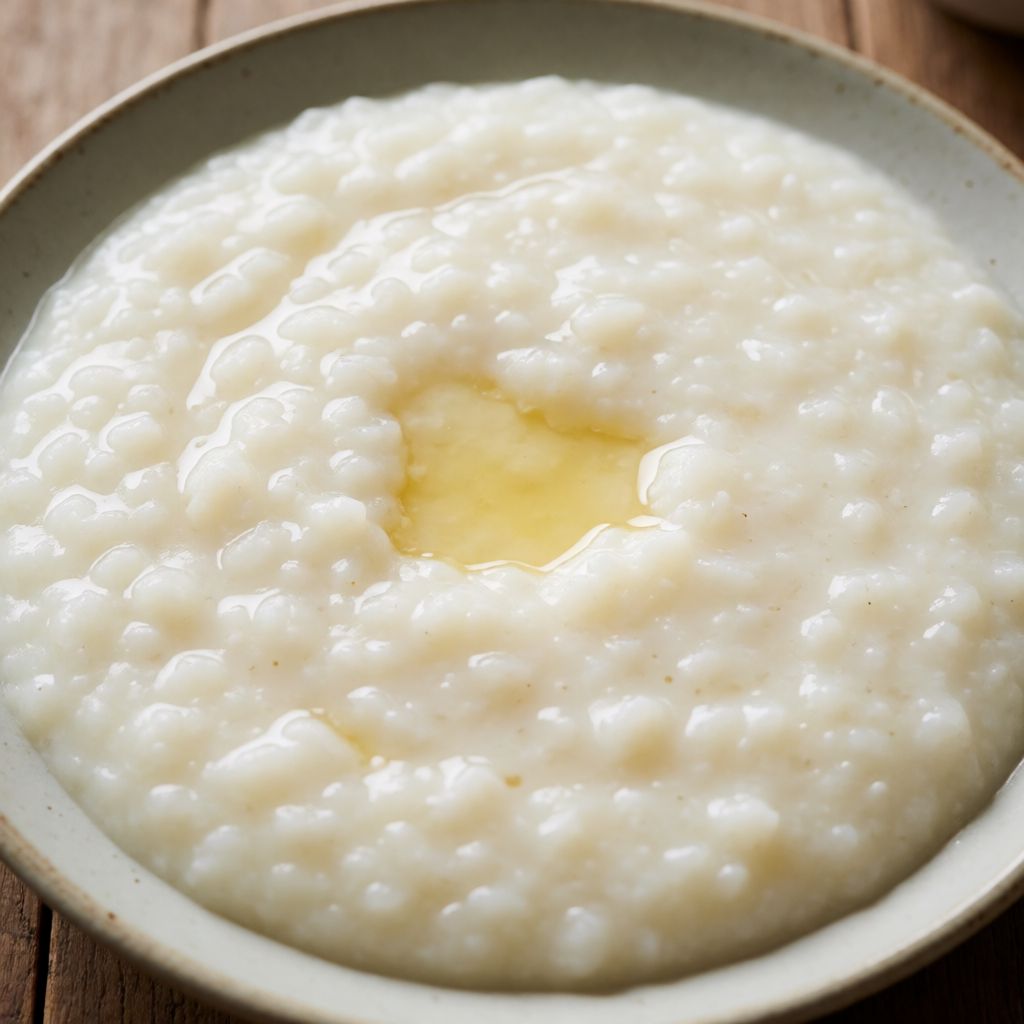
 AI photo
Rice Pudding with Cinnamon and Butter
A creamy baked rice pudding finished with cinnamon and a knob of butter.
Labels are worked out automatically from the ingredients and can be wrong. Check the packaging if it matters to you.
Ingredients







Steps
Put the pudding rice in a pan with the water and bring to the boil on the hob, stirring.
Pour in the milk once the water has boiled away, and heat the pudding, stirring, almost to the boil.
Cover the pan with a lid and place it in an oven preheated to 125°C.
Leave the pudding in the oven for about 35-40 minutes; the time may vary slightly depending on the pan.
40 minStir the pudding 1-2 times during cooking: remove the lid with an oven glove, stir, cover again and continue cooking.
Take the pan out of the oven, remove the lid and stir the pudding well.
Cover with the lid and let the pudding rest for a further 5 minutes before serving.
5 minIf there is too much milk in the pan, simmer it for a few minutes on the hob without the lid.
Cooking the pudding in the oven means it won't catch, there's no need to stir constantly, and you can get on with other things.
Rinse the pudding rice in cold water and put it in a pan with twice the amount of water given in the recipe.
Bring to the boil, stirring.
Pour the milk into the pan with the rice once the water has boiled away, and stir well for a few minutes, heating almost to the boil.
Reduce the heat to low and stir for another minute.
Cover the pan with a lid and leave on a low heat.
Stir the pudding roughly every 10-15 minutes, until the rice is soft and the pudding tastes good.
Add a little salt and serve the pudding hot with a knob of butter and cinnamon.
This is rice cooked in milk until it stops being rice-with-milk and becomes one soft mass — the starch let out of the grain thickens the liquid instead of just sitting in it. What decides whether it works isn't the rice or the milk, it's the heat: too fierce and the milk catches on the bottom of the pan before the grain has softened; too gentle and you're stirring for an hour and still have soup with grains floating in it.
Some say rice pudding has to be baked in the oven in a proper dish with a skin on top — no, because that's one method among several, born of having an oven already on for the Sunday roast and a free bottom shelf for two hours. The oven version in this recipe does the same job at a lower, steadier heat than any hob burner manages without babysitting: 125°C is gentle enough that the milk never gets close to scorching, so you can leave it covered and go and do something else. That's the whole point of it — not flavour, not tradition, just: nobody wants to stand at a cooker stirring milk for forty minutes.
The hob method is the older, more honest one in the sense that it asks more of you. You boil off the water first — that's not an odd detour, it's there to pre-soften the rice before the milk goes in, because rice cooked straight in milk from dry takes longer and risks the milk breaking down before the grain's done. Once the milk's in, the heat drops right away and stays low, because milk simmered hard splits and skins over; a low, steady heat lets the starch dissolve slowly into it instead.
Pudding rice — the short, round, starchy grain, not basmati or any long-grain — is chosen because it carries more surface starch to give up into the milk. Long-grain rice stays separate and bouncy; it's bred to do that for pilaf, which is exactly the wrong trait here. If pudding rice isn't in the cupboard, risotto rice (arborio) is the nearest stand-in — it releases starch the same way, just with slightly firmer grains at the end. What you're choosing for is the starch content, not the shape.
The milk is the actual cooking medium, not a flavouring — two litres to 400g of rice is roughly five parts liquid to one part grain, because rice needs to sit swelling in liquid for most of an hour and most of that liquid needs to still be there, thickened, at the end. Full-fat milk gives body; if you use something leaner the pudding will be thinner and need longer to thicken, because there's less fat to carry the texture. This isn't a dish that forgives skimmed milk and a short cooking time both at once.
The initial water and its boiling-off (step 1-2, or 10-11) isn't padding in the method — it gives the rice a head start softening in plain liquid before the milk's sugars and proteins are in the pan, which is also why the milk shouldn't be added before the water's gone: milk introduced too early, to raw rice, means the grain and the milk are racing each other, and the milk usually loses, catching or skinning before the rice is actually cooked.
Salt here is doing what salt always does in a sweet dish — not seasoning toward "salty" but sharpening the sweetness you perceive, which is why half a teaspoon in two litres is enough; you're not meant to taste it as salt.
Sugar and cinnamon and butter go in late or on top, by design, not at the start — sugar heated with milk for forty minutes tends to catch at the pan bottom faster than milk alone, and cinnamon boiled that long loses its top notes and turns into dust-flavour rather than warmth. Added at the end, or stirred through at serving, they stay themselves. The butter is for melting on the hot surface at the table — any butter will do, there's no technical reason here for salted over unsalted, it's just a last fatty gloss, so use what's in the fridge.
If you've no oven free — maybe it's full of a Sunday roast and you need the hob version anyway — remember the trade you're making: more attention from you, in exchange for not tying up the oven. Neither method is the "proper" one; they're two answers to the same problem of keeping milk from scorching while starch does its slow work, chosen by whatever else your kitchen is doing at the time.