
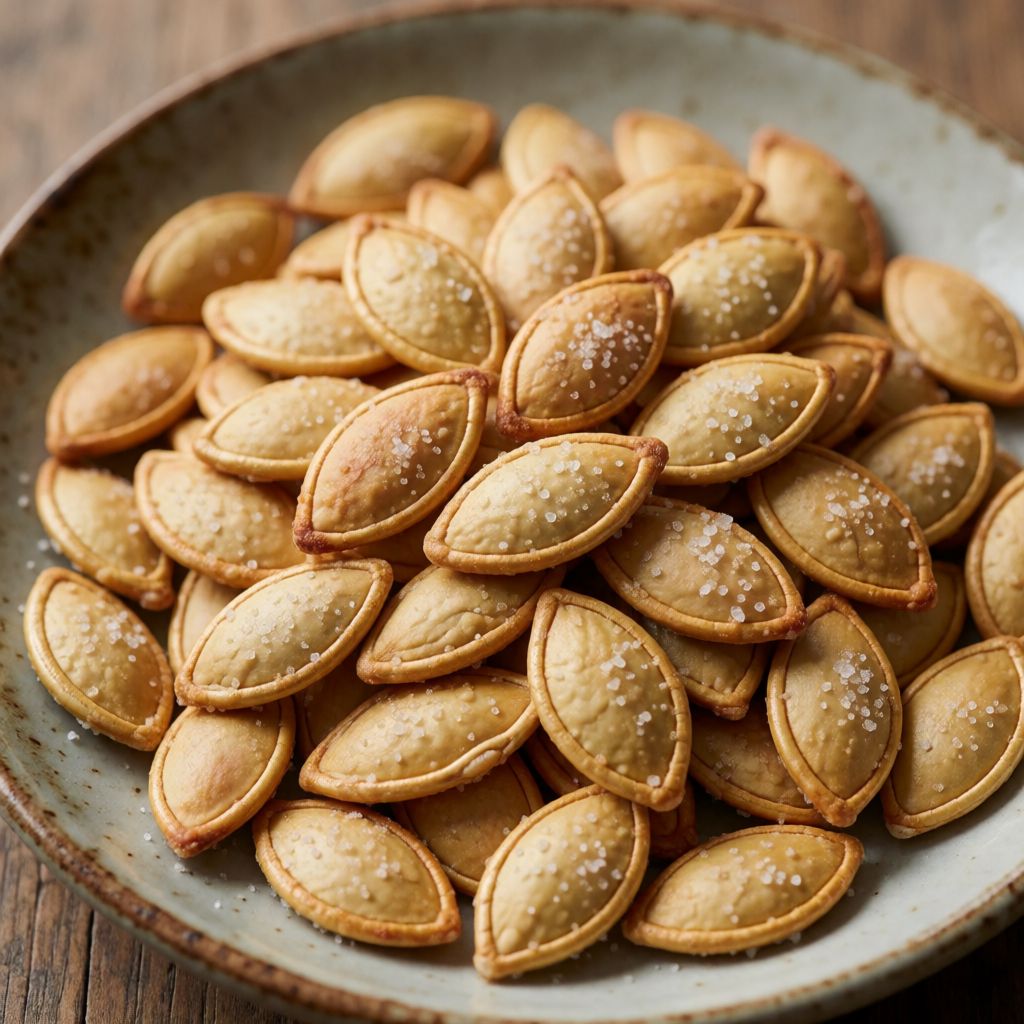
 AI photo
Roasted Pumpkin Seeds
A simple way to turn saved pumpkin seeds into a crunchy, golden roasted snack.
Labels are worked out automatically from the ingredients and can be wrong. Check the packaging if it matters to you.
Ingredients



Steps
Scoop the seeds out of the pumpkin with a spoon, then rinse them, removing any flesh and fibres. Lay them on paper towels and pat dry.
Dissolve the coarse salt in the water and soak the pumpkin seeds for at least 8 hours.
480 minDrain the seeds, spread them on a towel, pat dry and leave to dry for at least 1 hour.
60 minPreheat the oven to 160°C. Line a baking tray with parchment paper and spread out the seeds.
Roast for about 1 hour, turning the seeds every 8-9 minutes.
60 minPut butter or olive oil on a microwave-safe plate and heat for 30 seconds.
Spread the seeds on the plate and microwave until golden, stirring every 2 minutes.
8 minTransfer the seeds to a frying pan over medium heat. Stir constantly for about 1 hour, until golden.
60 min
This isn't really a recipe for a dish — it's a recipe for not binning something. You've already used the pumpkin, for soup or a pie or next to the Sunday roast instead of parsnip, and what's left is a bowl of slippery seeds that usually go straight in the bin. Treat them properly and they turn into a salty, crunchy little handful — good with tea, good on its own, good because it cost you nothing extra.
What decides whether it works is two things: whether the salt gets into the seed, not just onto it, and whether the seed is properly dry before any heat touches it. Everything else — which oven, which pan, which plate — is detail.
Some say rinse the seeds and go straight to a hot tray. No — because a wet seed on heat steams itself soft before it has any chance to brown, and no amount of extra roasting afterwards turns a steamed seed crunchy. It just turns it into a dry, chewy thing that tastes of the oven and nothing else. Dry first, always.
The recipe gives you three finishing methods — oven, microwave, frying pan. Read that as a menu, not a relay race. Pick the one that suits the kitchen you've got; running the same seed through all three, back to back, for an hour each, won't make it crisper, it'll make it taste of carbon.
The seeds themselves have no fixed weight here, and that's honest, not lazy — a pumpkin gives you what it gives you. Don't go buying a bag of shop seeds to top it up; this dish exists because the seeds were already there.
The brine is the real engineering. Seventy-five grams of salt in half a litre of water is strong — roughly one part salt to seven of water, closer to a preserving brine than a seasoning one. That's deliberate: the seed's shell is a poor doorway for salt, so you push concentration up and give it eight hours instead of eight minutes. Coarse salt is specified not for texture — you're dissolving it, so texture disappears — but because it's easier to weigh out seventy-five grams of large crystals accurately than fine ones that compact in the spoon. Table salt dissolves the same way and works fine if that's what's in the cupboard.
The hour of drying afterwards isn't a formality, it's the step that prevents the exact failure the myth above describes. Surface water sitting on the shell has to leave before heat can do anything useful — the same logic as patting a steak dry before it meets a hot pan, just applied to something the size of a fingernail.
The oven stage, 160°C, turning every eight or nine minutes — a domestic oven doesn't heat evenly, there's usually a hotter back wall or a fan that favours one side of the tray, and turning is how you stop one half roasting while the other sulks. 160°C is gentle on purpose: it lets the last of the inside moisture work its way out slowly instead of hardening the shell shut around it.
Butter or oil for the microwave finish is a flavour choice, not a technical one — butter gives you richness, a neutral oil (sunflower, rapeseed, anything with no voice of its own) lets the seed taste of itself, and olive oil sits in between, with its own opinion about the result. Use whichever you'd happily eat on bread.
The microwave and frying-pan steps are alternates for people without a reliable oven, or without patience for one more hour of it — but they ask for more attention, not less, because both are far more direct heat than oven air. A microwave plate has no buffer; a frying pan has even less. Stir or you'll find out the hard way, in the smell, before you find out in the taste. Count on the whole thing taking the better part of a day if you include the soak — nine of those hours are just sitting, which is the cheapest ingredient in the recipe and the one people skip first.