
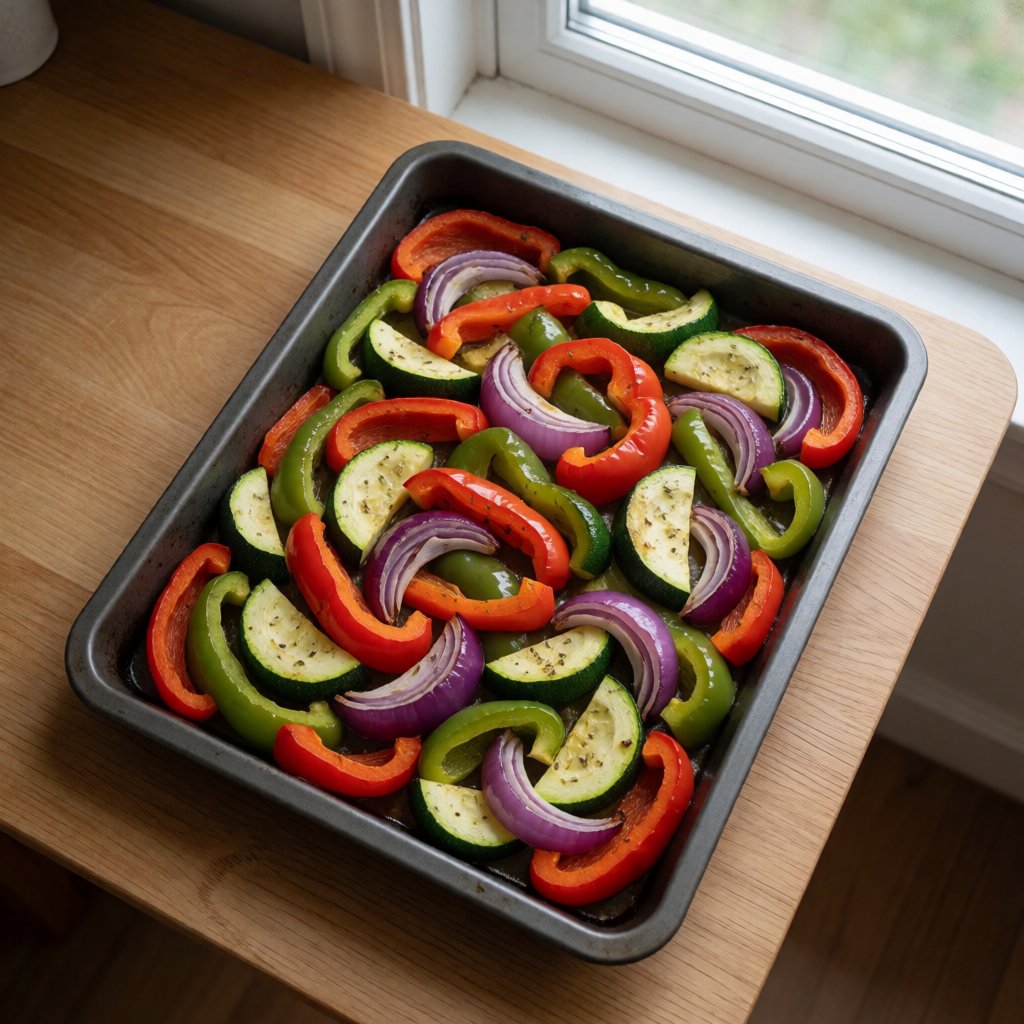
 AI photo
Roasted Vegetables: Pepper, Courgette, Onion
Roasted peppers, courgette and onion, tossed with oil and herbs and baked until tender.
Labels are worked out automatically from the ingredients and can be wrong. Check the packaging if it matters to you.
Ingredients
- 2 pcs bell pepper
- 1 pcs courgette
- 1 pcs red onion
- 2 tbsp sunflower oil
- 1 pinch salt to taste
- 1 pinch dried herbs to taste, such as herbes de Provence


Steps
Cut the vegetables into large chunks, about 3 cm.
Toss with the oil and spices, and spread loosely on a baking tray.
Put the tray into an oven preheated to 200°C for 30 minutes.
30 minTake the tray out of the oven.
This is not really a "recipe" so much as a demonstration of what dry heat does to vegetables that have given up their crunch. Pepper, courgette, red onion - three different structures, same oven, same outcome: edges that caramelise, middles that soften. No sauce, because none is needed - oil and the vegetables' own sugar do the work.
The single decision that decides whether this works is not the temperature, not the time - it's how loosely you spread them on the tray. Crowd it and you've built a lidded pan by accident: the moisture coming off courgette and onion has nowhere to go, it sits on everything, and the vegetables end up boiling in their own steam rather than roasting. Spread them with gaps between pieces and that same steam just leaves, straight up and out of the oven, which leaves a dry surface for the heat to actually brown. That's the mechanism this whole dish stands on.
200°C is hot enough to dry a wet vegetable surface fast and then catch the sugars in it before anything has time to collapse to mush. Any cooler and you'd mostly be slow-steaming them in their own water; much hotter and the outside chars before the middle gives in. Thirty minutes is where you start checking, not where you stop - look for pepper skin blistered and a bit charred at the edges, onion gone from sharp pink to soft amber, courgette no longer squeaky-firm but not collapsed either.
Peppers: pick ones with firm, taut skin and no give when you press - a soft pepper has already started losing water on the shop shelf and turns to rag in the oven instead of blistering. Colour is yours to choose; red and yellow peppers are just riper green ones, sweeter for it, which matters more here, cooked plain, than it would raw in a salad.
Courgette is almost entirely water - that's the whole problem with it. Cut it small and there's nothing left at the centre after thirty minutes of dry heat; cut it to roughly the same 3cm as everything else and there's enough bulk in the middle to stay a vegetable instead of becoming juice on the tray. No courgette - any other thin-skinned, high-water squash behaves the same way. Aubergine is close in texture but drinks oil rather than releasing water, so give it a little more.
Red onion earns its place because it's sweet enough in big chunks to hold its own against pepper and courgette, and it keeps some colour through the browning instead of disappearing the way a standard onion does - you can still see the layers once the edges have gone caramel. Any onion roasts fine; a white or brown one just ends up a less interesting colour on the plate.
Sunflower oil has one job: coating the surface so heat transfers evenly and nothing welds itself to the bare tray. Any oil with no strong smell of its own does the same - rapeseed, a plain vegetable oil, whatever's in the cupboard. Olive oil works too, but at 200°C for half an hour you're not tasting its fruitiness, you're burning it off for nothing - save the good stuff for drizzling on afterwards if you want that flavour at all.
Dried herbs, not fresh, for a plain reason. Herbes de Provence is mostly rosemary, thyme, oregano - woody, low-moisture herbs that sit through thirty minutes of dry heat without turning bitter. Fresh basil or parsley would scorch long before the vegetables are done; if that's all you've got, add it after the tray comes out, not before.
Salt goes on with the oil, before the oven, but as a pinch - not a seasoning you adjust to taste at that stage, because you can't taste raw vegetables usefully anyway. Salt pulls water to the surface; a little speeds up the evaporation that has to happen before browning can start, too much keeps the tray wet and slows the whole thing down. This feeds two as a side, generously. Doubling it for four means doubling the tray space, not just the vegetables - crowd a bigger pile onto the same tray and you're back to steaming, whatever the numbers say.
·