
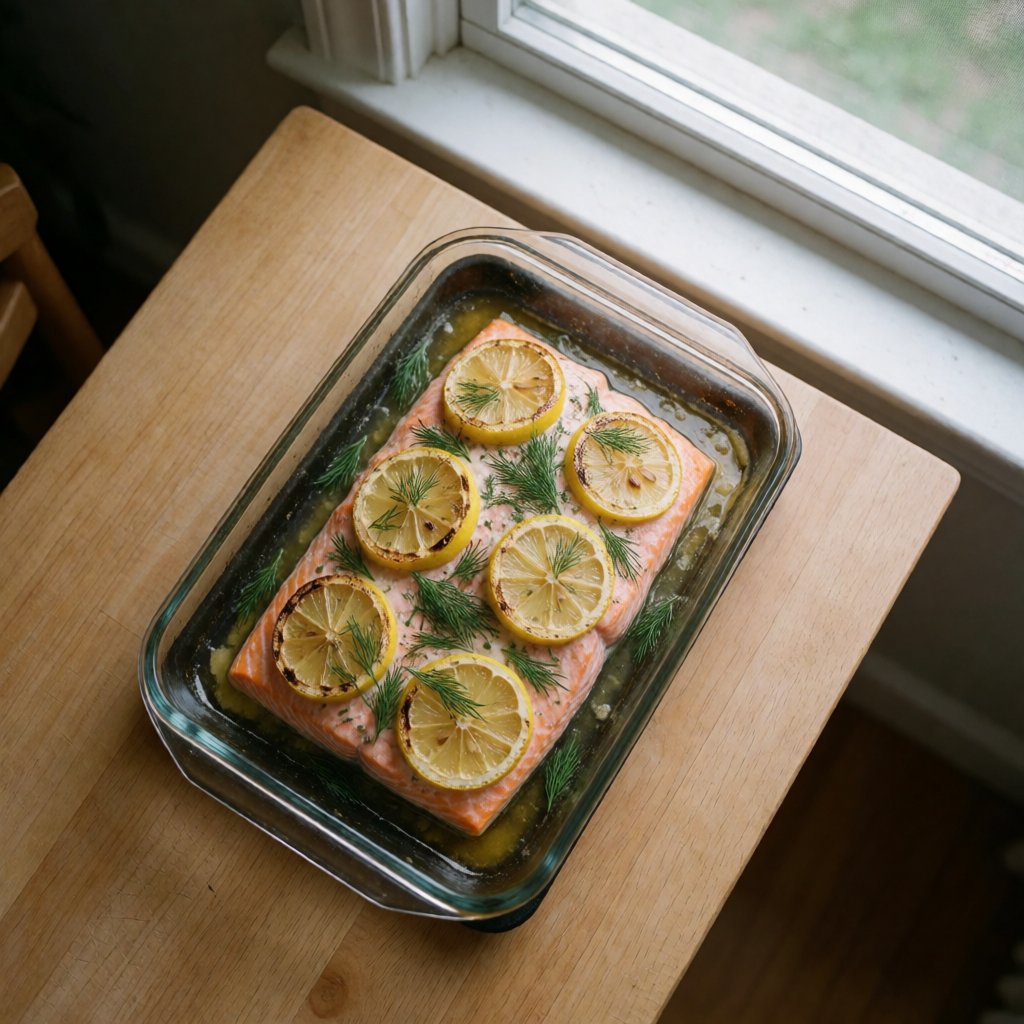
 AI photo
Salmon with Lemon and Dill
A quick weeknight salmon baked with lemon slices and dill.
Labels are worked out automatically from the ingredients and can be wrong. Check the packaging if it matters to you.
Ingredients
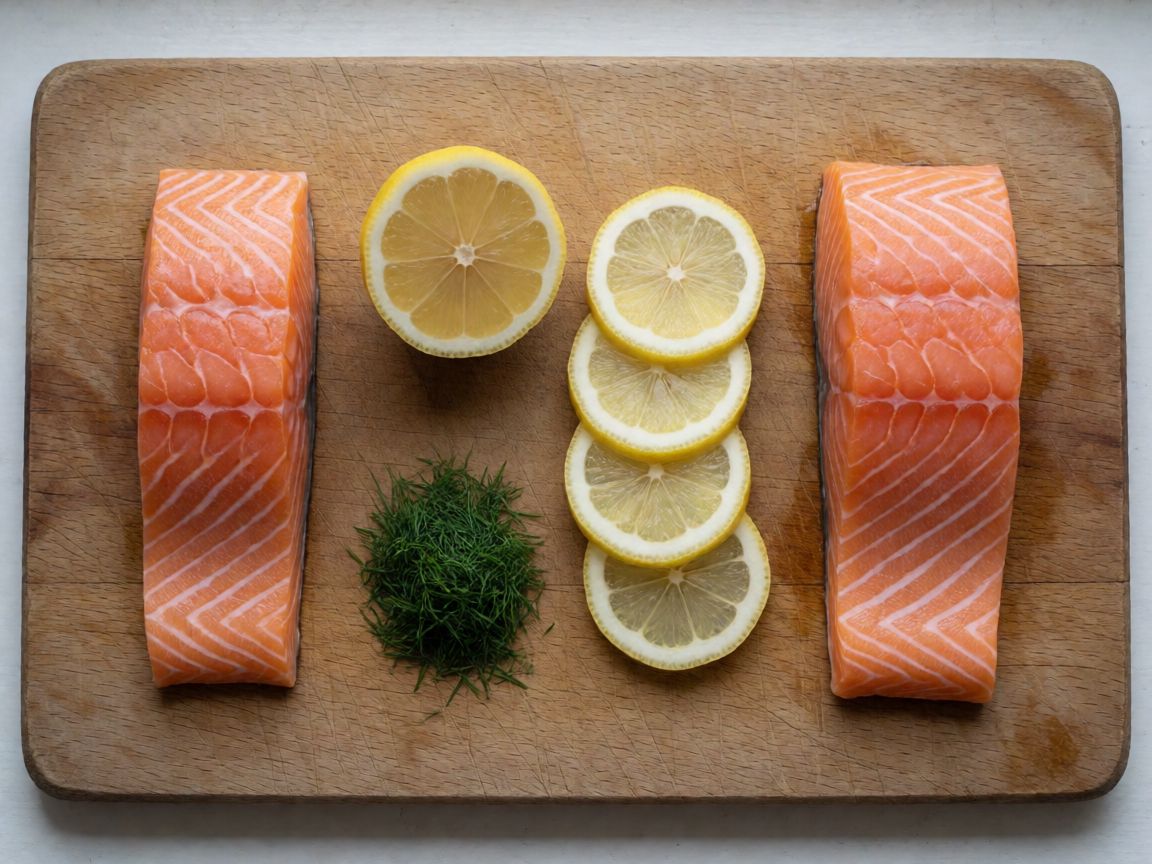
- 300 g salmon fillet 2 pieces, about 150 g each
- 0.5 pcs lemon thin slices
- 1 pinch dill to taste
- 1 tsp sunflower oil
- 1 pinch salt to taste





Steps
Season the fish with salt, brush with oil, then top with thin lemon slices and dill.
Place in an oven preheated to 200°C for 18 minutes, until 63°C inside.
18 minRemove the fish from the oven.
This isn't really a recipe so much as a protective coat thrown over a fast fish before you shove it into a hot box. Two fillets, a handful of lemon slices, a pinch of dill — minimal, because salmon doesn't need help, it needs defending. Left bare on a tray at 200°C it dries out in minutes; the oil and lemon are there to slow that down, not to flavour the fish for show.
What decides whether this works isn't the 18 minutes on the timer — it's the 63°C. That's the only number here worth trusting. Below it the fish is still raw in the middle; a few degrees above 70 and the proteins have already squeezed their moisture out, and no amount of lemon brings that back. The minutes given are a guess for people without a probe thermometer — a lower bound, not a deadline. If you own even a cheap meat thermometer, use it; it ends the guessing game completely.
And here's a myth worth retiring: "fish is done when it flakes and goes white all through." No — by the time it flakes that easily, it's already overcooked. You want the flesh just losing its glassy, translucent pink, still holding together, giving gently under a fork rather than collapsing into dry threads. Catch it there, not later.
Salmon fillet: look for flesh that's firm and springs back a little when you press it, deep pink to orange, no grey bruising at the edges. Skin on or off is your choice — skin on gives you a little crisp underside and holds the fillet together in the heat, skin off cooks a touch faster since there's no barrier to push through. If salmon's not available or the price has put you off, trout works on the same logic — it has the same fat running through it that keeps the flesh from seizing up and turning dry under direct heat. Thin white fish like cod doesn't behave the same way here; it has almost no internal fat to self-baste with, so this particular method isn't built for it.
Oil: the rule isn't "sunflower oil", it's any oil with no smell of its own — sunflower, rapeseed, even a flavourless light olive oil if that's what's open. Its job is to sit between the fish and the dry oven air, slowing the surface from crusting over before the inside has caught up, and to carry what little flavour the lemon and dill give off down into the flesh rather than letting it sit on top and burn off. Skip the oil and the surface toughens fast while the middle lags behind — that's the usual reason home-baked fish ends up with a leathery top and a cold centre.
Lemon: thin slices, not juice squeezed over. Juice runs straight off a tilted fillet and pools in the tray, which poaches the fish in acid rather than roasting it, and gives you a sourer, wetter result than intended. A thin slice sits where you put it, softens, blisters slightly, and shields the patch of fish underneath from the full blast of hot air — a small parasol, really. Cut the slices thick and you get raw pith that's bitter and never cooks through in 18 minutes; thin is the whole point.
Dill: fragile, and placed under cover of the lemon slice rather than loose on the tray, because dill thrown directly into 200°C dry heat for 18 minutes turns to ash and bitterness long before the fish is done. Any soft herb that doesn't need slow cooking to release itself works the same way — fennel fronds, chervil, even flat parsley at a pinch, though none of them smell quite like dill, and that's fine, this isn't a dish that lives or dies by one herb.
Salt: put it on right before the fish goes in, not an hour earlier in the fridge. On a fillet this thin, salt applied early pulls moisture out through the surface by osmosis, and that moisture doesn't go back in — you'd be roasting a slightly pre-dried piece of fish. Salt it at the counter, straight onto the tray, straight into the oven.
On a UK domestic oven: most fan ovens run hotter than the dial claims, so if you've roasted enough Sunday joints to know yours runs fierce, trust that knowledge over the number on the recipe and check the fish a few minutes early. No roasting dish needed — a flat tray lined with parchment for the washing-up's sake is enough; this dish doesn't ask for a lid or steam, it wants dry open heat with a thin shield on top. And once it's out, give it a minute before you cut in — the fish keeps climbing those last degrees off the heat, finishing itself gently rather than you rushing it onto the plate. That minute of patience is as much a part of this as the lemon.
·