
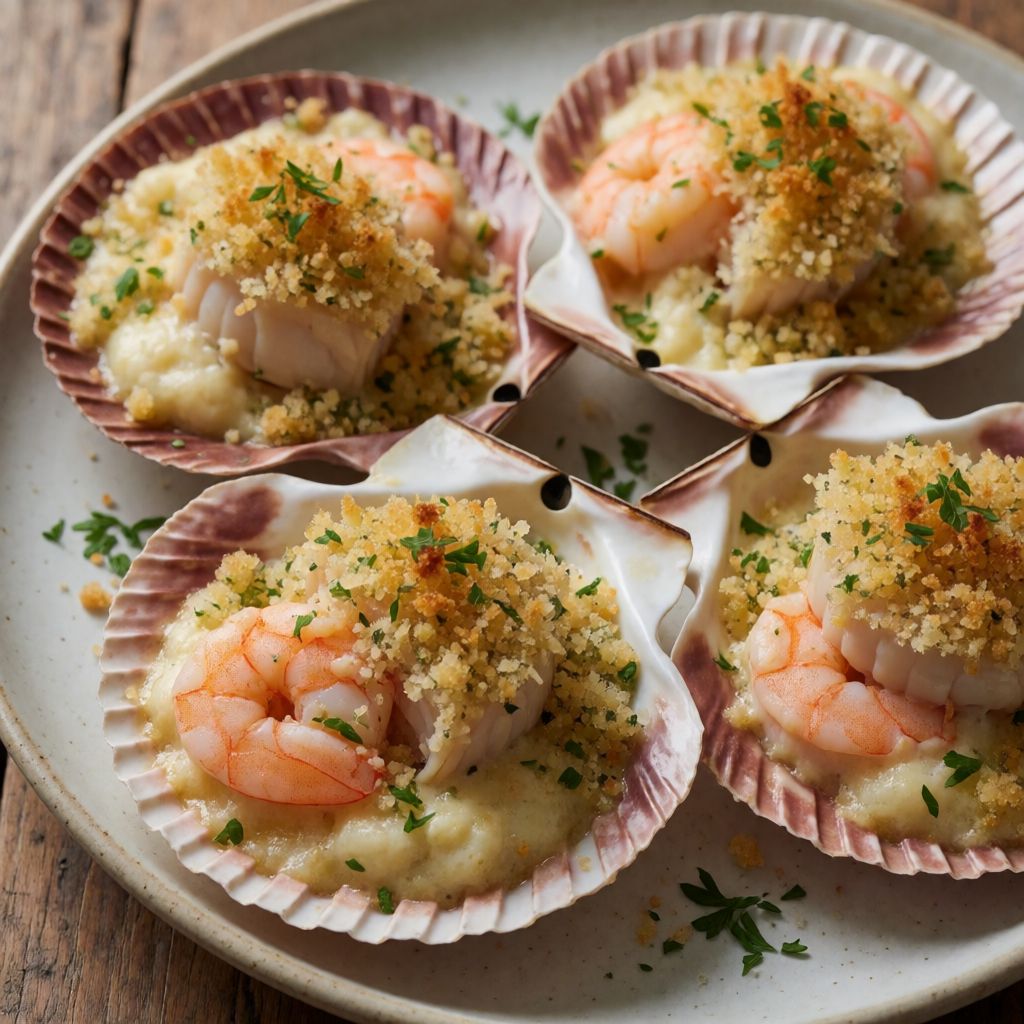
 AI photo
Scallop Gratin with King Prawns in Vermouth
A quick scallop and king prawn gratin baked with breadcrumbs and a splash of vermouth.
Labels are worked out automatically from the ingredients and can be wrong. Check the packaging if it matters to you.
Ingredients
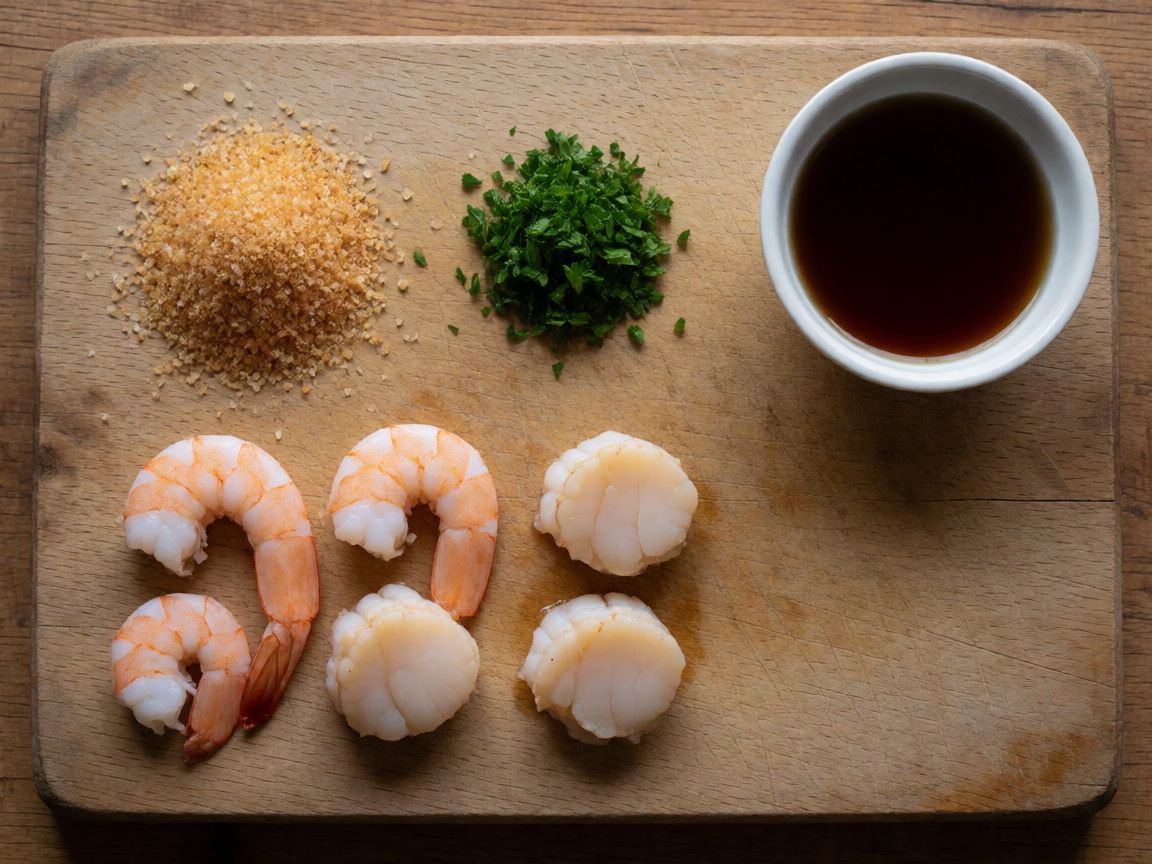
- 120 g Breadcrumbs dried
- Salt to taste
- Black pepper to taste
- Parsley to taste
- 25 ml Olive oil
- 25 ml Dry vermouth or Sambuca
- 4 pcs King prawns
- 4 pcs Scallops





Steps
Mix the breadcrumbs, salt, black pepper, parsley, olive oil and vermouth until evenly combined.
Clean the prawns, removing the head, shell and tail, and devein them.
Line a baking dish with baking paper, arrange the scallops and prawns, sprinkle with the breadcrumb mixture and drizzle with olive oil.
Bake in the oven at 180°C. Doneness: 63°C at the thickest point.
8 minServe hot.
This is not a sear and it's not a stew — it's a thin crust baked onto raw-tender shellfish, the kind of dish that works because the oven does almost nothing and does it fast. Four minutes either way and you've either got dry crumb over rubber, or wet paste over raw fish. The margin is narrow on purpose.
What decides it is the paste on step one — breadcrumbs bound with oil and vermouth until they clump like wet sand. That clumping matters: dry crumb on its own just toasts and falls off, scorching before the prawn underneath is even warm. Wet it enough and the crumb steams gently against the shellfish while the top of it crisps — two different cooking methods stacked in one pan, which is the whole trick of a gratin.
Some say scallops need a hard sear in a hot pan to be worth eating, that's the only way to get flavour into them. No — that's one method for one effect, a caramelised crust and a raw centre. This is a different dish entirely: here the crust is the crumb, not the scallop's own surface, and the scallop underneath barely crosses into "cooked" at all. Don't try to make this dish behave like a seared one, you'll just overshoot it.
Breadcrumbs: dried, not fresh. Fresh crumb carries its own moisture and goes gummy under the vermouth instead of staying structural — you'd end up with paste on paste, nothing that crisps. Dried crumb can drink in the oil and vermouth and still hold a shape, which is the only reason it browns rather than just steams. If you're making your own, dry stale bread properly first — damp heel-of-the-loaf crumb will betray you here the same way shop-bought fresh ones do.
Olive oil, in the crumb and drizzled after: its job is to carry the vermouth's aroma into the crumb and stop the crumb from scorching dry in a hot oven, nothing more poetic than that. Any oil with no smell of its own strong enough to fight the seafood will do the same job — a light olive, a sunflower, something neutral. Don't reach for a heavily peppery extra virgin here; its personality has nowhere to hide and will sit on top of the prawn instead of behind it.
Vermouth, or Sambuca: both are dry, aromatic, and mostly going to cook off in the oven, leaving behind the herbal or aniseed note they were infused with rather than raw alcohol. Vermouth gives you a bitter-herbal backdrop that cuts the natural sweetness of scallop meat; Sambuca swaps that for an anise top note that does something similar from a different angle — pick by what you want sitting next to shellfish, not by what's in the cupboard. No vermouth, no Sambuca: dry white wine with a pinch of crushed fennel or anise seed gets you close enough. What you're looking for is dry and aromatic, not sweet — a sweet liqueur here will caramelise in the crumb and burn before the fish is through.
King prawns: buy them shell-on if you can and do the cleaning yourself — removing head, shell, tail, and the dark vein running along the back, which is the gut track, not decoration, and tastes of grit if you leave it. This is fifteen minutes of fiddly work, not skilled work, and it's where the patience in this recipe actually lives — the oven time is nothing, the prep is the whole job.
Scallops: buy dry-packed if the counter can tell you which is which. Wet-packed scallops have been dunked in a phosphate solution that bulks them with water for weight — that water comes straight back out in the oven, turns your crumb to porridge, and steams the scallop from underneath instead of letting it bake. A dry scallop looks slightly matte and feels tacky, not shiny and wet; that's the one you want.
A Sunday-roast oven that's used to running hot and holding heat evenly is actually an advantage here — you want consistent, gentle top heat, not a blast. If your oven runs hotter at the back or the top element browns faster than the middle cooks, turn the dish halfway and trust the thermometer over the dial. Four people, one scallop and one prawn each, is a starter's portion, not a main's — treat it as the opening of a meal, something to eat slowly with bread for the vermouth left in the dish, not the thing that fills you up.