
 AI photo
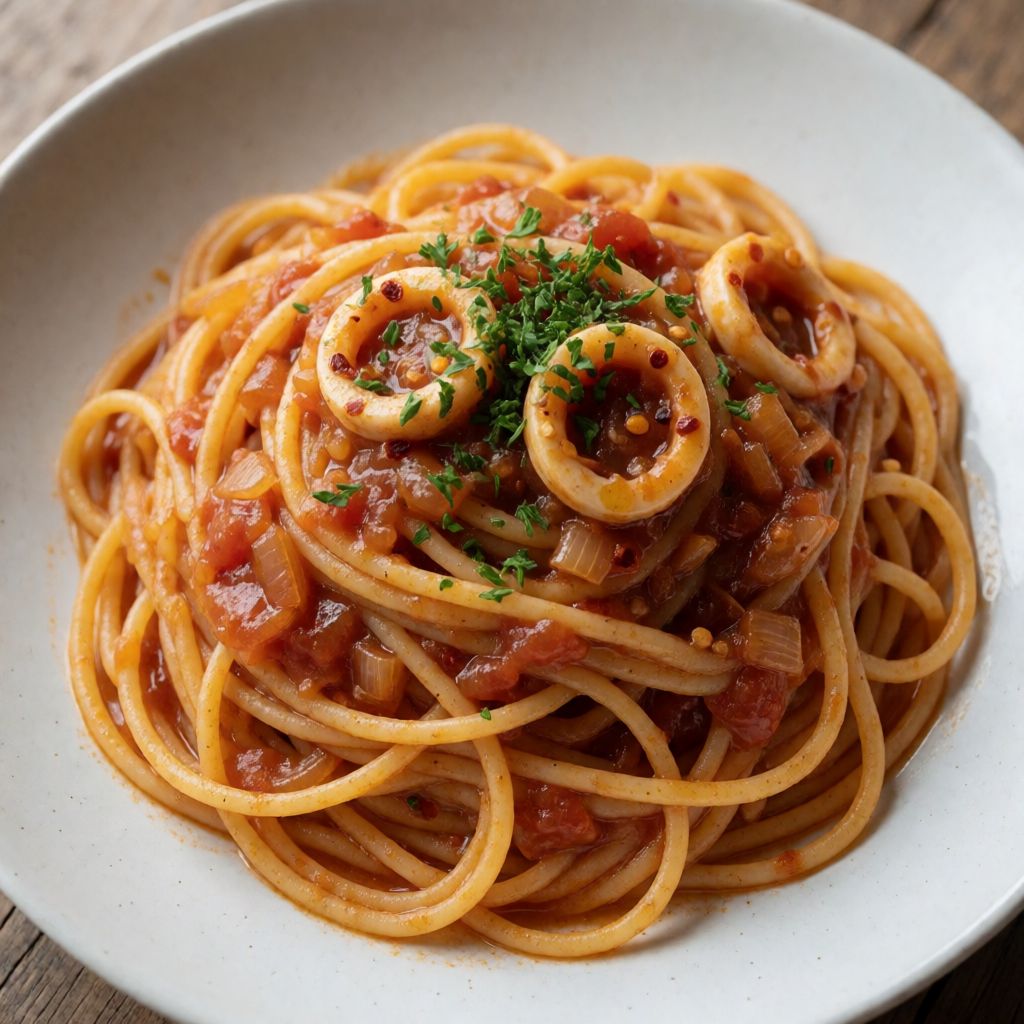
Spaghetti with Squid Sauce (Calamarata)
A quick Italian-style spaghetti with a rich squid sauce, finished with chilli and parsley.
Labels are worked out automatically from the ingredients and can be wrong. Check the packaging if it matters to you.
Ingredients
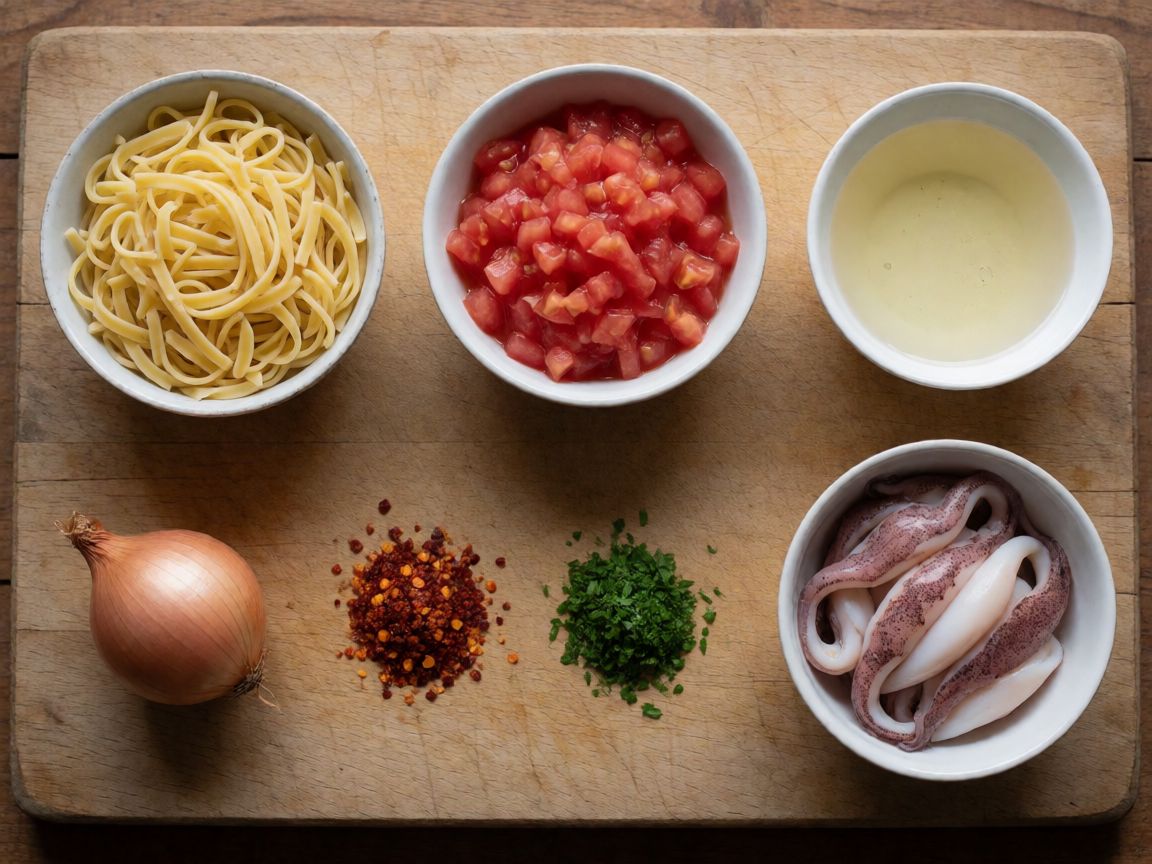
- 400 g Spaghetti
- 230 g Peeled San Marzano Tomatoes
- 1 pcs Onion or shallot
- 2 tbsp Olive Oil
- 1 pinch Chilli Flakes crushed
- Parsley to taste
- Salt to taste
- 500 g Squid cleaned
- 8 tbsp White Wine









Steps
In a pan, sauté the onion in olive oil until translucent.
Add the crushed chilli flakes and the squid, sliced into rings, and fry gently.
Cook the squid gently for 5 minutes.
5 minPour in the white wine and let it evaporate.
Add the peeled San Marzano tomatoes and simmer. Doneness: 63°C at the thickest point.
Add salt to taste and sprinkle with parsley.
Cook the spaghetti until al dente.
Drain the spaghetti, toss with the finished sauce, sprinkle with parsley and serve.
This is a Neapolitan dockworker's dish dressed up for a dinner table: squid, which was cheap and plentiful, stretched over pasta with whatever tomatoes were put up in jars the summer before. The name "calamarata" belongs to the sauce and to a ring-shaped pasta that mimics the squid itself — here you're using spaghetti, which is a perfectly honest swap, because the sauce doesn't care what shape carries it to your mouth.
What decides whether this works is not the tomato, it's the squid. Squid mantle is almost pure muscle with barely any connective tissue, and that muscle does one thing under heat: it seizes. Hit it hard and keep hitting it, and the fibres squeeze out their water and go to rubber in minutes. That's why the squid gets a short, gentle fry, then a short simmer under the tomato — you want it in and out of the danger zone fast, not lingering in it.
Some say squid needs a long, slow cook to go tender, the way you'd braise an octopus leg for an hour. True, but that's a different clock entirely — octopus has thick connective tissue that needs real time, an hour or more, to melt. A sliced squid ring sitting in a tomato sauce for the twenty minutes it takes to boil your pasta is in no-man's-land: too long for quick-sear tenderness, nowhere near long enough for braise tenderness. So this recipe refuses the middle ground — short sear, short simmer, done.
Start with the squid itself. Buy it cleaned if you can — it saves you a messy ten minutes with a beak and an ink sac — and look for mantle that's firm, faintly sweet-smelling, with no hint of ammonia. Frozen squid is not a compromise here; freezing actually ruptures some of the muscle fibre, which can make it slightly more forgiving, less prone to snapping rubbery. Slice it into rings of even width — uneven rings mean some pieces finish before others, and the thin ones will always be the first to overcook.
The tomatoes: San Marzano are grown in volcanic soil near Vesuvius, which gives them a low acidity and a dense, sweet pulp rather than a lot of watery juice — useful when you want a sauce that thickens on its own without an hour of reduction. If you can't find them, any good tinned whole plum tomatoes will do, crushed by hand rather than blitzed — a food processor turns them into something closer to passata, smooth and thin, and you lose the texture that lets the sauce cling to the pasta rather than pool under it.
Onion or shallot — either is fine, the criterion is mild sweetness without sharp bite. Sauté it only to translucent, not to gold: translucent means the moisture is cooking out and the raw sting is gone; push it further and you start building sweetness and colour you don't want competing with the squid and tomato. Burnt onion edges here would read as bitterness in the finished sauce, and there's no fixing that later.
The wine's job is acid and aroma, and it has one piece of real work to do: lose its raw alcohol smell entirely before the tomato goes in. Let it bubble hard and uncovered until the sharp vapour is gone — smell the steam, not the clock. Skip it only if you must, and if so use a splash of something acidic like lemon juice instead; it won't taste the same, but it will stop the dish tasting flat.
Chilli flakes are there to wake the dish up, not to set it on fire — a pinch, tasted and adjusted, never a fixed rule. Parsley goes in raw at the very end, off the heat if you can manage it, because cooked parsley turns a dull khaki and loses its brightness — you want the green and the smell intact on the plate, not boiled away.
On your hob: a wide pan does the job a kazan would in a professional kitchen, but it spreads heat less aggressively, so don't crowd the squid in there — a packed pan steams instead of searing, and steaming is exactly the slow, moist heat that pushes squid toward rubber. Give it room, keep the heat lively, and treat patience as the one ingredient the ingredient list forgets to mention: rushing the wine, rushing the onion, rushing the sauce — each rushed step shows up later as a fault in the texture, and there's no sauce reduction that fixes an impatient squid.