
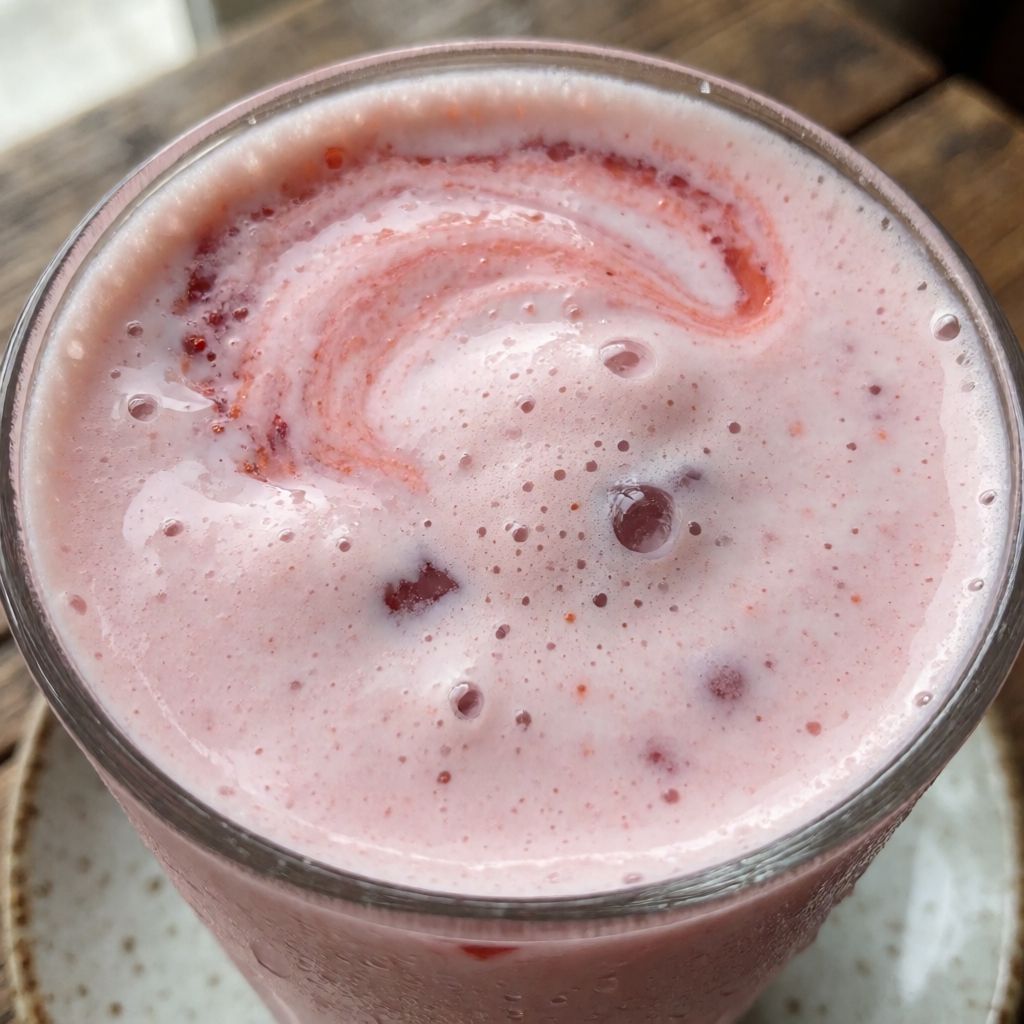
 AI photo
Strawberry Smoothie
A simple, refreshing strawberry and milk smoothie, ready in minutes.
Labels are worked out automatically from the ingredients and can be wrong. Check the packaging if it matters to you.
Ingredients
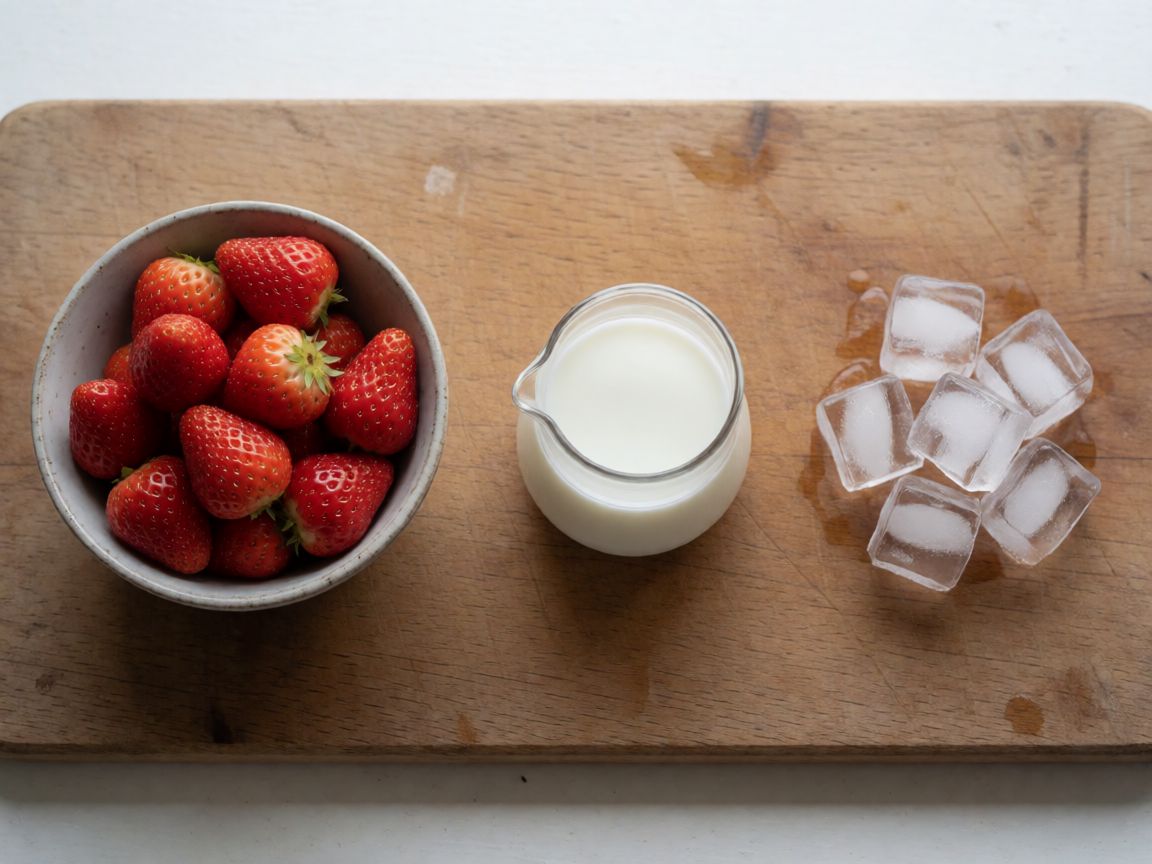
- 400 g Strawberries
- 500 ml Milk
- 30-40 g Ice cubes



Steps
Rinse the strawberries thoroughly in water with a little bicarbonate of soda, then leave them to soak briefly. Trim off the green tops with a knife and cut the berries into medium-small pieces.
Put the ice cubes into a blender, add the strawberries, switch it on and pour in the milk, then blend everything at maximum speed.
The smoothie is ready — pour it into a tall, clear glass.
Serve at the table, garnishing the rim of the glass with a whole strawberry.
A smoothie is not cooking, it's engineering with a blade spinning at a few hundred watts and a window of maybe twenty seconds before it either turns into one smooth drink or a red foam full of ice chips. Three things go in: strawberries, milk, a scatter of ice. The whole trick lives in what order they meet the blade, not in any clever step.
Put the ice in first. Not for looks — because a jug blender at home needs something hard near the blade to get a vortex going. Ice does that job. Drop soft strawberries in first and the blade turns them to foam before the ice even wakes up; the ice then floats half-crushed on top and you end up with red mousse rattling with cubes instead of one drink.
Some people think more ice means a thicker, colder smoothie. No — thirty to forty grams against five hundred millilitres of milk and four hundred of fruit is already the balance that works. Throw in a fistful more and you're asking a small motor to grind rock: the blade can't shift it, the jug just spins the cubes in place, and you get gritty shards sitting in liquid, not one body.
Doneness here is a look, not a clock: no red threads floating, colour even all the way through, and when you tilt the glass it moves as one liquid, not as two layers trying to come apart. Ten minutes is a floor, not a target — the blender tells you itself, the sound changes from a rattle to a smooth hum when it's actually done.
Strawberries: buy them red through to the core, not just on the skin. A white centre means picked too early — it will be sour and watery no matter how much sugar or milk you throw at it, and watery fruit is exactly what gives you that two-layer sulk in the glass later. The bicarbonate wash isn't magic chemistry, it's mechanical: the mild alkalinity and a bit of agitation loosen grit sitting in the tiny hairs around the hull, same as a splash of vinegar would, no need to believe one is holier than the other. Cut the green top off because the calyx is fibrous and faintly bitter — those are exactly the red threads you're checking for when you judge whether the blend is finished.
Milk: whole milk earns its place here because fat carries flavour and smooths the crush of ice and fruit into something that coats the tongue instead of just wetting it. In a British kitchen there's usually a jug of it in the fridge anyway, next to the teapot, so this is one ingredient you're not shopping for specially. If you swap to a plant milk, judge it by one thing — does it have enough body to bind, or does it behave like flavoured water. Full-fat oat or almond milk will do the job; skimmed anything, dairy or not, tends to separate faster once poured.
Ice: thirty to forty grams is there for chill and a little thickness, nothing more ambitious. If your strawberries are frozen rather than fresh, you can often drop the ice altogether — frozen fruit gives the blade the same hard resistance to start the vortex, and it's already cold. This matters in Britain more than people admit: fresh strawberries have a real season of about six weeks around Wimbledon, and outside that window the ones on the shelf came a long way from Spain or Morocco, picked early so they survive the trip, pretty but thin on taste. Frozen fruit, picked ripe and frozen fast, is often the better strawberry for exactly this drink, where you're crushing it anyway.
Patience shows up twice. Once while the berries sit in the bicarb water — that pause is the water working into the hull creases where grit hides, not you scrubbing harder. And once at the blender: don't blitz it in one short burst and call it done because the noise stopped. Let it run until the sound settles, that's the fruit actually giving in rather than just being interrupted.
The tall clear glass isn't there to be pretty, though it is. It's a diagnostic: pour the smoothie and if it starts separating while it sits — thin at the bottom, thick cap on top — that tells you the order was wrong or the blend was cut short. The whole strawberry balanced on the rim costs you one berry and does nothing for the drink; it's dressing for the table, and there's no shame in admitting that's all it is.