
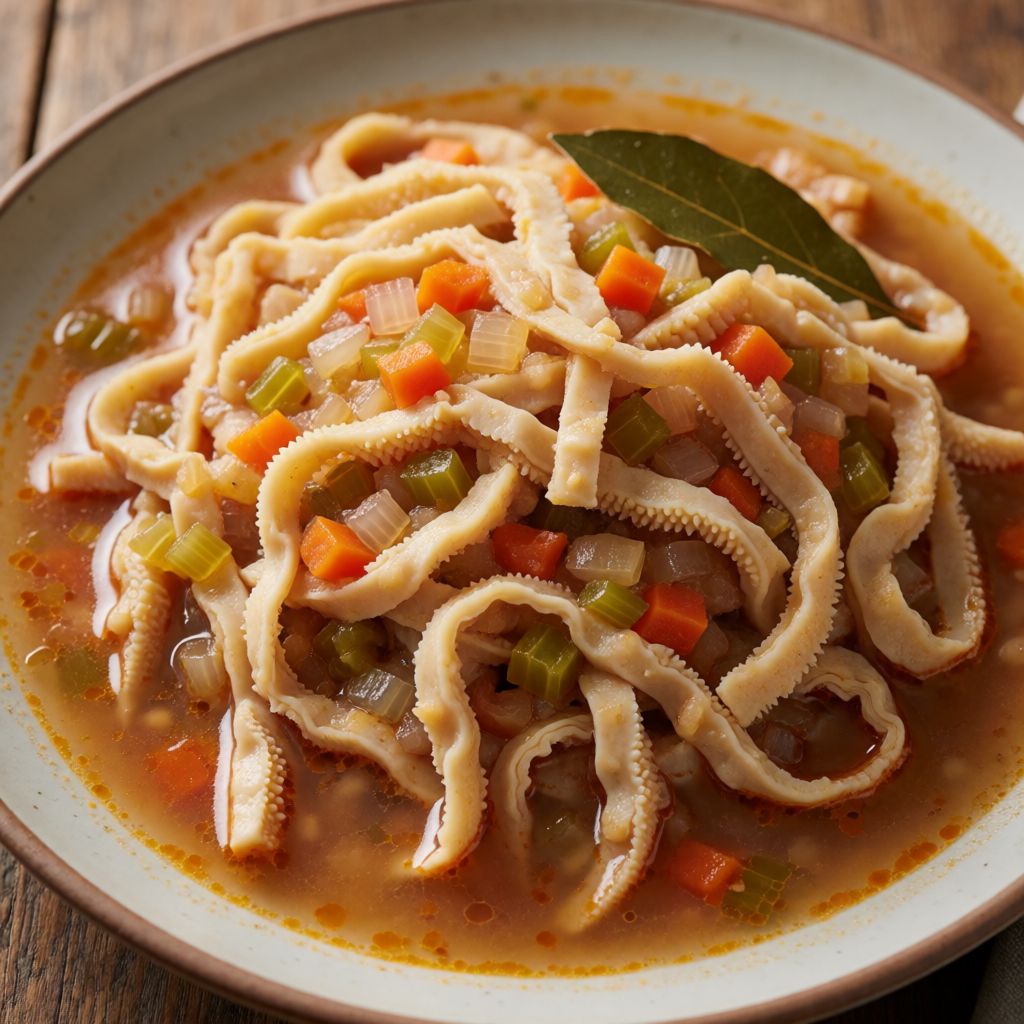
 AI photo
Roman-Style Tripe
A classic Roman offal dish: tripe braised slowly in a tomato sauce with vegetables, finished with mint and a sprinkle of pecorino.
Labels are worked out automatically from the ingredients and can be wrong. Check the packaging if it matters to you.
Ingredients
- 800 g Tripe
- 1 pcs Onion
- 1 pcs Celery stalk
- 0.5 pcs Carrot
- 1 pcs Bay leaf
- 1-2 pcs Cloves
- 200 ml Tomato passata
- Pecorino Romano to taste
- Fresh mint to taste
- Olive oil to taste
- Salt to taste
- Black pepper to taste











Steps
Thoroughly rinse the tripe under running water and cut it into fairly thin strips.
Peel half the carrot and slice into rounds; slice the celery the same way. Peel the onion and chop it not too finely.
Bring a large pot of water to the boil, salt it and add the chopped vegetables, bay leaf, cloves and a pinch of salt.
Once the water returns to the boil, lower in the sliced tripe and cook for at least 1 hour, until tender.
60 minRemove the tripe from the broth with a slotted spoon and transfer to a bowl.
In a pot, heat a few tablespoons of olive oil and add the tomato passata.
Season with salt and black pepper and simmer the sauce for about 10 minutes.
10 minOnce the tomato sauce comes to a simmer, add the cooked tripe and stir to coat it evenly in the sauce.
Cook on low heat for a further 10-15 minutes, then remove from the heat and transfer to a serving plate.
12 minGarnish the Roman-style tripe with fresh mint leaves and serve hot, with toasted slices of homemade bread and grated Pecorino Romano.
What was changed
Tomato passata was swapped in because in the UK "tomato sauce" means ketchup, so tomato passata is used for the cooked base; Fresh mint replaces mentuccia with ordinary fresh mint, as mentuccia is not available in UK shops.
Trippa alla romana is poor man's food that ended up on trattoria menus because somebody worked out that the cheapest cut in the shop, treated right, beats half the expensive ones. Tripe is stomach lining — pure muscle and connective tissue, no fat to render, nothing to baste. That means the whole dish is decided by one thing: how long and how gently you boil it before it ever meets the tomato. Everything else — the sauce, the mint, the cheese — is dressing on a job already done.
Some say tripe is naturally chewy and that's just what it is. No — chewy tripe is undercooked tripe. The collagen in it needs sustained, gentle heat to turn to gelatine; rush it and you get rubber, not because of the ingredient but because of your clock. An hour in barely-moving water is the floor, not the target — you're watching for strips that go soft and slightly translucent at the edge, that you could cut with the side of a fork, not strips that spring back.
The second thing that decides the dish is restraint with the tomato. This isn't a stew drowned in sauce — passata here is a thin coat, there to carry salt and a little acid against the mineral flavour of offal, not to hide it. If you've only ever had tripe stewed to mush in a thick gravy, that's a different tradition entirely; this one keeps the tripe's own bite, just tamed.
Mint at the end is not decoration, it's a cut-through — tripe has a particular smell even when properly cleaned, and raw mint leaves do the same job lemon does on fish. Skip it and the dish still works, but it tastes flatter, more "offal," less itself.
Tripe itself: buy it already cleaned and pre-blanched if you can — most UK butchers who stock it sell it that way, because raw honeycomb tripe needs hours of scrubbing and several changes of water most home kitchens can't be bothered with, and this isn't the recipe to learn that on. Rinse it well regardless; the "thoroughly rinse under running water" step isn't fussiness, it's removing the last trace of the cleaning lime or brine it was stored in, which otherwise turns bitter in the broth. If your shop has none, ask — it's cheap, it keeps the whole bill for four people under what one Sunday roast joint costs, and that economics is the whole reason this dish exists: offal was what was left after the better cuts went to people who could pay.
The vegetables in the first boil — onion, celery, half a carrot, bay, cloves — are not there to be eaten. They're a flavour base for the water the tripe cooks in, same logic as a stock, so don't chop them fine or worry about presentation; rough is fine, you're fishing them out with the tripe and discarding them, or leaving them in the broth for soup another day if you're not wasteful about it (you shouldn't be — that broth, strained, is a decent base for a Monday soup, which is its own small victory for a Tuesday-to-Sunday household).
Passata: thin tomato purée with no skins or seeds — if you only have whole tinned tomatoes, blitz and sieve them, or just crush them well; chunkier tins work but you'll be cooking the sauce a touch longer to break them down. Don't reach for ketchup or fresh tomatoes out of season — fresh winter tomatoes here are mostly water and acid with none of the sweetness that makes the sauce round rather than sharp.
Pecorino Romano is a hard, salty sheep's cheese — if you can't find it (most UK supermarkets now stock it near the Parmesan), Parmesan will do, but go lighter with your added salt since pecorino is saltier and the dish is built assuming that saltiness arrives with the cheese at the table, not before.
Fresh mint, not dried — dried mint is a different, duller flavour, more suited to lamb than to this. If you genuinely have none, a little lemon zest at the end does a similar cutting job, though it's not the same dish anymore, just a decent cousin of it.
Patience is the actual ingredient that costs you nothing but time: the hour of simmering is non-negotiable the way a Sunday roast's slow roast is non-negotiable — you can't shortcut collagen into gelatine with higher heat, you'll just toughen the outside before the inside gives up. Put the kettle on, make your tea with milk, and leave the pot alone; this is a dish that rewards not fussing over it far more than it rewards technique.