
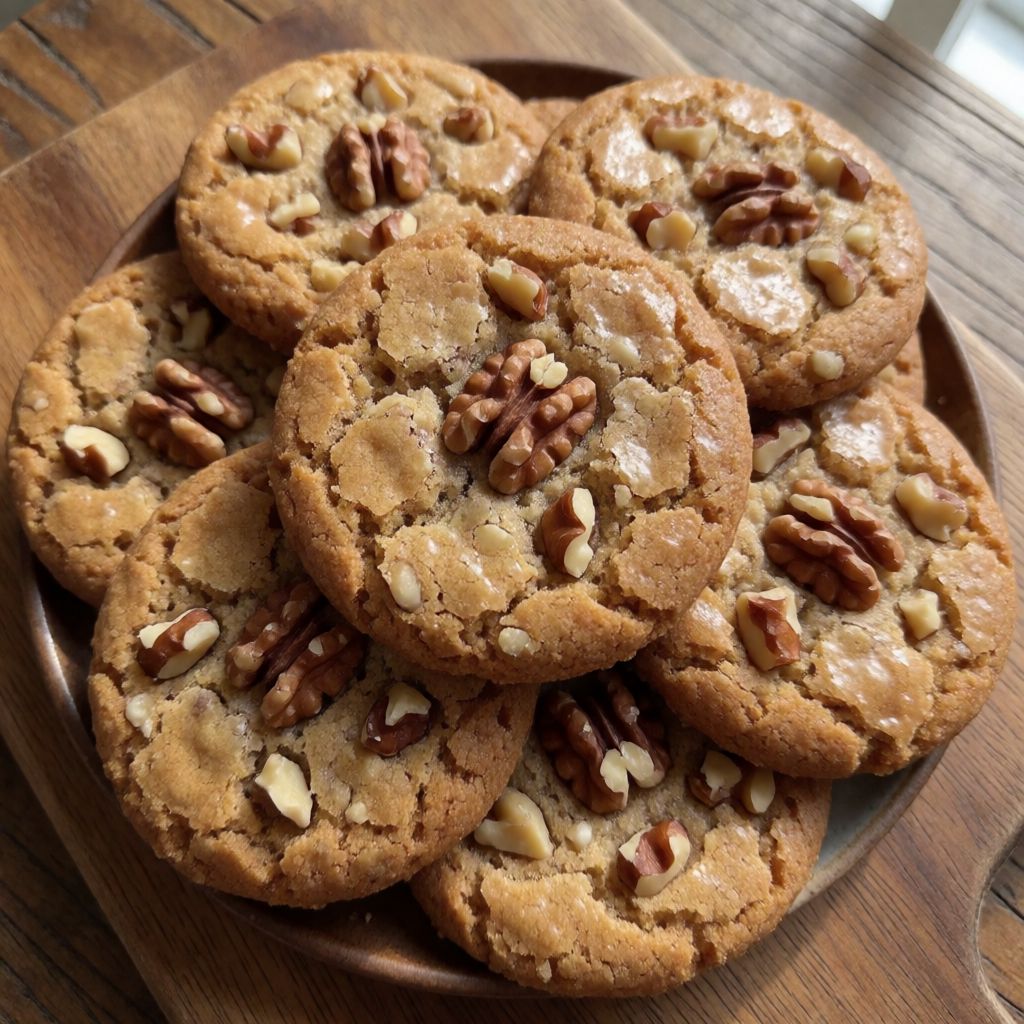
 AI photo
Walnut Cookies
Simple cookies made with ground walnuts, sugar and egg.
Labels are worked out automatically from the ingredients and can be wrong. Check the packaging if it matters to you.
Ingredients



Steps
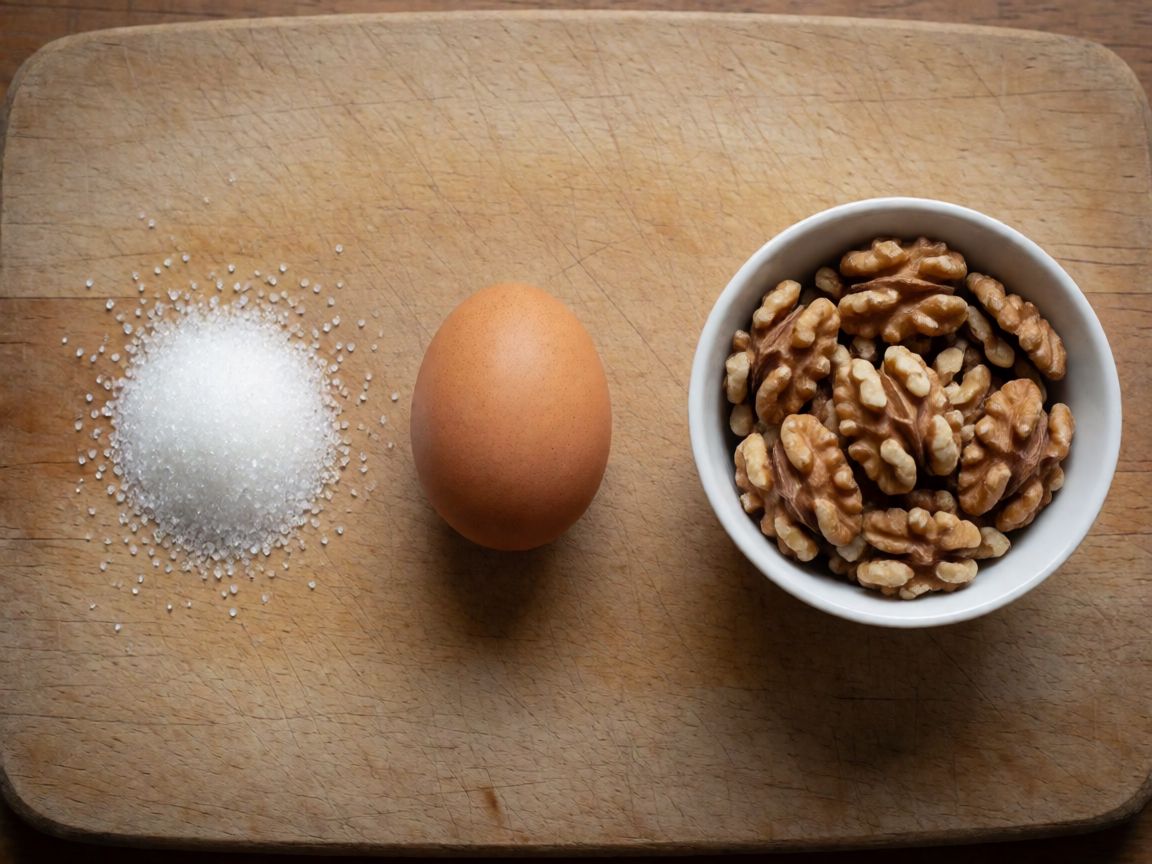
Blitz the walnuts in a blender to fine crumbs, tip into a bowl, add the sugar and egg, and mix well.
With your hands, shape small portions of the dough into balls and flatten them slightly.
Place the cookies on a baking tray lined with parchment and bake in an oven preheated to 180°C with the fan (convection) setting.
If your oven doesn't have a fan (convection) setting, continue baking for about 5 more minutes.
5 min
Three ingredients, no flour, no butter — and that's not poverty, it's precision. A walnut is nearly two-thirds oil. Blitz it fine enough and that oil comes out on its own, doing the job butter does in every other cookie. So the nut here is flour, fat, and texture all at once; sugar and egg just hold what it gives you.
What decides whether this works is the grind. Blitz to fine crumbs and the cell walls break, the oil wets the crumb, and you get a dough that holds a shape without any added fat. Stop too early and it stays sandy, won't bind, falls apart on the tray. Go too far into paste and the opposite problem — too much oil loose at once, the cookie spreads flat and turns greasy instead of chewy. Fine crumb, not flour, not paste — that's the window.
Some say a cookie without butter can't hold together. No — because the fat was never missing, it was inside the nut the whole time, locked in cells that just needed breaking open. Adding butter on top of that would only loosen things further, not strengthen them.
Doneness isn't a clock here either. Watch the edges: they go from pale dough-colour to a honeyed amber, and that shell is what holds the shape once the cookie leaves the oven. The centre should still look a touch underdone — it firms as it cools, the egg protein keeps setting off the heat. Pull them when the whole tray looks evenly gold and you'll have dry, biscuit-hard centres instead of the soft bite these are meant to have.
Walnuts: buy them where turnover is high, because a nut that's two-thirds oil is a nut that goes rancid fast — a bitter, musty edge at the back of the tongue is the tell, taste one raw before you commit the lot. If you're stocking up, the fridge or freezer slows that turn. The criterion for swapping them out isn't flavour, it's oil content: any nut around 55–65% oil will self-bind the same way — pecans, hazelnuts. Almonds sit lower, nearer 50%, and can still work, but the dough will feel a touch drier, so don't be surprised if it wants slightly less egg to stay firm rather than slack. None of this is a health-food choice, by the way — walnuts turn up in this kind of bake because in places where walnut trees grow in every third garden, they were the cheap, abundant thing to put in a cookie, long before anyone cared about omega-3.
Sugar does two jobs, not one. It sweetens, obviously, but under heat it also dissolves into the egg's moisture and caramelises right at the surface — that's the glossy, faintly cracked shell you see on the outside, not the sweetness talking, the Maillard reaction and melted sugar talking. Any white sugar does this; granulated is fine, just let the mixed dough sit a few minutes before you shape it, so the coarser grains get a head start dissolving in the egg. Skip that and you'll get a faint grittiness in the bite — not a disaster, just avoidable with a little patience.
Egg is the binder that locks in what the walnut oil has already half-done. A standard UK medium egg is the assumption here. Its protein sets in the oven and holds the ball's shape once the fat has bound the crumb loosely together — without it the mixture would be a spreadable paste, not something you can roll between your palms. If your egg is unusually large or small, trust your hands over the scale: the dough should hold a ball shape without sticking to your palm. Too wet, work in a little more ground walnut; too dry to come together, that's the sugar not yet doing its dissolving work — give it the few minutes of patience mentioned above.
The fan setting isn't a fussy detail — a convection oven moves hot air across the tray, which genuinely transfers heat faster than a still oven where the air around the food barely circulates and heat leans more on radiation. That's the real reason the recipe adds roughly five minutes without the fan: it's physics, not a manufacturer's whim. Domestic ovens vary a lot in how true their dial runs, so lean on the visual cue — amber edges, a centre that still looks slightly soft — over trusting the clock on faith.
Line the tray with parchment, because caramelised sugar welds itself to bare metal; try to lift a cookie off a scorched patch and you'll tear the centre apart instead of lifting it whole. And once they're out, leave them be for a few minutes before you touch them — they're still setting as they cool, the egg firming and the oil settling back from liquid toward solid. Pick one up too soon and you'll see the structure give way in your hand, which looks like a mistake in the mixing but is really just impatience at the end.
This quantity makes a modest batch, three or four cookies a head for four people — plan for tea, not for a tin to last the week. There's no butter here to act as a preservative, so they dry out faster than a normal biscuit; a couple of days in a sealed tin is the honest limit. With British tea and milk, the astringency of a strong brew cuts straight through the nut oil and sugar — which is really the same logic as serving these with any strong, slightly bitter drink, just dressed in local habit.