
 AI photo
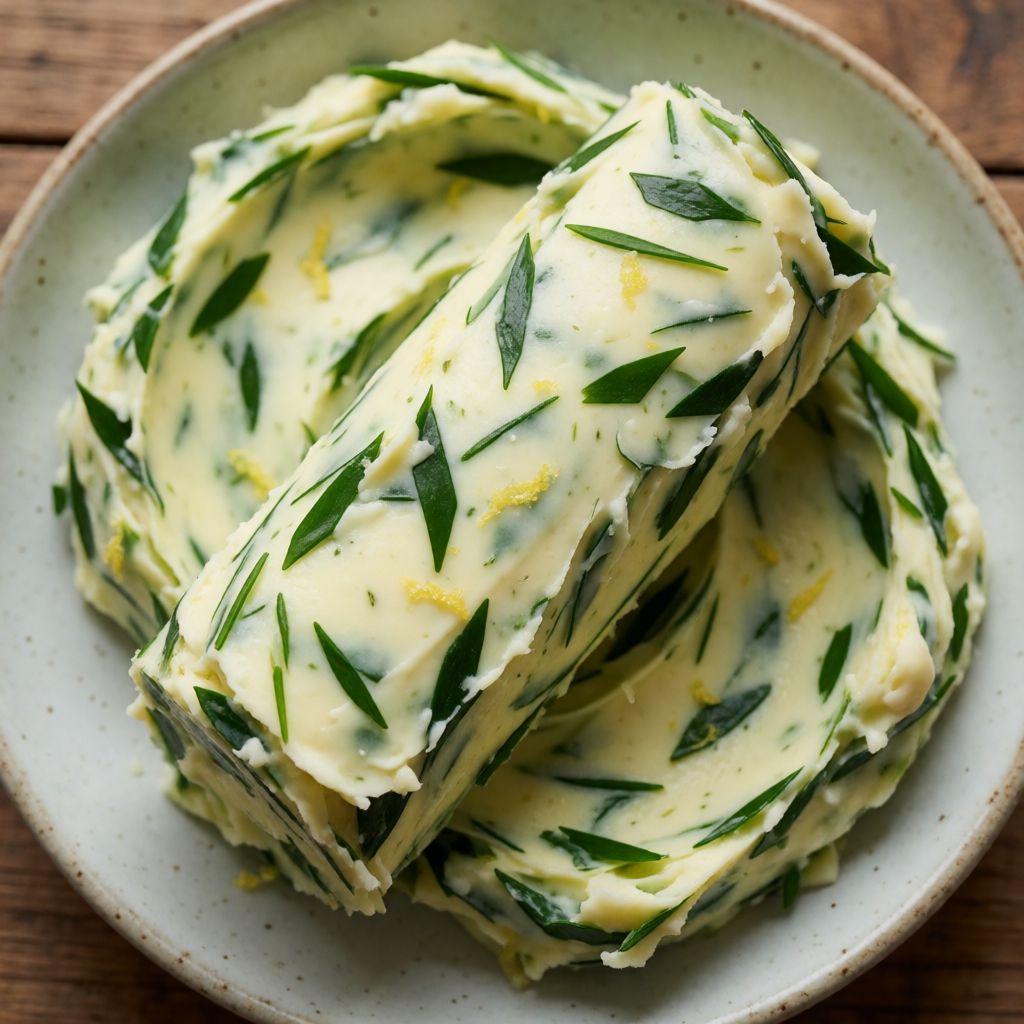
Wild Garlic Butter
A simple butter mixed with wild garlic, lemon zest and juice, perfect for spreading on fresh bread.
Labels are worked out automatically from the ingredients and can be wrong. Check the packaging if it matters to you.
Ingredients
- 200 g Butter at room temperature
- 1 bunch Wild Garlic finely chopped
- 1 pcs Lemon finely grated zest
- 1 tbsp Lemon Juice
- 0.5 tsp Salt





Steps
In a large bowl, combine the softened butter, finely chopped wild garlic, lemon zest and a little juice, and mix well.
3 minAdjust the seasoning with flaky salt to taste.
1 minShape the butter into a log and wrap it in parchment or wax paper.
2 minChill in the fridge for 30 minutes before serving.
30 min
This is not a garlic butter in the usual, bulb-and-crush sense. Wild garlic — ramsons, the stuff carpeting British woodland floors for about six weeks every spring, smelling the place up before you even see the white flowers — is gentler and greener than a clove ever is. The butter's whole job is to catch that short season and keep it, so you can drop a disc of spring onto a roast potato in November and remember what April smelled like.
What decides whether it works has nothing to do with quantities and everything to do with temperature and chop. The butter must be properly soft — not melted, not fridge-cold, but spreadable with a spoon without effort — because butter is already an emulsion of fat and a little water, and a soft fat is the only state that can take on more moisture (the herb's juice, the lemon juice) and hold it evenly instead of letting it pool and weep later in the fridge. Cold butter just smears the wild garlic through itself in streaks; warm, melted butter loses its structure altogether and comes back from the fridge greasy and separated.
The second thing that decides it is how fine you chop. Too coarse, and you get pockets of raw, assertive flavour next to pockets of plain butter — uneven bites. Too fine, pureed to mush, and you bruise the leaves, which oxidise fast and turn the whole thing a tired khaki instead of staying bright, and release more bitterness than you want. Fine but distinct — that's the target, and a knife does it better than a food processor, which heats the blade and turns chopping into pulping before you notice.
The butter itself should be plain and unsalted — you're adding your own salt later and want to control how much. Criterion for choosing one: high fat, low water, because that's what gives you clean structure when it sets again; a cultured butter works a shade better here because its slight tang talks nicely to the lemon, but a standard block is fine. For a dairy-free version the honest answer is I haven't tested one against this exact recipe, so I won't promise you coconut oil behaves the same way when it resolidifies — it goes harder and doesn't take air the same way, so treat any substitute as an experiment, not a swap.
Wild garlic itself, the thing that makes this basics rather than another compound butter, is free and seasonal, which is the real reason it's traditionally turned into butter, pesto, oil — anything that outlasts its own six weeks. If your bunch has arrived with thick stems, those stems are more fibrous and milder than the leaf — chop them in too if you want body, or leave them out if you want the butter to read purely leafy-green. No wild garlic to hand, out of season or no woodland nearby: the honest substitute is something that gives sharp green allium character without bulb-garlic's lingering burn — garlic scapes, or a mix of chives with the faintest trace of a crushed clove, get you closer than rocket does, though rocket's pepperiness isn't a bad direction either if that's what's in the fridge.
Lemon does two separate jobs and that's why it's split into zest and juice. The zest brings aromatic oil from the fruit's skin without adding liquid — this is what lifts the smell of the butter without threatening its structure. The juice is there in a small, deliberate amount, because butter can only absorb so much extra water before the emulsion gives up: too much juice and the butter splits when chilled, coming out grainy or weeping liquid onto the parchment. One tablespoon is a boundary, not a suggestion to round up.
Salt goes in as flaky or coarse, not fine table salt, and the reason is mechanical: in cold-set butter, undissolved crystals stay as crystals, giving you a little crunch as the butter melts on hot food — on your Sunday roast potatoes, say. Fine salt just dissolves invisibly into the fat and you lose that small pleasure for no gain.
Rolling the mixed butter into a log and wrapping it isn't decoration — it's what gives you clean, even discs later instead of a tub you have to hack at with a warm knife. And the 30 minutes in the fridge is a floor, not a target: what you're actually waiting for is the fat crystals reforming into something firm enough to hold a cut edge without smearing. Feel it before you trust the clock — if it still gives like putty, it needs longer, whatever the timer says. That's patience doing its job, not the recipe being slow for no reason.