
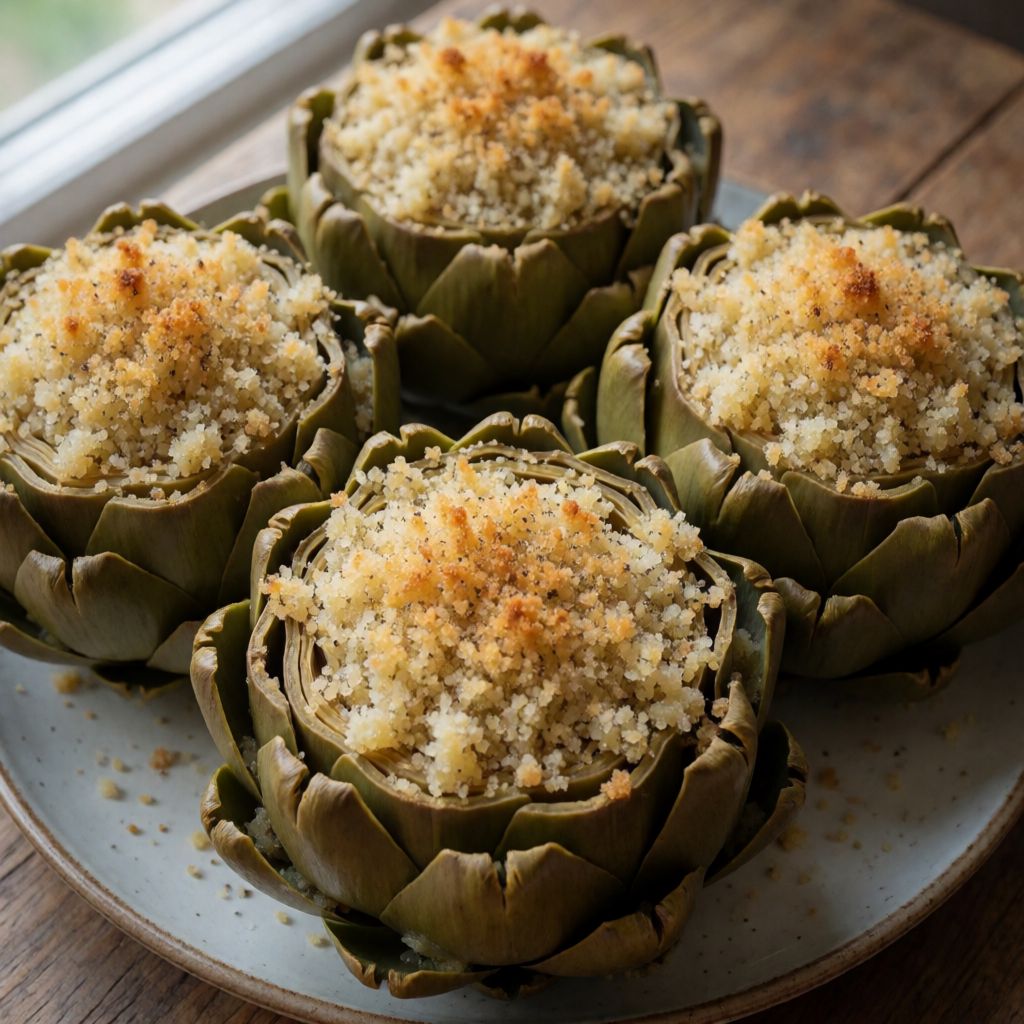
 AI photo
Stuffed Artichokes with a Breadcrumb Cap
Artichokes filled with a savoury egg, cheese and breadcrumb stuffing, simmered gently in tomato sauce.
Labels are worked out automatically from the ingredients and can be wrong. Check the packaging if it matters to you.
Ingredients
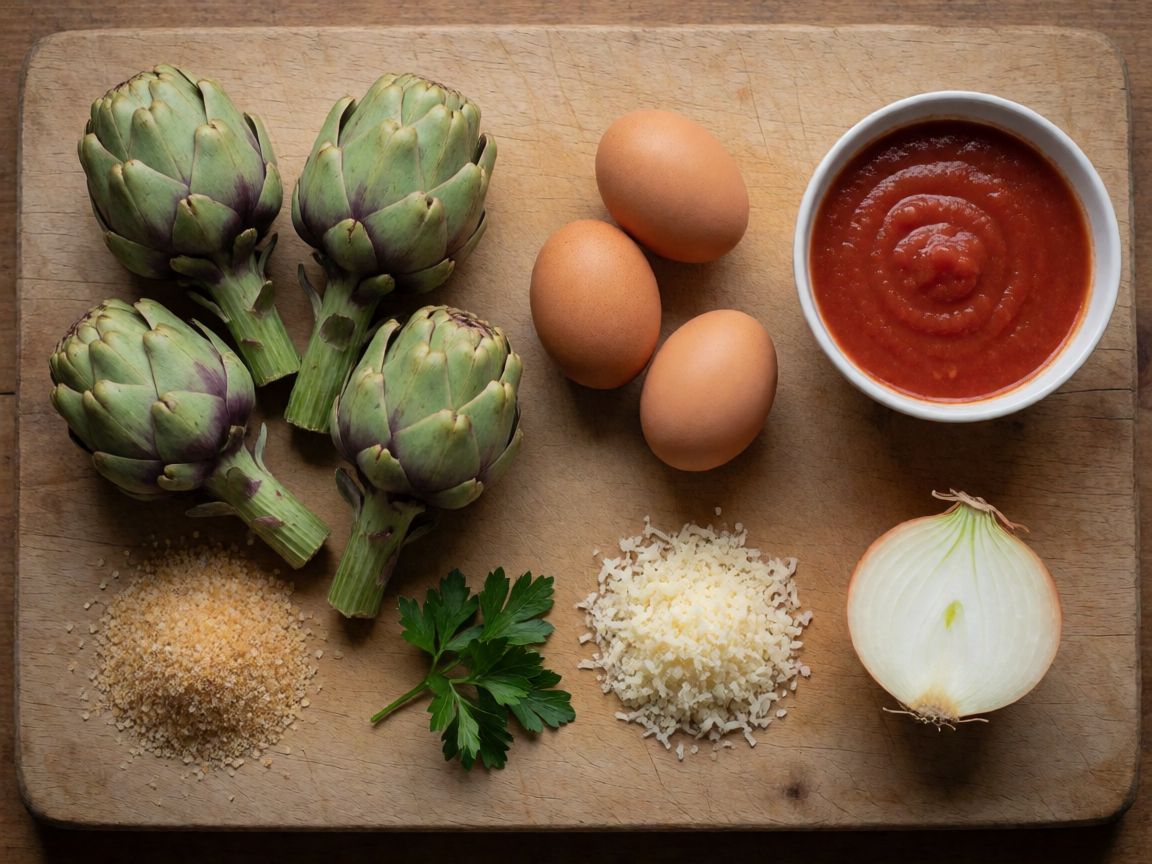
- 4 pcs Artichoke
- 3 pcs Eggs
- 50 g Breadcrumbs dried
- 100 g Caciocavallo
- Salt to taste
- Black pepper to taste
- Parsley to taste
- 700 g Tomato passata
- 1/2 pcs Onion
- Olive oil to taste









Steps
Clean the artichokes and place them in water acidulated with lemon juice.
Finely chop the onion and fry it in olive oil until golden.
Add the tomato passata, season with salt and pepper, and cook the sauce.
Beat the eggs with salt and black pepper.
Add the breadcrumbs and caciocavallo, mix with a fork and stir in the finely chopped parsley.
Press the artichokes down on the work surface to open out the leaves.
Distribute the filling, trying to fill the gaps between the leaves.
Pack the filling in well, right up to the surface, to form a sort of 'cap'.
Heat a little olive oil in a non-stick pan and fry the capped artichokes.
Transfer the capped artichokes into the tomato sauce.
Cook the capped artichokes on a low heat, covered, for 40 minutes.
40 min
This is an artichoke doing two jobs at once: vegetable and vessel. You open it up like a flower, pack egg-breadcrumb-cheese stuffing into the gaps between the leaves and over the top, then poach the whole thing in tomato sauce until the leaves give up their toughness and the cap sets into something between a frittata and a dumpling lid. What decides whether this works is not the sauce — it's whether you actually get the filling down between the leaves rather than just on top of them. Skip that, and you've made a tomato-braised artichoke with a hat, which is fine but is not the dish.
The leaves of a raw artichoke are stiff, almost woody at the base, because that's structural tissue meant to hold the plant upright — it has nothing to do with flavour, it's just fibre. Pressing the artichoke down on the counter and splaying the leaves does the mechanical work of opening gaps a knife can't reach; you're widening the cracks so the egg mixture can actually run down into them rather than sit on the surface. If you don't press, the filling stays as a lid, and the inner leaves near the heart — the best part — stay dry and unseasoned.
Caciocavallo is there for two reasons: it melts into the egg and breadcrumb so the filling binds rather than crumbling out, and it salts the mixture from inside rather than needing you to oversalt the eggs. It's a stretched-curd cheese, same family as provolone, firm enough to grate and with enough fat to go gooey without turning to oil. If you can't get it, use a hard provolone or a mature, dry cheese that melts cleanly — a well-aged Cheddar will do the job in the UK, though it brings its own flavour along for the ride, which caciocavallo mostly doesn't. Avoid anything soft and wet like mozzarella: it'll weep water into the breadcrumb and you'll get sludge instead of a cap.
The breadcrumbs are the skeleton of the filling — dry ones, not fresh, because dry crumb drinks up the beaten egg and holds its shape as it cooks, where fresh breadcrumb just goes soggy and slides off the leaves. Three eggs for four artichokes sounds like a lot until you remember the filling has to go into every gap on four separate "flowers" — you need volume, and egg is what turns loose crumb and cheese into something that packs.
The onion fried to gold, not further, before the passata goes in: that's the Maillard reaction building sweetness and depth onto a vegetable that's mostly water and sulphur compounds — push it past gold into brown and you get bitterness instead, which no amount of simmering with tomato will undo. Frying the artichokes briefly before they go into the sauce isn't decorative — it sets the surface of the breadcrumb cap so it holds together in liquid rather than dissolving into the tomato like an unbaked dumpling.
Forty minutes covered on gentle heat is the lower bound, not the answer. What you're actually waiting for is the base of the artichoke leaf — fibrous and nearly inedible raw — to soften enough that you can pull a single leaf free with your fingers without a fight. On a normal UK hob, "low" rarely means a gentle simmer unless you watch it; a domestic ring often surges hotter than the dial suggests, so keep the sauce at a bare bubble, not a rolling one, or it'll reduce to paste before the artichoke hearts are tender. A loose lid substitute — a plate over the pan, or foil — traps enough steam to keep the sauce from scorching onto the base, which is the real reason recipes insist on covering: not flavour, just protecting the sauce from the pan.
Any oil with no flavour of its own works for the frying stage — a light olive oil, not your good finishing oil, which you'd be wasting on heat it can't survive anyway. Save the extra-virgin for drizzling over the finished plate if you want it, not for the pan.
This is a sit-down starter, not a weeknight five-minutes job — the prep of cleaning and stuffing four artichokes properly takes patience, and rushing the leaf-opening is where most people lose the dish before it even reaches the pan.