
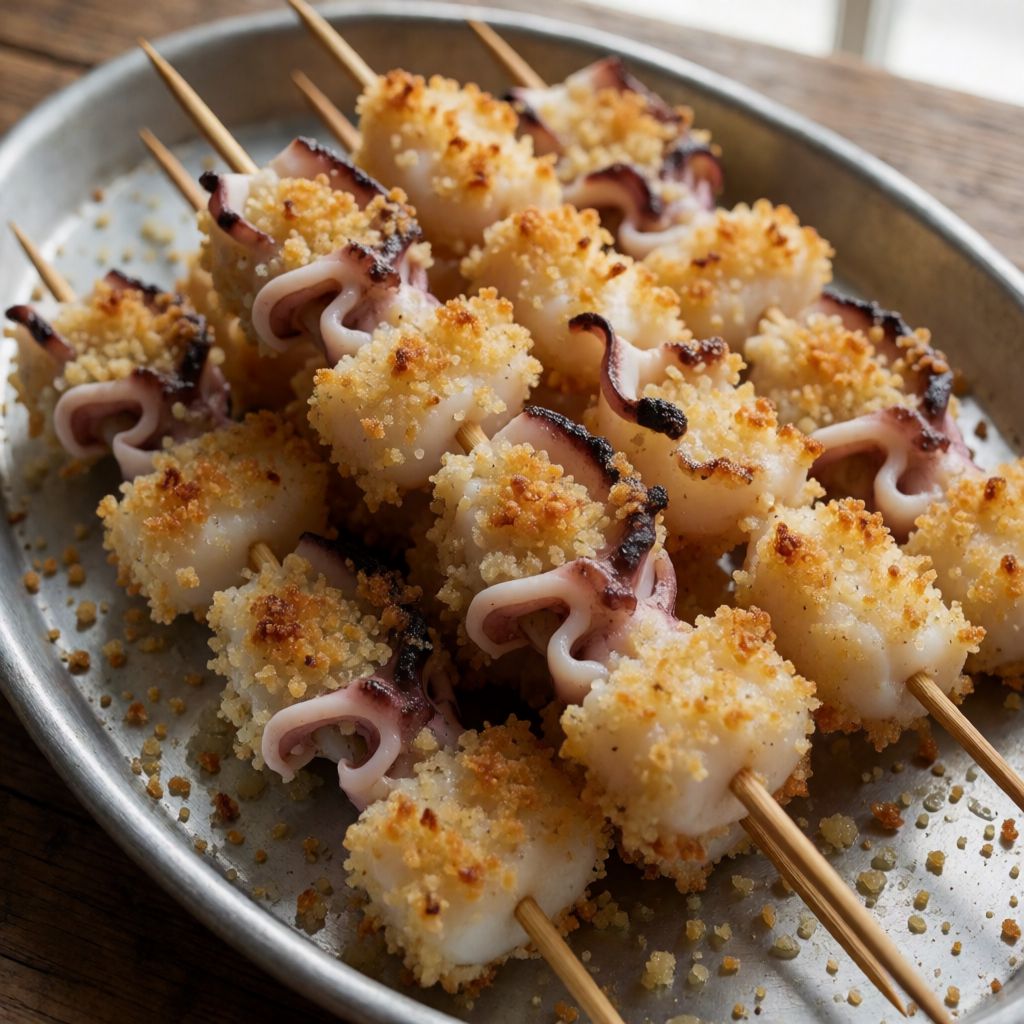
 AI photo
Baked Fish Skewers in the Oven
Squid and cuttlefish skewers coated in breadcrumbs, baked until golden and tender.
Labels are worked out automatically from the ingredients and can be wrong. Check the packaging if it matters to you.
Ingredients
- Small cuttlefish
- Squid
- Baby squid or another fish if you prefer
- Breadcrumbs dried
- 1 tbsp Vegetable oil
- 1 pcs Butter a small pat
- Salt to taste






Steps
Clean the seafood and thread it onto skewers in any order to make kebabs.
Coat the skewers in breadcrumbs on all sides.
Place the skewers on a baking tray lined with baking paper and drizzle with vegetable oil.
Bake at 160°C for 30 minutes.
30 minDot butter over the surface, season with salt, and continue baking for 10 minutes.
10 minTurn on the grill and brown the skewers until golden, then serve hot. They are done when the thickest part reaches 63°C.
This is not a fry, though it looks like one on the plate. You thread squid, cuttlefish, baby squid — whatever soft-bodied seafood is cheap that day — onto skewers, dress them in dry crumbs, and put the whole lot in the oven to behave itself. No fat spitting on the hob, no squid ring jumping out of hot oil and landing on the tea towel. That's the whole reason this method exists: someone got tired of frying squid and decided the oven could do the job without the drama.
What decides whether it works isn't the oven dial, it's the crumb. Squid and cuttlefish are mostly water held inside a thin muscle wall, and the moment heat hits them that water wants out. A dry crumb coat is there to catch it — it pulls the surface moisture into itself and turns it into a crust instead of a puddle sitting under the fish. Skip the crumb, or let it go on damp, and you get steamed rubber wearing a soggy jacket, not a skewer.
Some say squid has to be cooked hard and fast or it turns rubbery — true enough for a hot pan, where seconds matter. In an oven at 160°C the logic flips: a slow, dry heat gives the collagen in the tentacles time to soften instead of seizing up, while the crumb above is quietly drying and starting to colour. The grill at the end isn't there to cook the fish through — the oven's already done that — it's there to brown a crust that's been patiently waiting for its moment.
Cuttlefish, squid and baby squid together on one skewer isn't fussiness, it's what the box of mixed seafood looked like that morning. Squid fishing brings up smaller squid and cuttlefish as by-catch, and mixing them keeps the price down compared to buying one perfect, uniform species. Thread them together and the size difference actually helps: the thin baby squid cooks faster, the thicker cuttlefish ring slower, and the crumb jacket buffers the gap so neither one is badly wrong by the time the other is right. If you've no squid family at all, the recipe's own line — "or another fish if you prefer" — is the real instruction: pick something firm enough to hold its shape threaded on a skewer. Cod or monkfish chunks will do it; something that flakes apart on its own, like plaice, won't survive the thread.
The crumb has to be dried, not fresh, and that word is doing real work. Fresh breadcrumb carries its own moisture and has no spare capacity to take on more — it just goes gluey. A dried crumb, shop-bought or your own stale loaf grated and left to dry out, has room to pull water from the seafood's surface as it cooks. That's the whole mechanism of the crust, not crunch for its own sake.
The tablespoon of oil is there for two small jobs: it helps the crumb stick and bond to itself rather than falling off in flakes, and since the underside of the skewer never sees the grill, it's the only thing giving that bottom edge any crisping at all. Use any oil with no smell of its own — sunflower, a light rapeseed — because seafood's smell is delicate and shouldn't have to fight a strong olive oil for attention. Save the good olive oil for something that can stand up to it.
The butter is a small pat for a reason — it's there late, for flavour and shine, not as a cooking fat for the whole thirty minutes. Dairy fat browns and burns faster than most oils, which is exactly why it goes on with ten minutes left rather than at the start. Leave it out and use a touch more oil instead if you've none in the house; you lose a bit of richness, nothing more.
Salt goes on at the same late point, and that's not an accident either. Salt on raw squid draws water out through the flesh by osmosis — the very same enemy the crumb is trying to defeat from the other direction. Season early and you're fighting your own crust.
In an ordinary flat kitchen, use metal skewers if you have them, or soak wooden ones in water first so they don't catch under the grill, which runs hotter and more directly than the oven body did. Keep the baking paper, don't swap it for foil — paper breathes, which lets the underside of the crumb dry too, while foil traps steam underneath and undoes the work the top crumb is doing. And watch the grill stage yourself rather than trusting a clock: I've pulled squid out a minute late more than once and spent the rest of dinner chewing. The forty minutes in the recipe is a floor, not a verdict — the real finish line is a crust the colour of toast, not pale, not black, and a thickest point that's actually reached 63°C, not just had thirty minutes pass over it. That little bit of watching is the patience this dish asks for, and it's cheap compared to the squid.