
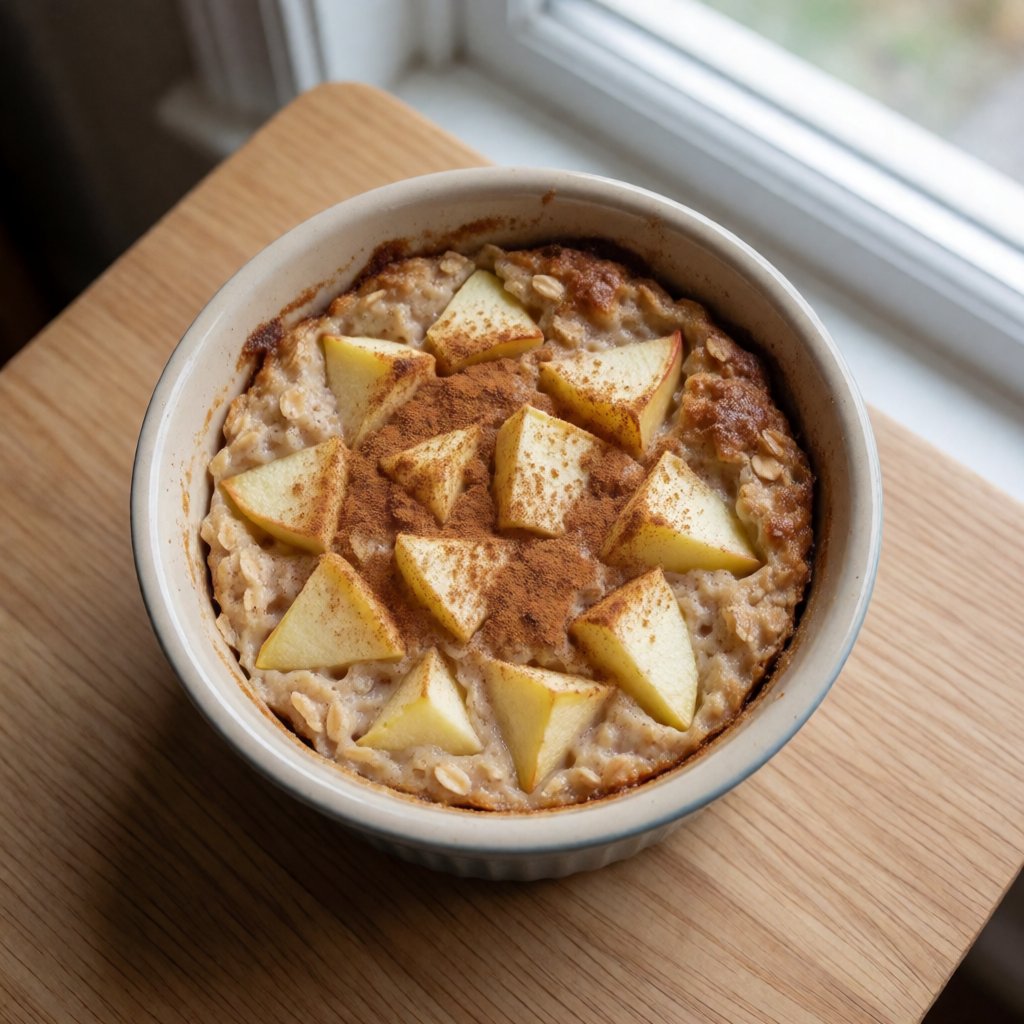
 AI photo
Baked Oatmeal with Apple
A warm baked oatmeal with apple, cinnamon and honey, finished in the oven.
Labels are worked out automatically from the ingredients and can be wrong. Check the packaging if it matters to you.
Ingredients






Steps
Whisk the egg with the milk, honey and cinnamon.
Mix in the oats, pour into a baking dish and arrange the thin apple slices on top.
Place the dish in an oven preheated to 200°C and bake for 30 minutes.
30 minRemove the dish from the oven.
This isn't porridge that happens to visit an oven. It's a custard with oats suspended in it — egg and milk are the binder, and oven heat sets that custard exactly the way it sets a quiche: proteins in the egg tighten up as they pass through the upper seventies in Celsius, and everything around them locks into place. Forget stirring a pot on the hob; that's a different dish with a different job for the egg, if there's an egg in it at all.
What decides whether this works is whether the middle actually sets, not just the top. Pull it out when the surface looks brown and you can still get a wet, slithery layer underneath — it looks finished and isn't. The real cue is the wobble: give the dish a small shake, and if the centre still moves like liquid, it needs more time, full stop, the clock is only ever a floor under that judgement, not the answer.
The apple on top is doing two things, and that's why it's sliced thin rather than in wedges. Thin, it cooks through before its edges have time to char, and as it softens it lets juice run down into the oat layer, basting it from above the way fat bastes a roast from the pan. Go thick and you get raw apple sitting on cooked custard — one texture problem hiding inside another.
Some people insist oats need boiling on the stove or they stay chalky and raw. No — because the custard here carries enough milk, and the oven gives enough time at heat, to soften the oats fully without ever touching a flame. That's the whole point of a baked oatmeal: one dish, one heat source, no second pot to wash.
Start with the oats, because the type matters more than the brand. Rolled oats, not instant — instant oats have already been steamed and flattened once at the factory, which means their starch is pre-gelatinised and ready to collapse into paste the moment it meets liquid. Put them in here and you lose the bite entirely; the dish turns to wallpaper paste with apple on it. Rolled oats still have enough structure left to soften without dissolving, which is the texture you actually want — soft, but with a little resistance between your teeth.
Milk is the carrier for the custard, and what matters is fat. A milk with some fat in it — whole milk, or a semi-skimmed at a push — gives the custard body; go very lean and the set is thinner, less rich, more like a wet sponge than something you'd call a pudding. If you're out of dairy, any milk with enough fat to coat a spoon will do the same job — oat milk works, almond milk less well, because thin milks make a thin custard.
The egg isn't flavour, it's structure. It's the only thing in this bowl that actually sets under heat — the oats swell, the milk gets absorbed, but only the egg protein forms the mesh that holds the whole thing together once it's out of the oven and cooling on the counter. Leave it out and you have warm, sweet oats in a dish, which is fine, but it's not this dish; it won't hold a slice the way a baked oatmeal does.
Honey is doing double duty: sweetness, obviously, but also moisture. Honey holds onto water better than table sugar does, which keeps the baked oats from drying out at the edges where they're closest to the oven's heat. If you swap in sugar, you'll get a drier, slightly more crumbly result — not wrong, just a different outcome, and you might want a splash more milk to compensate. Maple syrup sits somewhere between the two and works fine.
Cinnamon is the one spice that's expected here, but it's a role, not a rule — any warm spice that doesn't fight the apple will do the same job: a little nutmeg, a little ground ginger. Choose by nose, not by habit.
On proportions: a hundred grams of oats to two hundred and fifty millilitres of milk and one egg is enough liquid to bind the oats without drowning them — that ratio is what gives you custard rather than soup or dry crumble, and it's built for two. Scale it up and keep that ratio; scale the dish too shallow or too deep and you'll fight the oven either way, since a shallow layer sets through fast but can dry at the top before the middle's ready, and a deep one does the opposite. The oven you already trust for a Sunday roast is exactly the right tool for this — no kazan, no special kit, just an ordinary dish and the patience to leave it alone until the wobble test says otherwise.
·