
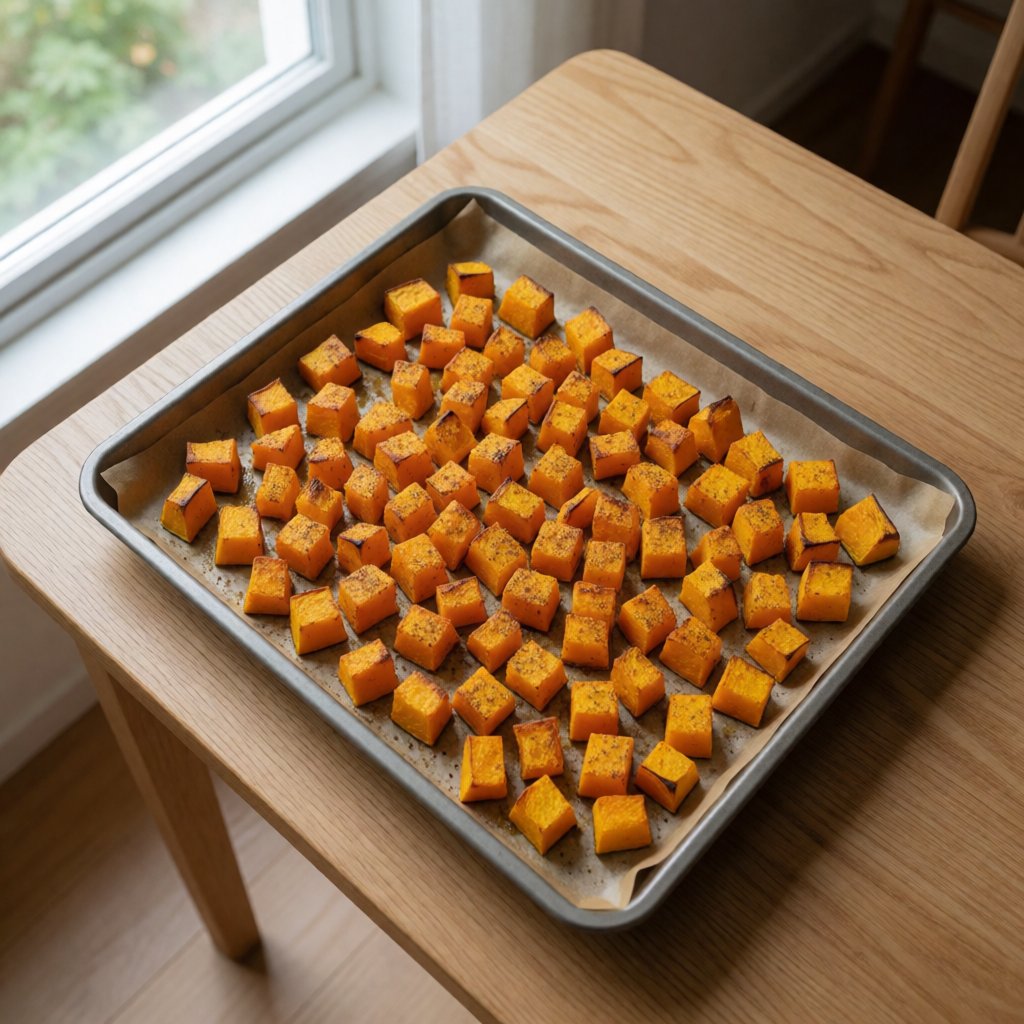
 AI photo
Roasted Butternut Squash Cubes
A simple side of roasted butternut squash cubes, seasoned and baked until tender.
Labels are worked out automatically from the ingredients and can be wrong. Check the packaging if it matters to you.
Ingredients
- 600 g butternut squash
- 1 tbsp sunflower oil
- 1 pinch salt to taste
- 1 pinch ground coriander to taste, or paprika




Steps
Cut the squash into cubes of about 2.5 cm, then toss with the oil and spices.
Spread out on a baking tray in a single layer.
Place the tray in an oven preheated to 200°C for 30 minutes.
30 minRemove the tray from the oven.
The dish is just squash, cut small, coated in oil and spice, and left in dry heat until the inside softens and the outside goes dark at the edges. No sauce, no stirring tricks, no basting — the whole mechanism is water leaving the cut surface fast enough that the squash's own sugar can caramelize before the inside turns to mush.
What decides whether it works is space on the tray, not the clock. Spread in a single layer, every cube has most of its faces touching either hot metal or hot moving air. Pile them two deep and each cube sits in the steam coming off its neighbour — you get squash that's grey and wet underneath, pale on top, never that amber crust. That's the usual failure here, and it has nothing to do with the oven being too hot.
Doneness is a fork sliding in without a fight, and cut faces showing patches of dark gold to brown, not just "soft all through." Soft-but-pale is a half measure — the sugars never got the chance to turn. Thirty minutes is a floor, not a verdict: your tray's shape, your oven's hot corners, how much water that particular squash was carrying — all of it shifts the real time a bit.
One myth worth naming: "turn the oven down so it doesn't catch." No — 200°C is there precisely to pull moisture off the surface quickly, and that's not what causes burning. Burning comes from crowding the tray, or from oil pooling in the corners and scorching while the cubes in the middle barely colour.
Squash itself: go by weight, not size. A squash that feels heavy and dense for its length has tight, less watery flesh, which means more sugar per bite and a better caramelized edge — a light one for its size is mostly water and air pockets, and it'll steam before it browns. If butternut isn't to hand, any firm orange winter squash or pumpkin behaves the same way under heat; swede will roast but won't sweeten the same, it's a stand-in, not an equal.
Oil: the job is purely mechanical — it carries heat from metal to flesh faster than air alone, and keeps the cut surface from drying into leather before the inside catches up. So the criterion is an oil with no smell of its own, so it doesn't argue with the coriander or paprika. Sunflower, groundnut, a light olive oil — any of these do the job without adding their own opinion to the plate.
Salt, even just a pinch, isn't only for taste here — a little salt on a cut surface draws moisture out early, which thins the water film and lets browning start sooner rather than later. Skip it and the first few minutes in the oven go to drying out the surface instead of colouring it.
Coriander or paprika — pick one, don't reach for both. Ground coriander gives something citrus-ish and light; paprika leans sweeter, and the smoked kind brings a whisper of char without actually charring anything. Either is an accent, not a seasoning blend — the point of this dish is the squash's own sugar doing the work, not six spices competing over it.
As for why squash ends up on the English Sunday table at all: it's a storage vegetable. Before refrigeration, hard winter squash and roots like swede and parsnip were what you had in quantity through the cold months, and roasting them in the same oven as the joint cost no extra fuel — you got a second dish for free out of heat you were paying for anyway. That's the whole of the tradition; no mystery, just an oven that was already lit.
A domestic oven is not perfectly even — fan ovens get close, but a plain element oven will run hotter at the back or near the top, and a tray left untouched for thirty minutes might come out browner on one side than the other. Turn the tray round partway through if you notice this happening in yours; it costs nothing and saves you a tray of half-pale, half-scorched cubes. And leave the squash alone between turns — fussing with it, stirring every few minutes, just interrupts the one thing that needs time and stillness to happen: the crust forming. Patience is the real ingredient doing the work here, the oven is just the tool.
·