
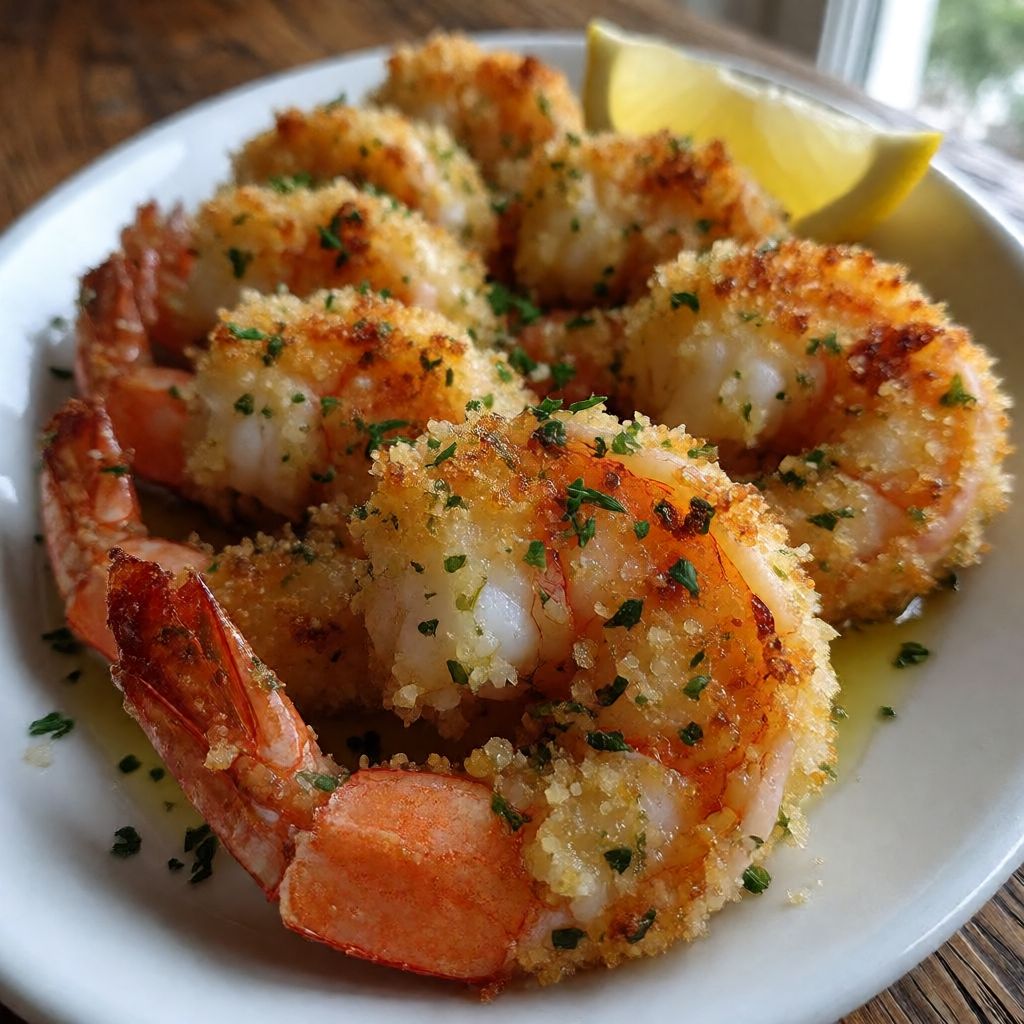
 AI photo
Oven-Baked King Prawns
Succulent king prawns baked in the oven with a golden garlic and parsley breadcrumb coating.
Labels are worked out automatically from the ingredients and can be wrong. Check the packaging if it matters to you.
Ingredients
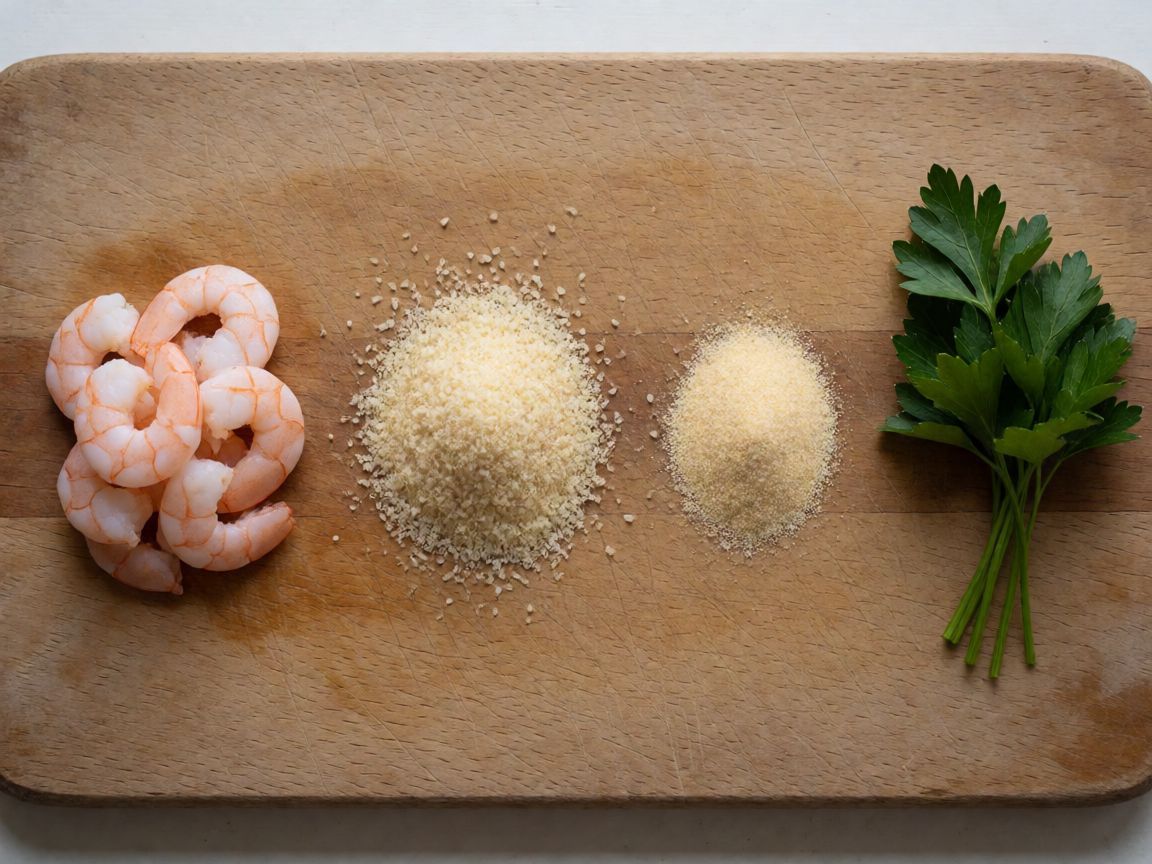
- 1.5 kg King Prawns
- Breadcrumbs to taste
- Garlic Powder to taste
- 1 bunch Parsley
- Olive Oil to taste
- Salt to taste





Steps
Peel the king prawns, removing the shell but leaving the tail and head intact. Remove the digestive tract with a toothpick.
In a bowl, mix the breadcrumbs, garlic powder, salt and finely chopped parsley.
Coat the prawns in the breadcrumb mixture, paying particular attention to the middle section.
Line a baking tray with parchment paper, arrange the prawns on it and drizzle with olive oil.
Bake in an oven preheated to 180°C until the breadcrumb coating turns golden. Doneness: 63°C at the thickest part.
20 minArrange fresh lettuce leaves on a plate and place the cooked prawns on top.
This is finger food — prawns roasted in their own crumb jacket, the kind of thing you make when you want the smoke of a grill but your flat only has an oven. The crumb isn't decoration. A prawn has almost no fat to self-baste with, so once the shell comes off, the flesh is naked against dry heat. The crumb is the only buffer it gets.
What decides whether this works is a race between two clocks that don't run at the same speed. At 180°C, breadcrumbs need a certain stretch of time to brown — that's the Maillard reaction, sugars and proteins in the crumb colouring and crisping. The prawn flesh underneath has its own clock: somewhere around 60–63°C its proteins firm up and go opaque, and past that it just keeps tightening into rubber. Twenty minutes is the lower bound, not the answer — a hotter oven than yours runs and the crumb scorches before the flesh is ready; a cooler one and the crumb stays pale dust while the prawn overshoots into toughness. Watch the crumb's colour, and when in doubt, press the thickest part of a prawn — it should give like a flexed muscle, not snap, not squash.
Some say a prawn is done 'when it turns pink.' No — colour alone lies to you, because pinking can start before the centre is actually cooked, especially on a fat king prawn. The real tell is the flesh itself: it goes from a slightly translucent grey-glass look to solid, opaque white, and the whole prawn curls into a tight C. That curl is the muscle doing exactly what muscle does under heat — contracting. A straight prawn on your tray is an underdone prawn.
On the gut-string running down the back — the bit you lever out with a toothpick — people sometimes call it 'the poison line' and treat deveining as a safety step. It isn't. It's the prawn's digestive tract, full of grit and sometimes a bitter note, and leaving it in won't hurt you, it'll just crunch unpleasantly and taste faintly off at the end of a mouthful. You take it out for texture and taste, not survival.
Buy king prawns raw — in the UK that usually means frozen, shell-on, with a greyish-blue cast before cooking. If the bag says 'cooked' or the prawns are already pink, this isn't your recipe; they'd go rubbery fast under a second round of heat. Thaw them slowly, in the fridge or at least in cold water, never under the hot tap — hot water starts cooking the outer layer before you've even peeled them, and you end up with a prawn that's part-cooked on the outside and raw in the middle, which no amount of oven time fixes evenly.
For the crumb, the only real criterion is that it stays as separate dry grains and crisps rather than turning gummy once it meets oil. Fresh soft breadcrumbs carry too much of their own moisture and tend to steam rather than brown unless you dry them out first in a low oven; a drier, crustless crumb — the commercial panko kind, or just stale bread grated and left out overnight — crisps faster and more reliably. Cracker crumbs do the same job if that's what's in your cupboard.
Garlic powder rather than fresh minced garlic is doing real work here, not standing in for it out of laziness. Fresh garlic, exposed directly to twenty minutes of dry oven heat, burns at the edges and turns bitter well before the prawn is cooked through. Powder is milder, spreads evenly through the crumb, and won't scorch at 180°C. If you only have fresh garlic, work it into the olive oil instead of the dry mix — the oil buffers it a little from direct contact with the hot tray.
Parsley wants to be fresh and finely chopped if you can get it — it brings a bit of moisture and brightness into a dry coating that would otherwise just be crumb and powder. Dried parsley will do at a pinch, but it's concentrated and has lost most of its aroma to the drying process, so use less than you'd think, or you'll taste dust instead of herb.
The olive oil's job is to carry heat evenly into the crumb's surface — without it, dry crumb just sits there and goes stale-pale rather than golden, because there's no fat to conduct that browning. Any oil without a strong smell of its own will crisp a crumb; olive oil earns its place here because you'll actually taste it alongside the garlic and parsley, which a flavourless oil like sunflower won't give you. Salt the crumb mixture itself, not the bare prawn flesh well ahead of time — prawns are mostly water, and salt sitting directly on raw flesh for any length of time draws that water out by osmosis, leaving you with a tougher prawn before it's even seen the oven.
The lettuce underneath isn't garnish for the photo. Hot, oiled, crumbed prawns on cold crisp leaves is a deliberate contrast — temperature against temperature, crunch against crunch — and practically, the leaves catch the oil that runs off so it doesn't pool on the plate. And give yourself the full fifteen minutes the prep asks for: peeling and deveining a kilo and a half of prawns one by one is not a step you can rush without tearing tails or leaving the vein in half of them. Patience here isn't virtue for its own sake — it's what keeps the prep as clean as the final plate needs it to look.