
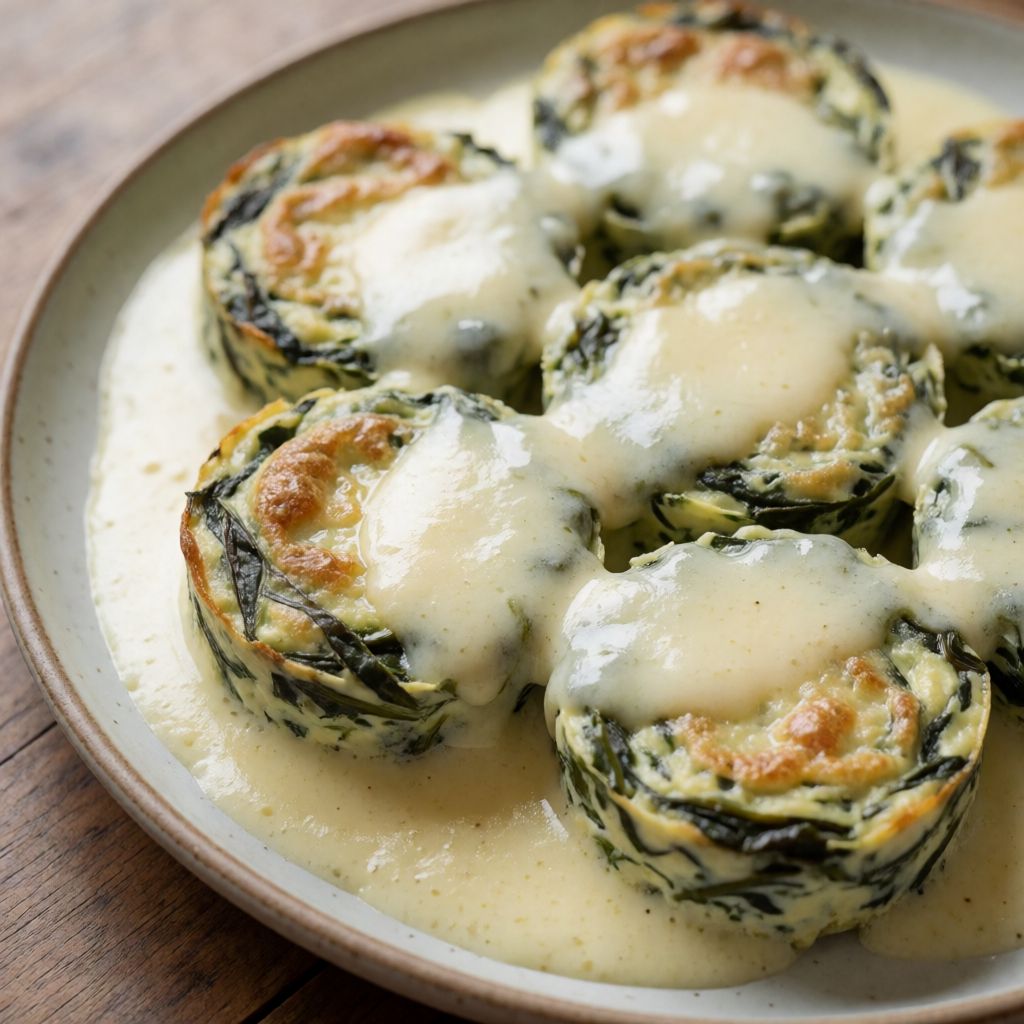
 AI photo
Baked Chard Timbales with Parmesan Fonduta
Individual baked chard and egg custards served with a smooth Parmesan fonduta sauce.
Labels are worked out automatically from the ingredients and can be wrong. Check the packaging if it matters to you.
Ingredients
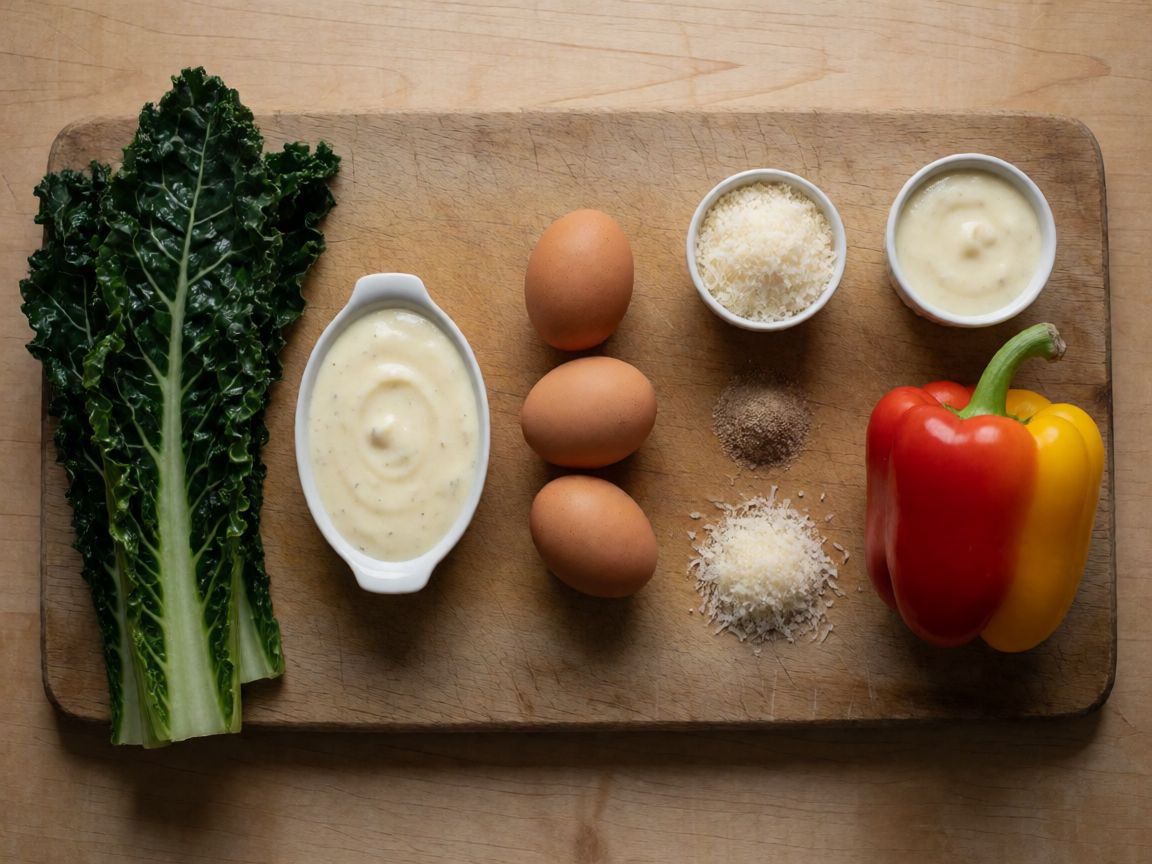
- 200 g Chard
- 250 g Béchamel sauce
- 4 pcs Eggs
- 50 g Parmesan
- Salt to taste
- Nutmeg to taste
- 200 g Béchamel sauce
- 60 g Parmesan grated
- 1 pcs Bell pepper
- Salt to taste




Steps
Put the chard, béchamel sauce, 4 eggs, Parmesan, a pinch of salt and a little grated nutmeg into a blender. Blend until smooth.
Take a tray with individual moulds, lightly greased with butter, and pour the blended mixture into them. Pour a little water into the tray around the moulds.
Bake in a water bath in the oven at 160°C for 20 minutes.
20 minIn a small saucepan, mix the béchamel sauce, grated Parmesan, egg yolk and a pinch of salt. Whisk until smooth.
Warm the fonduta over the heat, stirring constantly, until it thickens.
Spoon a little Parmesan fonduta onto a plate, then place the baked timbale in the centre.
This is a timbale, not a soufflé — don't wait for it to rise. It's an egg custard, backed up by béchamel and parmesan, with chard blended straight into it, baked gently in small moulds, then turned out onto a pool of its own warm parmesan sauce. Visually it looks like something from a trattoria menu, but mechanically it's a crustless quiche filling that's been asked to hold its own shape without a pastry case to lean on.
What decides whether it works is the water bath, not the oven thermostat. Egg proteins curdle — they seize and squeeze out water — once they pass a certain point, not far above 80°C. Surround the moulds with water and that water physically can't get hotter than it boils; it caps the heat that ever reaches your custard. Skip the water bath and you get scrambled chard with lumps in it, not a timbale.
Myth worth naming: people think egg in any form cooks the same way, so if "medium heat" works for an omelette it must work here too. No — an omelette is thin and done in seconds; this is thick and in the oven for twenty minutes, which is plenty of time for direct, dry heat to overcook the outside while the centre's still raw custard. The bain-marie is what turns that twenty minutes into slow, even cooking instead of a race.
Chard goes in raw, straight into the blender. Its job is partly flavour, mostly water and bulk — it's what keeps the custard from tasting like plain scrambled egg with cheese in it. Choose leaves that are glossy and don't droop in your hand; the pale stalks are tougher and worth trimming off and cooking separately another day rather than forcing them through a blender. If you've no chard, any leaf that collapses to about a third of its volume and weeps water when you squeeze it will do the same job — spinach is the obvious stand-in, just milder, so nudge the salt up a touch to compensate.
Béchamel appears twice and does two different jobs. Inside the timbale it's not filler, it's insurance — the flour in it holds onto water that would otherwise rush the egg proteins into clumping too fast, which is exactly what gives you a tender set instead of a grainy one, and it's forgiving if your oven runs a touch hot. In the fonduta, the same sauce is the vehicle that lets melted parmesan behave like a pourable sauce instead of seizing into stringy clumps — cheese melted alone just splits into fat and curd; cheese melted into a starch-thickened base stays smooth.
Parmesan is there for salt and savour, but also as fat that carries that flavour through the dish. The criterion for a substitute: any hard, well-aged cheese that melts into a sauce rather than stretching like a string cheese — grana padano, an aged pecorino, something in that family. Pecorino's saltier, so if you use it, go lighter on the added salt than the recipe suggests.
Whole eggs go into the blended custard and build its structure — the mesh of set protein that holds the chard and cheese suspended rather than letting them sink. The fonduta's method calls for an egg yolk, but you'll notice it isn't in your ingredient list — that's the recipe's gap, not yours. Crack one more egg, use the yolk only, and keep the white for something else, an omelette or a meringue, don't waste it.
The bell pepper sits in the list but never gets a mention in the method. Treat it as the plate's job, not the mould's: roast it, peel it, cut it into strips, and lay them next to the fonduta pool. It does for the eye what the chard does for the inside — breaks up all that cream and dark green with something bright, and gives a sweetness the parmesan doesn't have.
You don't need proper bain-marie kit for this. Any deep roasting tin — the one your Sunday joint sits in — will do, as long as the water comes roughly halfway up the sides of your ramekins; too shallow and the custard cooks unevenly near the top. Nutmeg goes in by scent, not measure — a scrape should perfume the mix without announcing itself. And when you warm the fonduta at the end, treat it with patience: low, steady heat, constant stirring, and if it looks like it's about to catch, lift the pan off the hob for a second rather than turning the heat down — turning a dial doesn't cool a pan instantly, lifting it does.