
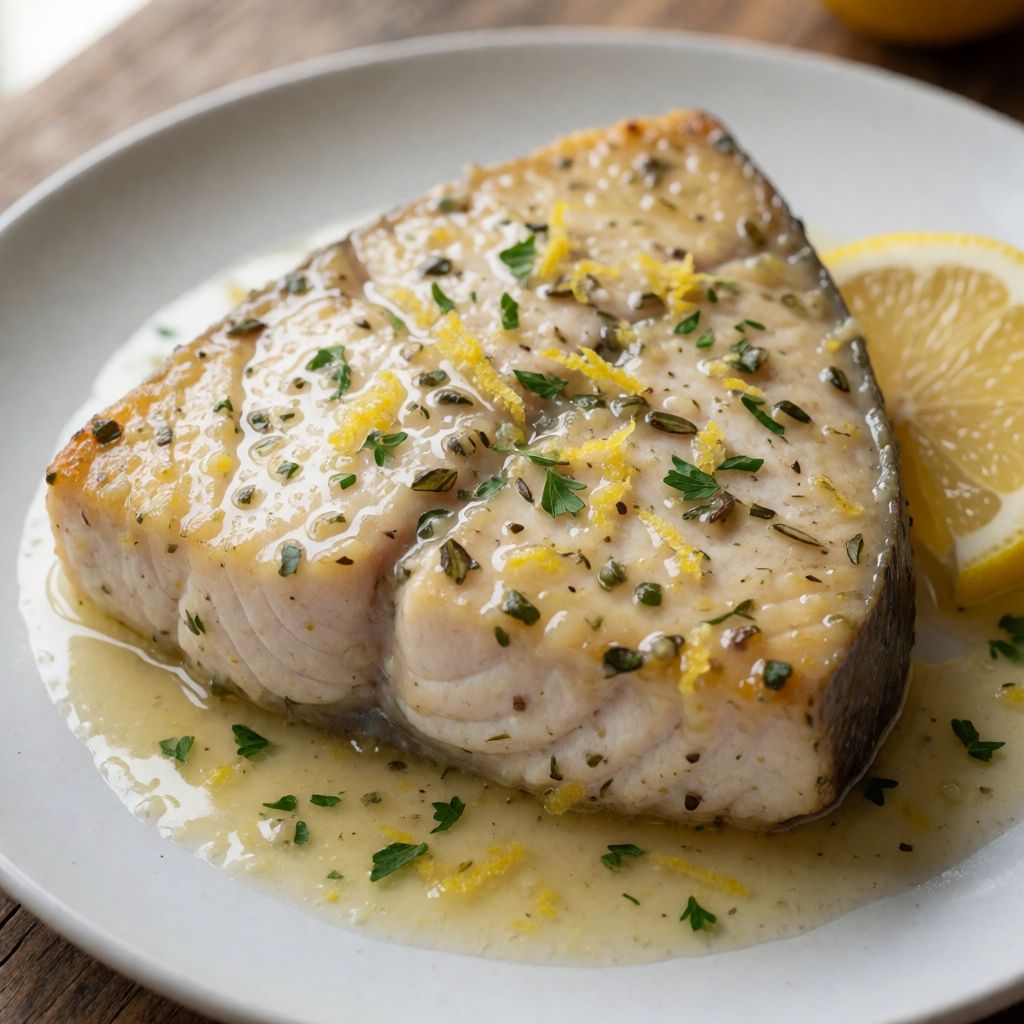
 AI photo
Baked Swordfish Steaks
Swordfish steaks baked with herbs, lemon and white wine until tender.
Labels are worked out automatically from the ingredients and can be wrong. Check the packaging if it matters to you.
Ingredients
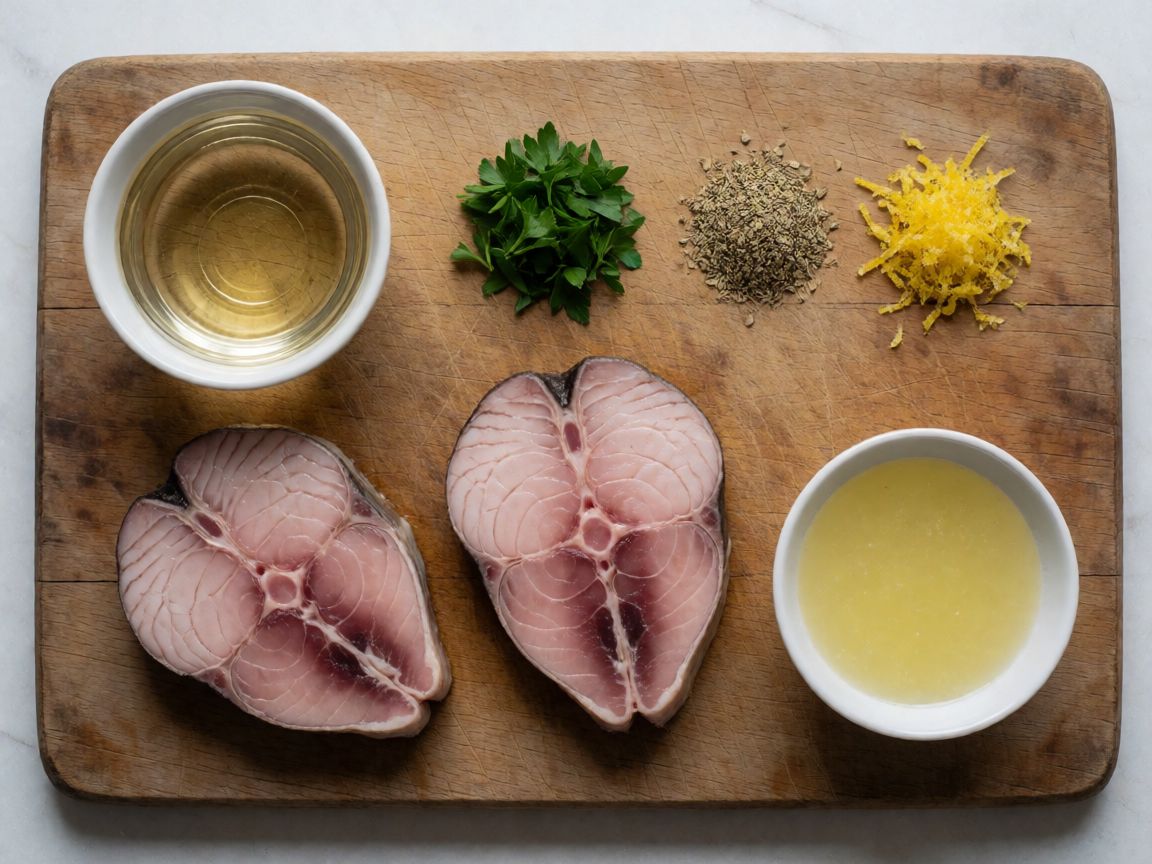
- 2 pcs Swordfish
- 250 ml White Wine
- Parsley to taste
- Oregano to taste, or thyme
- 1 pcs Lemon Zest
- 1 pcs Lemon Juice
- Olive Oil to taste
- Salt to taste








Steps
Finely chop the parsley and oregano, zest the lemon and add the zest to the herbs.
Mix the white wine, olive oil and lemon juice until smooth.
Rinse the swordfish steaks, pat dry, and coat them in the herb and zest mixture.
Place the steaks in a baking dish and pour over the marinade.
10 minPreheat the oven to 180°C.
Bake the swordfish in the preheated oven until done. It's ready when the thickest part reaches 63°C internally.
Remove the cooked fish from the oven and serve on plates, garnished with the sauce.
This is a Sicilian habit more than a recipe: swordfish is cut into steaks because the fish itself is enormous — you can't fillet a creature that size into neat little pieces, you slice it across like a round of beef. That shape is what lets you treat it almost like meat in the oven, and that's the whole trick here.
What decides whether this works is temperature, not minutes. Swordfish has almost no fat running through it, unlike salmon or mackerel, so there's no cushion of fat to forgive overcooking. Past about 63°C at the core the muscle fibres squeeze out their water and you're left with chalk. Below that it's still translucent and wrong in a different way. A thermometer pushed into the thickest part is not fussiness, it's the only honest answer — the time given is a floor, not a verdict, because steak thickness varies and so does every domestic oven's idea of 180°C.
The marinade is the second hinge, and it's deliberately short. Some cooks think longer marinating means more flavour worked in and more tenderness worked up — no, because the acid in wine and lemon juice does to fish exactly what it does in ceviche: it starts cooking the surface protein, turning it opaque and slightly firm. Ten minutes perfumes the outside. An hour gives you a grey, mealy rind before the fish ever sees the oven. Patience here means resisting the urge to "let it soak properly" — that urge is the enemy, not the friend.
Swordfish itself: look for steaks of even thickness, pale pinkish-white flesh, no browning at the edges and no strong fishy smell — that smell is the first sign of age, not of the sea. Any UK fishmonger's counter or supermarket fish aisle sells it ready-cut; ask for steaks of similar size to each other so they finish at the same moment. If swordfish isn't to be had or the price makes you flinch — it's an imported fish and prices swing with the season and the catch — tuna steak or a thick piece of halibut will behave the same way: dense, low-fat, meat-like, needing the same core-temperature discipline.
The wine: dry, still, white, nothing sweet and nothing oaky-heavy enough to fight the lemon. Its job is acid and aroma, not strength — you're not reducing it to a syrup, you're baking the fish in it, so a cheap drinkable bottle does the same work as an expensive one. No wine open in the house? A dry vermouth does the job, or a small splash of white wine vinegar cut with water and a touch more oil to compensate for the missing body.
Olive oil carries the herb aromatics into the flesh and glazes the surface so it doesn't dry out under oven heat — that's its mechanical job here, not just tradition. Use any oil with no smell of its own if you want the lemon and herbs to speak louder; a light olive oil, not an aggressive extra-virgin, keeps the balance. Sunflower or a neutral vegetable oil works in a pinch, you just lose the faint fruitiness olive oil adds for free.
Lemon: zest and juice do different jobs and that's why the recipe asks for both. Zest carries the oil-soluble citrus perfume — it goes in with the herbs, cooked, because heat doesn't destroy it the way it destroys the brightness of juice. Juice is the acid — it goes into the marinade liquid to do its short, controlled firming work and to balance the sauce at the end. If you only have a bottled juice, use it for the sauce, but find a real lemon for zest or skip the zest rather than fake it with dried peel — dried loses the aromatic oil that's the entire point.
Parsley and oregano (or thyme) aren't interchangeable with just any green herb, and the criterion is heat tolerance: anything thin and delicate like basil would scorch and turn bitter under 180°C oven heat for this long. Oregano and thyme have enough oil in their leaves to survive baking and still taste of something; parsley is added mainly for colour and a last touch of freshness, which is why it's chopped fine alongside, not relied on as the main aromatic. Any firm Mediterranean herb from that same family — marjoram, savory — will stand in without trouble.
Salt: add it to the fish before it goes into the marinade, not as an afterthought at the table. It needs those ten minutes to start drawing moisture to the surface and meeting the acid and oil there, which is how you get a seasoned steak rather than a steak with salt sitting on top of it. Go gently — swordfish's density means salt reads stronger in it than in a flaky white fish, and there's no fat to dilute it the way there is in salmon.