
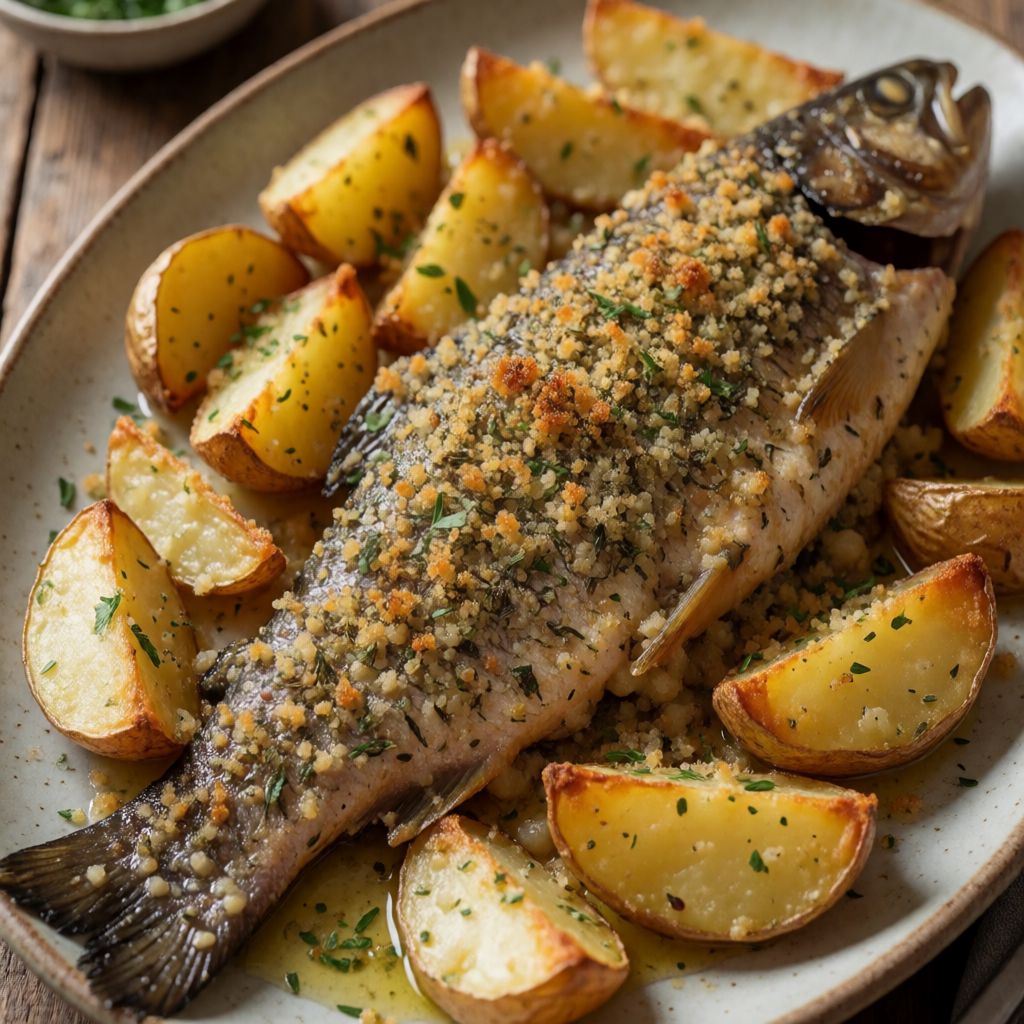
 AI photo
Baked Trout with Potatoes
A simple baked trout with potatoes, herbs and olive oil.
Labels are worked out automatically from the ingredients and can be wrong. Check the packaging if it matters to you.
Ingredients
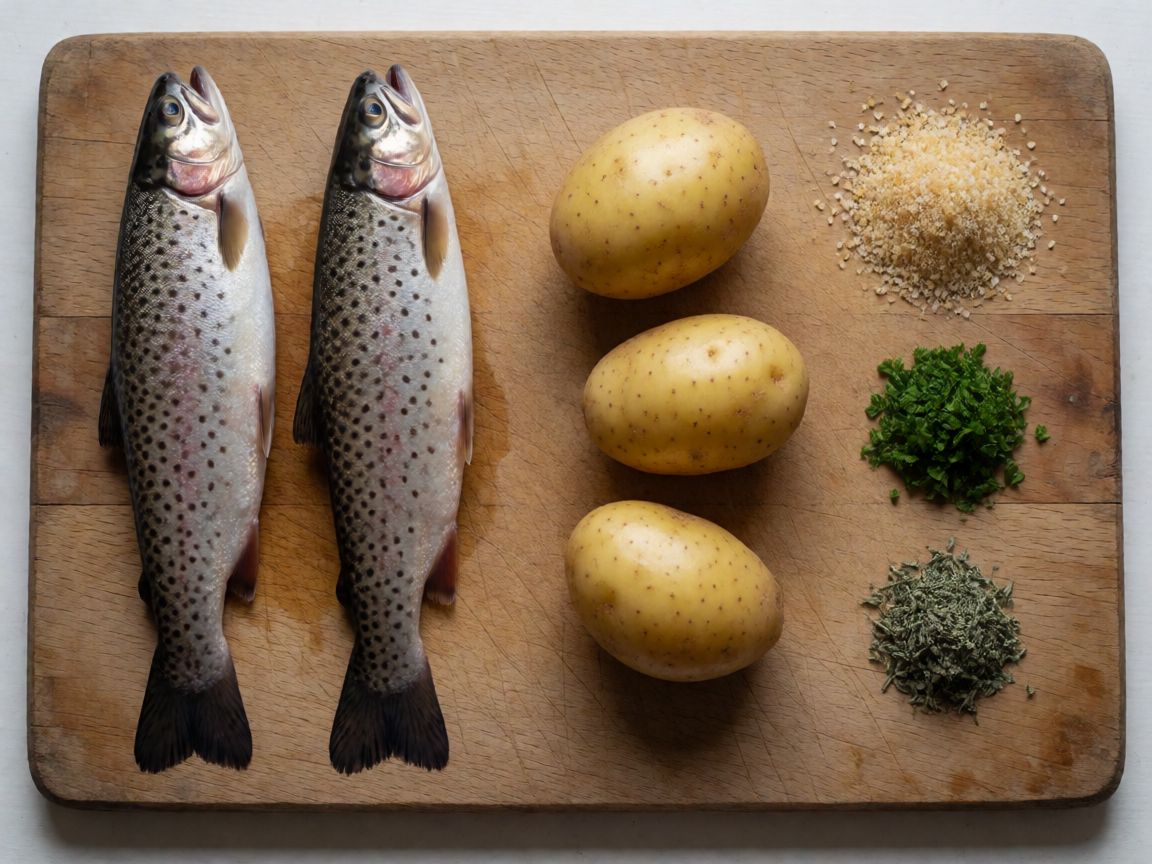
- 2 pcs Trout
- 3 pcs Potatoes
- Breadcrumbs to taste
- Parsley to taste
- Sage to taste
- Olive Oil to taste
- Salt to taste
- Black Pepper to taste







Steps
Rinse the trout under running water, cut along the belly and remove the innards and spine.
Rinse the potatoes and peel them. Cut two potatoes into thin slices and arrange them on a baking tray lined with baking paper.
Drizzle the potatoes with olive oil, season with salt and black pepper.
Bake the potatoes in an oven preheated to 200°C.
20 minFinely chop the parsley and sage, mix with the breadcrumbs, add salt and pepper.
Rub the trout inside and out with the mixture, then place the fish on top of the potatoes.
Slice the remaining potato as thinly as possible and arrange the slices on top of the trout.
Season with salt, black pepper and drizzle with olive oil.
Bake the trout with the potatoes in the oven at 200°C until the fish is cooked through.
25 minThe fish is ready when its internal temperature reaches 63°C.
Remove the dish from the oven and serve.
This is not really a baked fish recipe — it's a fish cooked on a potato cushion, under a potato lid. Both potato layers are doing a job: the bottom layer is a buffer between the tray's hard heat and the delicate trout flesh, and the top layer is a shield against the oven's drying blast. Take either one away and you get a different, worse dish — fish stuck to foil, or fish with a leathery top.
What decides whether it works is timing the two elements so they finish together, and timing here is not a stopwatch question, it's a thickness question. The bottom potatoes go in raw and dense, so they get a twenty-minute head start before the fish ever sees heat — some say you can bung fish and potato in together because "fish cooks fast anyway" — no, because the potato is the slow one, and a fast fish sitting on undercooked potato for the extra time it needs will simply overcook waiting. The top potato slices, by contrast, have to be nearly see-through thin, because they get only the second, shorter stretch of heat alongside the fish, and a slice with any bulk to it will still be raw and pale when the trout underneath is already done.
The spine removal matters for the same reason the potato does: heat management. A whole trout with its backbone in place cooks unevenly around that bone, and the bone also blocks the breadcrumb-and-herb mix from actually touching the flesh it's meant to season and protect. Butterflied open, the fish lies flat against the heat, the crumb coats it properly, and it all cooks as one even layer instead of a lump with a cold core.
On the trout itself: you want it gutted and the spine lifted out so it opens like a book, not filleted into two separate pieces — you need it in one piece to hold its stuffing and sit as a single flat unit on the potato base. If boning a whole fish feels fiddly, most fishmongers will do it for a couple of extra minutes while you wait; don't rush it yourself with a dull knife, because a torn belly means the crumb mixture leaks out into the tray instead of sitting against the flesh where it's doing its real job — insulating the top surface from direct dry heat and soaking up the juice that would otherwise just evaporate. The criterion for the fish is a whole fish with thin, even flesh that cooks through in twenty-odd minutes at this size — sea bream or a small mackerel would behave similarly, though mackerel is oilier and will feel done a touch sooner.
Potatoes: you want a variety that's starchy enough to go tender rather than waxy-stay-firm, but still holds together in a thin slice without falling apart — Maris Piper or King Edward are the obvious UK choices, since they're bred for exactly this balance and sit in every supermarket. Slice the bottom layer thin enough that a fork meets no resistance by the time it's had its head start, and slice the top layer thinner still, almost translucent — it has far less time and less direct heat, shielded as it is by its own position on top of the fish.
The tray matters more than people think. A roasting tin with raised sides traps the steam the potatoes give off, and that steam is exactly what stops the bottom layer crisping — use the widest, flattest tray your oven will take, so moisture has somewhere to escape rather than sitting under the fish turning it soft and grey instead of roasted.
Breadcrumbs, parsley and sage are the crust, and the crust has one real function: it dries and browns while the fish underneath stays moist, so you get contrast in one mouthful instead of one uniform texture. Sage is chosen here because it's a tough herb that keeps its own smell under heat instead of fading like a soft herb such as basil would; if you've no sage, thyme does the same job of surviving the oven. The breadcrumbs want to be dry enough to drink up the olive oil and herb oils without turning to paste — stale bread grated fine, or panko, both work; fresh soft bread will just go gummy.
Olive oil here is not a neutral cooking medium, it's doing flavour work too, so use one with some character for the drizzles, and save a cheaper bottle for just greasing the tray if you like — the criterion either way is an oil that won't fight the sage and fish, which rules out anything with a strong smell of its own, like a dark sesame oil would be wrong here.
The 63°C is the one number worth trusting over your eyes: some say press the fish and see if it springs back — no, because on a fillet this thin, by the time it visibly springs back it's already a few degrees past where you wanted it, and trout has little fat to forgive you for that. A thermometer pushed into the thickest part gives you the true moment the protein has just set, with carryover heat finishing the job gently while it rests on the tray for the minute it takes to get it to the table. That minute of rest, like the twenty-minute head start for the potato, is patience doing real work — not a formality.
This feeds two generously as it stands; for more people, don't just add more trout to the same tray — crowding stops the steam escaping and you're back to soggy potato. Add a second tray instead, or lay the fish in a single layer with real space around each one.