
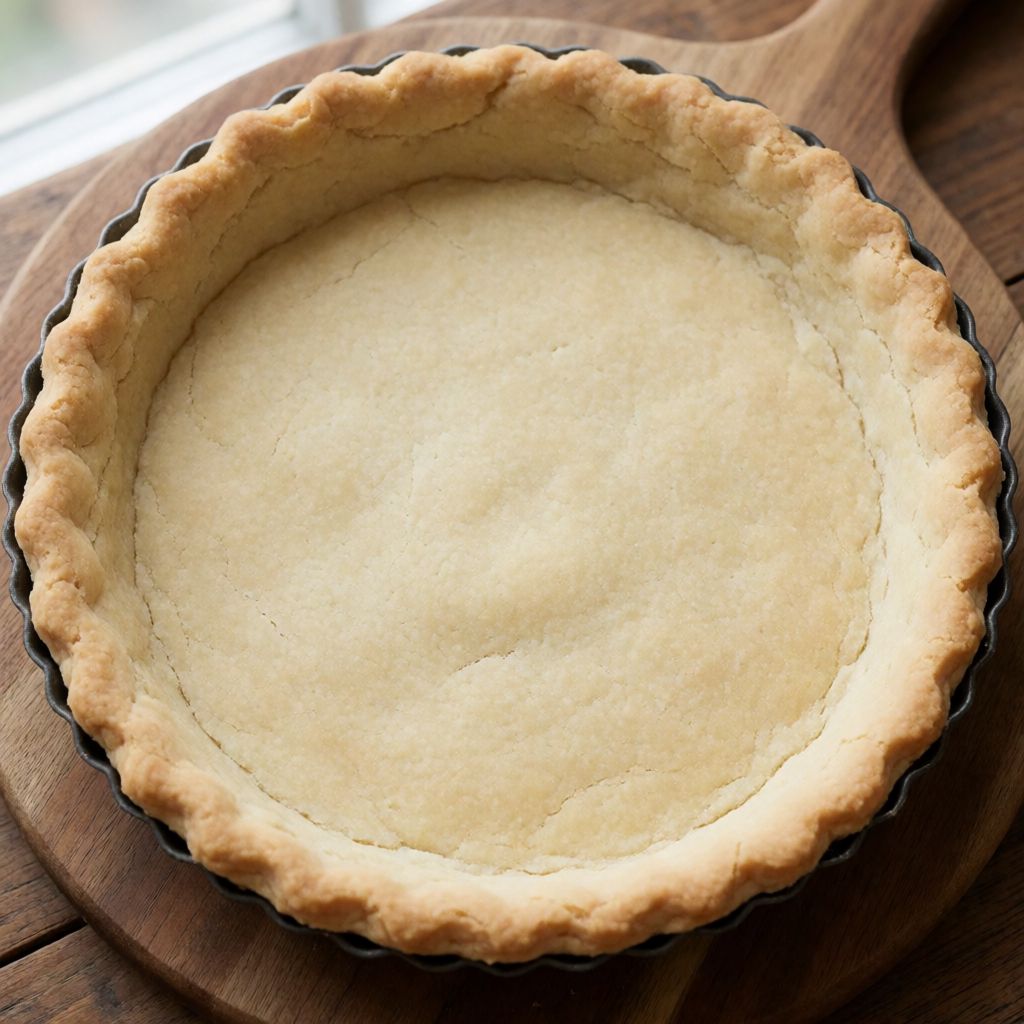
 AI photo
Foolproof Pâte Brisée
A reliable French pastry base, perfect for sweet or savoury tarts and pies.
Labels are worked out automatically from the ingredients and can be wrong. Check the packaging if it matters to you.
Ingredients
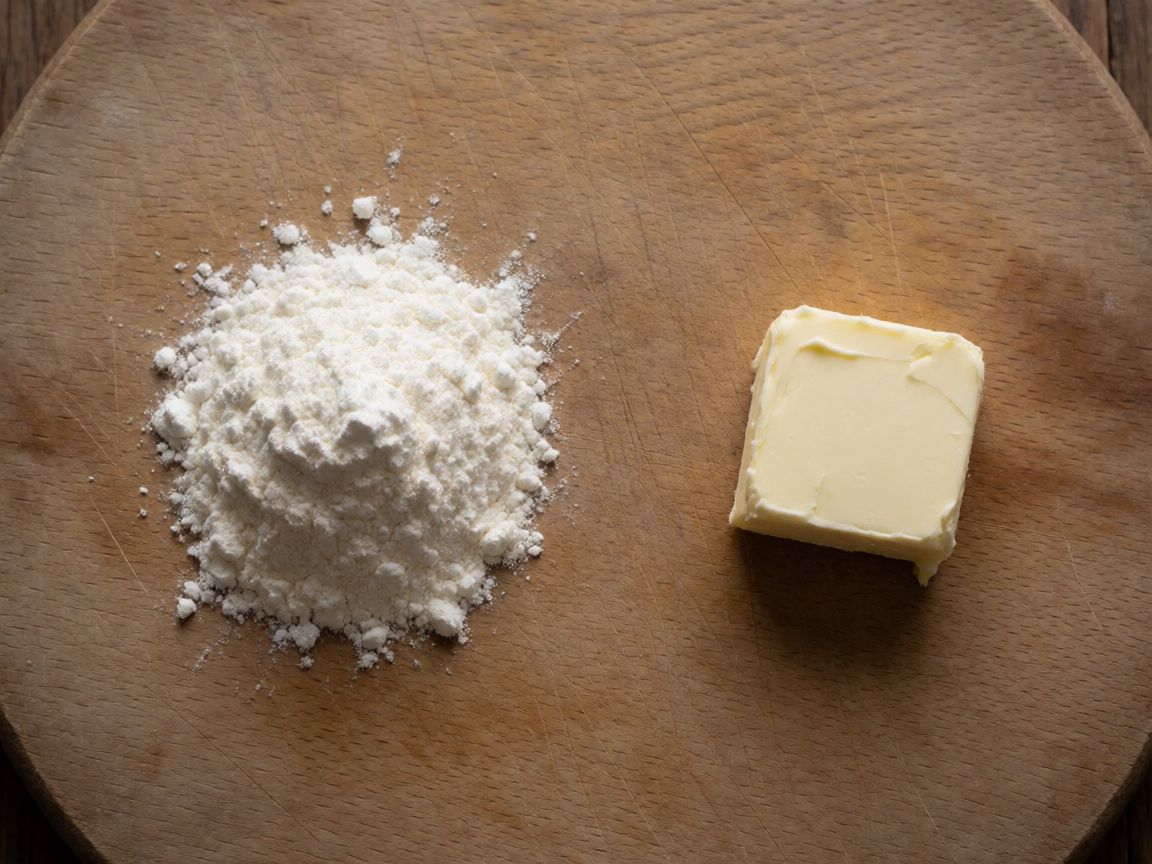
- 300 g Plain flour
- 150 g Butter cold
- 100 ml Water cold
- Salt to taste




Steps
Tip the flour onto a work surface in a mound, make a well in the centre and add the cold butter and cold water. Season with salt to taste.
Mix the ingredients by hand and knead well until the dough is smooth.
Shape into a ball, wrap in cling film and chill in the refrigerator.
30 minRoll out the chilled dough with a rolling pin to a thickness of about 5 millimetres and line the tin.
Trim away the excess dough with a rolling pin or palette knife — the pâte brisée base is ready.
Pâte brisée is nothing mystical — it's flour, cold fat and cold water arranged so the fat gets to the flour before the water does. That order is the whole trick. Fat coats the flour particles first, so when the water finally binds everything together, gluten (the stretchy protein network you'd want in bread) can only form in patches, not sheets. The result is a crust that shatters under a fork instead of chewing like a roll. Everything that goes wrong with pastry — toughness, shrinking, sogginess — traces back to that one sequence being disturbed.
What decides whether this works is temperature, not time. Butter has to stay in solid lumps right up until the moment it's crushed into the flour by your hands, not melting into it. Warm kitchen, warm hands, warm butter — you get grease mixed through flour like a sauce, and the dough turns elastic instead of short, because now the water can reach the protein unguarded. This is why the method says cold butter and cold water, twice, and means it literally.
Some say pastry demands a marble slab and ice-cold hands like a pâtissier's — no, because the physics is the same on a laminate worktop, you just work faster and chill the dough to compensate for a slower kitchen. The French well-in-the-flour method and the British habit of rubbing butter into flour with your fingertips (the way you'd do it for a crumble or a Mary Berry pie) are solving the identical problem — coat the flour before the gluten can organise — just with the hands moving in a different order. Neither is the "real" one.
The chill in the fridge before rolling (thirty minutes, and that's a minimum, not a target — give it longer if your kitchen runs warm) isn't just to firm the butter back up. Kneading and shaping stretch whatever gluten did form, and stretched gluten has memory — it wants to spring back. Skip the rest and you'll roll out a neat circle that shrinks itself smaller in the tin while it bakes, pulling away from the edges. The rest lets those strands relax before they're asked to hold a shape permanently. Patience here is doing structural work, not just flavour work.
Flour: plain flour, not strong or bread flour. Plain sits at a lower protein percentage, which caps how much gluten can ever form even if you misbehave and overwork it. Strong flour in a pastry is a liability — it's built for exactly the opposite job, holding air in a dough that needs to stretch, and here you don't want stretch at all.
Butter: cold, meaning fridge-cold, cut or grated small enough to distribute through the flour quickly before it softens in your palms. Unsalted or salted both work — salted butter plus the salt in the recipe just means go lighter on the extra pinch, taste before you add more. If you're out of butter, any solid fat that stays firm at room temperature will do the same coating job — lard was the historical default in Britain precisely because it was cheaper than butter and gave an even shorter, less rich crumb; margarine works but brings a flatter taste because it has no cultured flavour of its own to lose.
Water: cold from the tap is usually enough in a British kitchen that isn't overheated — ice water is insurance, not a rule, for keeping the butter from softening mid-mix. 100ml against 300g flour is a generous ratio, which gives you a dough sturdy enough to roll without cracking, rather than the very dry, barely-held-together style some French recipes push for. If your dough won't come together, add water a spoonful at a time — too much at once and you've handed the gluten exactly the hydration it needed to organise.
Salt isn't only for taste. It firms the structure a little and sharpens the pastry against whatever goes in the tin later — a savoury filling needs that backbone or the crust reads as blank.
Rolling to about 5mm matters because thinner won't hold a filling's weight without collapsing, and thicker bakes doughy in the centre while the edges are already done — there's no oven heat written into this recipe because this base is meant to be filled and baked afterwards; what you've made so far is the shell, not the finished dish. Trimming the overhang isn't tidiness for its own sake: dough left hanging over the rim burns before the base cooks through, and it's the thin excess that collapses into the filling as it bakes if you leave it. Keep the trimmings — they patch any crack in the lined base better than starting over. At 300g flour this gives you one standard tart or pie base, enough for a filling that feeds six, which in a British kitchen usually means a quiche big enough to follow the Sunday roast the day after, eaten cold with the tea.