
 AI photo
Gluten-Free Buckwheat Flour Jam Biscuits
Soft gluten-free biscuits made with buckwheat and rice flour, filled with jam and dusted with icing sugar.
Labels are worked out automatically from the ingredients and can be wrong. Check the packaging if it matters to you.
Ingredients
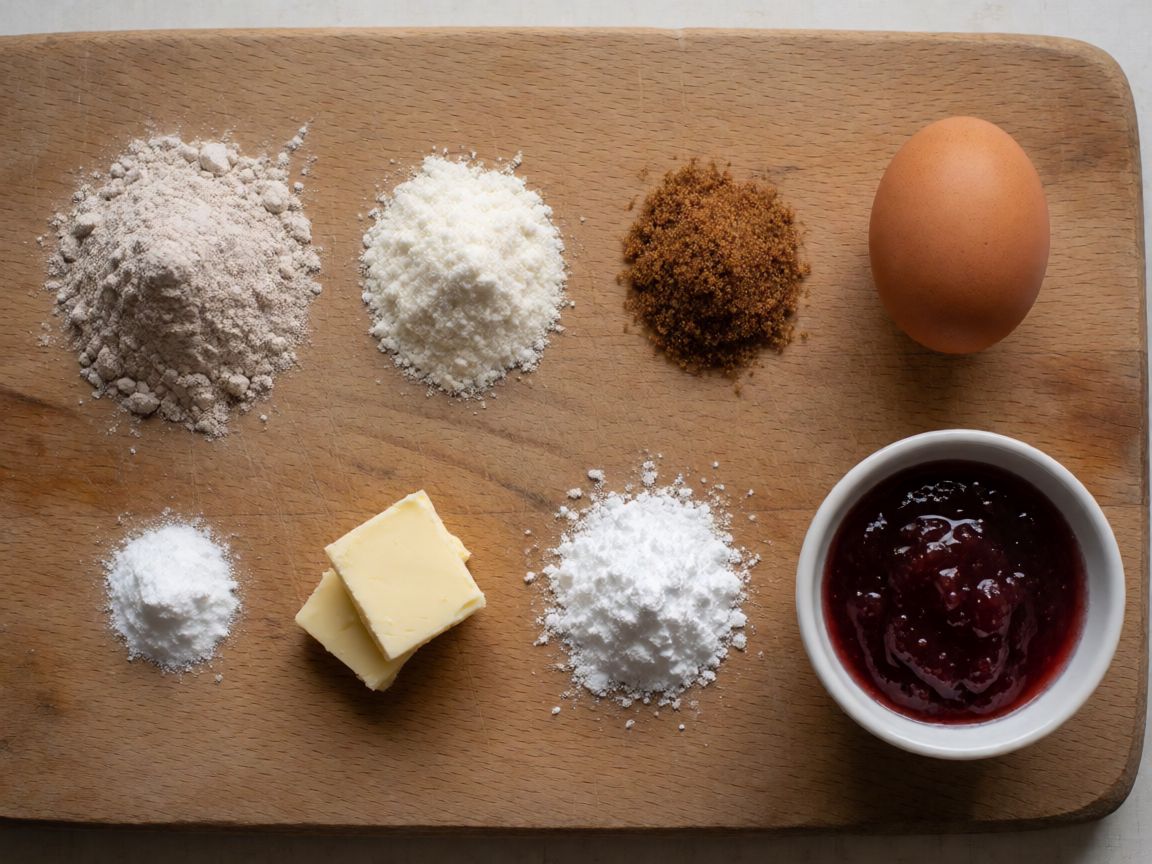
- 120 g Buckwheat flour
- 80 g Rice flour
- 100 g Brown sugar
- 1 pcs Egg
- 5 g Baking powder
- 80 g Butter
- Icing sugar to taste
- Jam to taste








Steps
Combine the rice flour with the buckwheat flour and the brown sugar.
Add the baking powder and crack the egg into the centre of the well, then start mixing the ingredients.
Add the butter, cut into small pieces, and knead the dough by hand until soft and smooth.
Shape the dough into a ball, wrap it in cling film and chill it in the fridge.
15 minOn a surface dusted with rice flour, roll out the dough with a rolling pin to a thickness of 3-4 mm.
Cut out circles of dough with a 6-7 cm round cutter and place them on a baking tray.
In half of the circles, cut out a hole with a smaller round cutter (2-3 cm).
Bake in a fan oven preheated to 170°C.
10 minLet the biscuits cool completely.
Dust the biscuits with holes with icing sugar, and spread jam on the remaining halves.
Sandwich the halves together and serve.
This is a linzer-style sandwich biscuit, but built without wheat — buckwheat flour and rice flour stand in for it, and that single swap decides almost everything about how the dough behaves. Gluten is what gives ordinary biscuit dough its stretch and its chew; take it away and you get something that crumbles more readily, bakes paler, and needs gentler handling at every stage. Nothing here is a flaw to fix — it's just a different material, and the recipe is built around that fact rather than pretending it's flour.
What decides whether these work is cold butter and a short, firm chill. Butter cut into small pieces and worked in by hand, not melted or warmed, means it stays in solid flecks that steam apart in the oven rather than soaking straight into the flour — that's what gives you a biscuit that shatters cleanly rather than one that's dense and greasy. The 15-minute rest in the fridge isn't decoration: it lets the butter re-firm after the warmth of your hands and lets the rice flour's moisture settle, so the dough rolls instead of tearing. Skip the chill and you'll fight the dough the whole way through, in a kitchen with no marble slab to keep things cool for you.
Buckwheat flour is the backbone here, not a health-food gesture. It has no gluten at all, so it can't overwork — there's no risk of a tough, chewy biscuit from kneading too long, which is the mistake people worry about with wheat dough. But it also means the dough has less natural elasticity, so you don't knead this the way you'd knead bread; you're bringing it together just until it holds, by hand, because your hands can feel when the butter has disappeared into the flour better than a mixer can tell you. If you can't get buckwheat flour, a gluten-free plain flour blend will hold together more easily, but you lose that slightly earthy, bitter edge that makes this taste like something rather than just sweet.
Rice flour is there for lightness and for dusting. On its own it bakes brittle and a touch gritty — rice starch doesn't gel the way wheat starch does — which is exactly why it's only two-thirds of the flour here, propped up by the buckwheat. It also does a second job: dusting your work surface with rice flour instead of wheat flour means you're not quietly reintroducing gluten into a gluten-free dough by accident, and it won't toughen the dough's edges the way a wheat dusting can.
Brown sugar earns its place beyond colour. It carries molasses, which means moisture and a rounder, slightly caramel flavour next to buckwheat's bitterness — white sugar would leave the biscuit flatter-tasting and a shade paler. Any molasses-bearing sugar works on the same logic: light muscovado, demerara, even a spoon of golden syrup worked into white sugar if that's what's in the cupboard.
Butter needs to go in cold and in small pieces, cut rather than softened, because the whole point of a short biscuit is butter staying as separate pockets in the dough until the oven's heat turns them to steam — that's what pushes the layers apart and gives you "short," crumbly texture instead of dense and compact. If your kitchen's warm, work fast, and know that the chill step is partly there to undo any damage your hands did warming the butter. Any firm fat with a clean flavour will do in principle, but butter's taste is doing real work against the buckwheat's bitterness — a neutral fat would leave the biscuit flatter.
The egg binds what gluten would otherwise bind — it's not for lift here, the baking powder does that, so don't skip it hoping to simplify; without it the dough is more crumb than dough and will fight you at the rolling stage.
On an ordinary UK fan oven, 170°C fan is a genuine instruction, not a guess — these are thin, pale biscuits and you're watching for the edges to just firm and take the faintest colour at the rim, not for an all-over gold, because buckwheat flour browns differently to wheat and can look done before it structurally is. Ten minutes is your lower bound: pull one out, let it sit ten seconds on the tray, and if it holds its shape without sagging, you're there. If it's still soft in the middle, give it another minute rather than trusting the clock.
Patience matters twice here: once in the fridge, once on the cooling rack. Sandwich these while warm and the jam will turn the biscuit soggy from the inside before you've even got them to the table — let them go properly cool, and they'll hold their snap with a cup of tea rather than wilting into it.